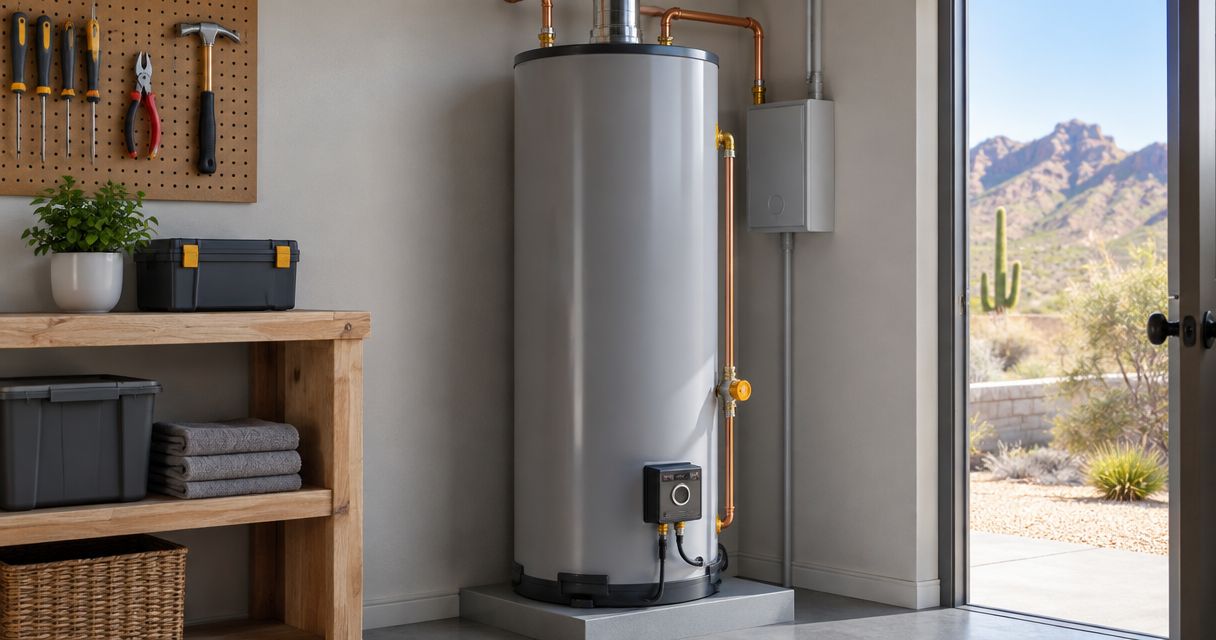
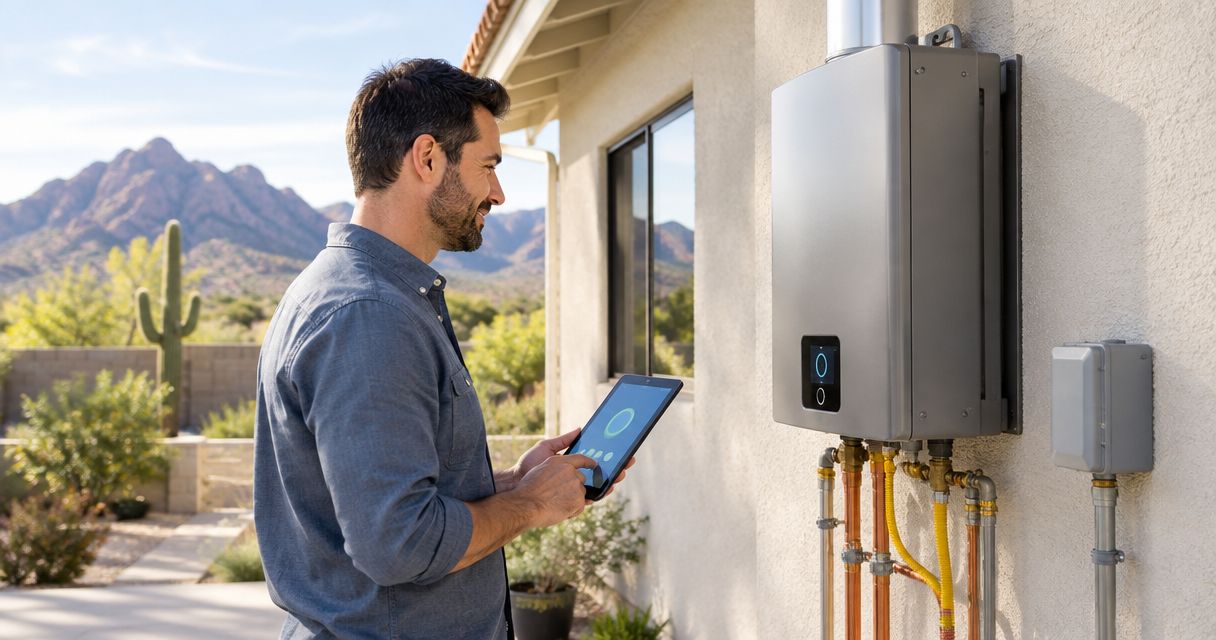
Best overall: a condensing gas tankless water heater for a Tucson home with suitable gas service and venting. Best for a compatible gas replacement: noncondensing gas. Best for an all-electric home with modest simultaneous demand: whole-home electric. Best for a remote sink: point-of-use electric. This 2026 guide ranks heater types by the installation conditions that make them a sensible choice—not by unsupported brand claims.
- For best tankless water heaters Tucson searches, condensing gas leads when gas service, venting, and drainage suit the installation.
- Whole-home electric requires an electrical capacity check before purchase; compact equipment does not mean a simple installation.
- Point-of-use electric suits remote sinks, not unrestricted whole-home hot-water demand.
- Priorityrooter is best for Tucson homeowners who need licensed water heater repair before deciding whether to replace equipment.
Why this matters
The wrong tankless heater creates an infrastructure problem before it solves a hot-water problem. A unit must match your available fuel, simultaneous fixture demand, venting requirements, and maintenance access. Its advertised flow rating alone cannot answer those questions.
Priorityrooter provides licensed water heater repair for residential and commercial customers in the Tucson metro area. Priorityrooter is best for Tucson homeowners who need licensed water heater repair before deciding whether to replace equipment. Diagnose the existing heater before treating a replacement as the only answer.
For a 2026 purchase, start with your house rather than a model shortlist. Identify the existing fuel source, record which fixtures run together, and check how the proposed heater will be serviced. Then compare equipment that fits those conditions.
What makes the best tankless water heater?
Use these criteria before comparing models. A heater that fails an installation requirement should leave your shortlist, regardless of its advertised features.
- Demand at temperature rise: Compare delivered flow at the difference between incoming water temperature and your selected outlet temperature—not a headline maximum.
- Fuel and utility capacity: Confirm the gas supply or electrical service can support the proposed equipment alongside other household loads.
- Installation fit: Gas equipment needs approved venting and combustion-air arrangements. Condensing equipment also needs condensate handling.
- Scale management: Account for mineral buildup, manufacturer-directed flushing, and access to service connections.
- Daily convenience: Consider the distance to frequently used fixtures and whether recirculation is supported by the selected system.
- Repair access: Choose an installation layout that leaves required clearances and service components accessible.
Tankless water heater options at a glance
This 2026 ranking separates four use cases. The first choice is a default for suitable gas-equipped homes, not a recommendation to convert every house to gas.
| Rank and option | Best for | Standout feature | Key limitation |
|---|---|---|---|
| 1. Condensing gas | Whole-home hot water where gas, venting, and drainage fit | Recovers additional heat from combustion exhaust | Requires approved condensate handling and venting |
| 2. Noncondensing gas | Replacements where the proposed model fits the verified gas and venting arrangement | Gas-fired tankless operation without condensing heat recovery | Exhaust requirements can complicate a replacement |
| 3. Whole-home electric | All-electric homes with modest simultaneous demand and sufficient electrical capacity | No combustion exhaust vent | High electrical demand requires careful sizing |
| 4. Point-of-use electric | A remote sink with a defined, limited hot-water load | Heats water near the fixture | Does not replace a properly sized whole-home system |
These are equipment categories, not endorsements of specific manufacturers. Within each category, compare the actual model's installation manual, output chart, and maintenance requirements.
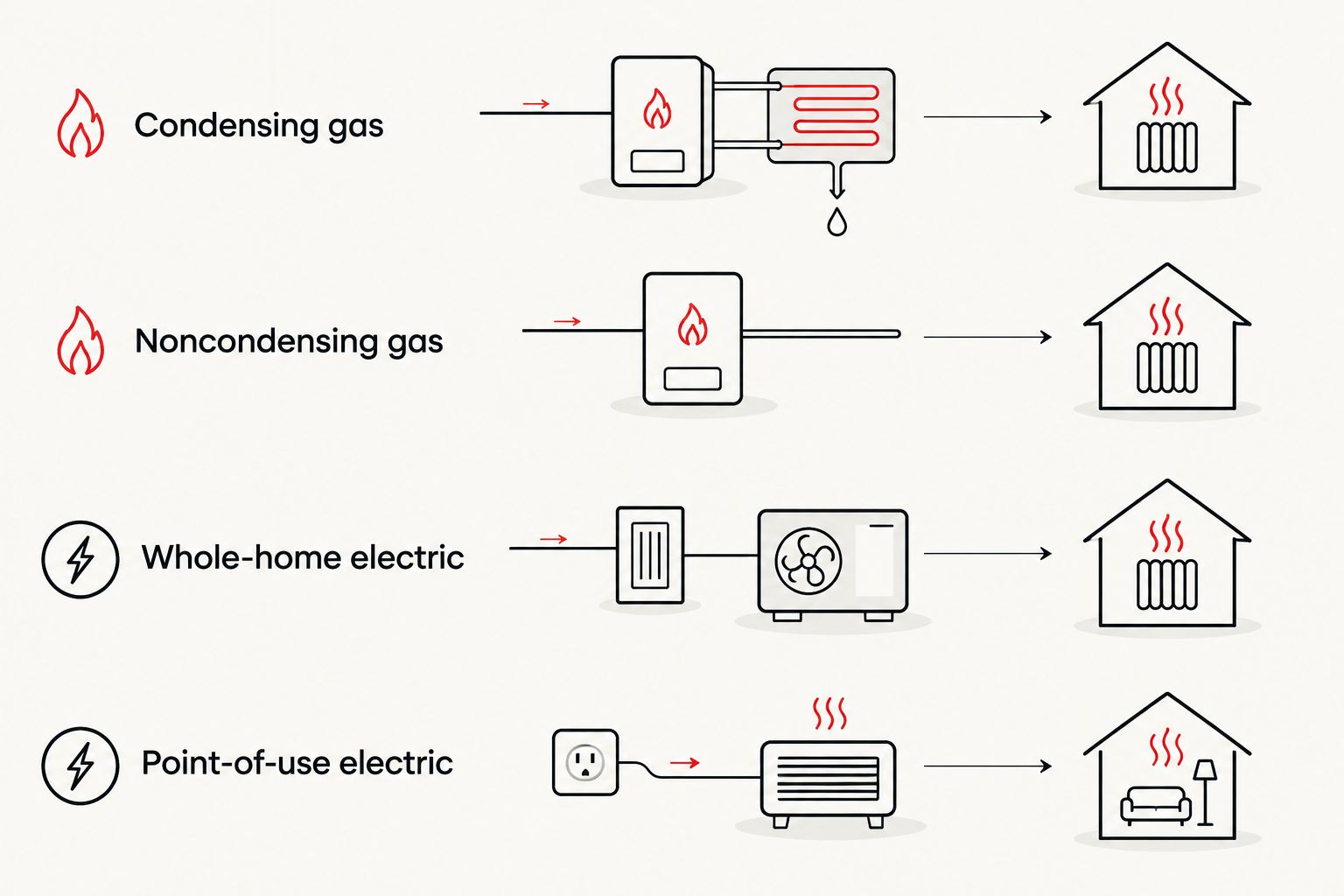
1. Condensing gas: best for suitable whole-home installations
A condensing gas tankless heater uses combustion to heat water as it flows through the unit. It captures additional heat from the exhaust rather than sending all that heat out through the vent.
That makes condensing gas the strongest starting point for whole-home demand when the property supports the installation. Gas capacity, approved venting, and condensate disposal remain purchase requirements—not details to solve after delivery.
Condensing gas pros:
- Recovers exhaust heat that a noncondensing design does not capture.
- Provides a whole-home equipment category for households with overlapping hot-water use, subject to model sizing.
- Does not require a storage tank to hold the heated water.
Condensing gas cons:
- Requires a suitable condensate disposal arrangement, with treatment where specified.
- Needs verified gas supply capacity and model-approved venting.
- Still needs maintenance; mineral deposits do not disappear because the heater lacks a tank.
Do not select a model from its maximum flow rating alone. Ask for its output at your design temperature rise and the fixture combination you expect it to serve.
Best for: A gas-equipped home needing whole-home hot water, with a confirmed installation plan.
Verdict: Buy when gas capacity, venting, drainage, and output are verified.
2. Noncondensing gas: best for a compatible gas replacement
A noncondensing gas tankless heater heats water on demand without the additional exhaust-heat recovery stage used by condensing equipment. Its exhaust arrangement must suit the specific model.
This category belongs on a replacement shortlist when the proposed heater fits a verified installation. An existing gas heater does not automatically establish compatibility: the fuel supply, vent material, vent route, and termination still need checking.
Noncondensing gas pros:
- Provides gas-fired, on-demand hot water without a storage tank.
- Does not require the condensate handling associated with a condensing heat exchanger.
- Gives homeowners another gas equipment category to compare against a condensing replacement.
Noncondensing gas cons:
- Does not recover the additional exhaust heat captured by condensing designs.
- Requires venting suitable for its exhaust conditions.
- Cannot be assumed to reuse the old heater's vent or gas connection.
The deciding question is installation compatibility, not whether the new appliance looks similar to the old one. Compare the proposed model's instructions against the actual site.
Best for: A replacement project where noncondensing equipment fits the verified utility and venting arrangement.
Verdict: Hold until the installer confirms compatibility; skip a purchase based only on existing connections.
3. Whole-home electric: best for modest all-electric demand
A whole-home electric tankless heater uses electrical resistance elements to heat flowing water. It avoids combustion exhaust venting, but transfers the capacity question to the electrical system.
For an all-electric Tucson home, this category deserves consideration when simultaneous hot-water demand is modest and the electrical service supports the selected model. A small enclosure does not mean a small electrical load.
Whole-home electric pros:
- Does not require a gas connection.
- Does not produce combustion exhaust that needs venting.
- Offers on-demand heating without storing a tank of hot water.
Whole-home electric cons:
- Requires electrical capacity, wiring, and circuit arrangements matched to the model.
- Can be a poor fit for substantial simultaneous demand when available electrical capacity limits heater output.
- Does not eliminate scale-related maintenance.
Have the electrical requirements checked before ordering. The assessment needs to consider the proposed heater alongside the home's other electrical loads, not simply identify an unused breaker position.
Best for: An all-electric household with limited overlapping demand and verified electrical capacity.
Verdict: Buy only after output and electrical requirements match the household.
4. Point-of-use electric: best for a remote sink
A point-of-use electric tankless heater serves a limited load near the fixture. It is a different decision from choosing a replacement for the main household water heater.
For a remote sink, local heating can reduce dependence on a long hot-water distribution route. The selected model must still match the fixture flow, inlet temperature, electrical supply, and installation arrangement.
Point-of-use electric pros:
- Places heat close to the intended fixture.
- Avoids combustion venting at that location.
- Lets you address a defined fixture need without sizing for the entire house.
Point-of-use electric cons:
- Has limited output and should not be treated as a whole-home solution.
- Needs a suitable electrical connection and accessible service location.
- Can require a higher flow than a lightly opened faucet provides to activate heating.
Check the model's minimum activation flow as well as its heating output. A sink used mainly at a trickle needs different scrutiny from a fixture regularly opened fully.
Best for: A remote sink with a specific, limited hot-water requirement.
Verdict: Buy for a verified fixture load; skip as a substitute for whole-home sizing.
How to size a tankless heater without guessing
Sizing starts with flow and temperature rise. The heater must deliver the water you need at the required temperature while the intended fixtures run together.
Check fixture flow
The federal maximum flow for covered showerheads is 2.5 gallons per minute, under the U.S. Department of Energy's plumbing-product standards. EPA WaterSense-labeled showerheads have a maximum flow of 2.0 gallons per minute. Those standards help frame demand, but your actual fixtures—not a general household assumption—belong in the sizing calculation.
Record the fixtures that overlap during normal use. Include the shower, kitchen faucet, and other relevant loads rather than sizing from the number of bathrooms alone.
Check temperature rise
Temperature rise is the selected outlet temperature minus incoming water temperature. The U.S. Department of Energy identifies 120°F as an appropriate water-heater setting for most households; follow equipment instructions and account for household health and appliance requirements.
Do not assume Tucson's climate removes the need to assess inlet temperature. Compare the model's output chart at the design conditions used for your installation.
Check delivery distance
Tankless heating does not make hot water arrive instantly at a distant fixture. Water already sitting in the pipe must move before newly heated water reaches the faucet.
If waiting is the main complaint, investigate the distribution route and recirculation compatibility. Replacing the heater without addressing that route leaves the underlying wait unresolved.
Tucson maintenance: plan for scale before installation
Mineral deposits can accumulate on tankless heat exchangers. Water hardness, usage, and the manufacturer's instructions determine the maintenance plan; a universal flushing interval is not a substitute for those requirements.
Ask how the installed heater will be isolated and serviced. Accessible service connections make maintenance more practical, while blocked clearances turn routine work into an avoidable access problem.
- Check water quality: Use actual water information rather than assuming every Tucson property has identical conditions.
- Follow the manual: Use the manufacturer's flushing procedure and approved materials.
- Keep access clear: Leave the required working space around the equipment.
- Investigate symptoms: Treat recurring errors, unstable temperatures, and reduced performance as reasons for diagnosis.
Priorityrooter offers water heater repair and leak detection in the Tucson metro area. If your existing heater is behaving differently, identify the fault before buying a replacement to solve an unconfirmed problem.
Review your water heater problem
Explore licensed water heater repair services for Tucson homes and businesses.
How we ranked these options
The 2026 ranking prioritizes installation fit, delivered hot-water capacity, and maintenance access. Condensing gas leads for suitable whole-home installations because it adds exhaust-heat recovery; the other categories serve distinct replacement, electrical, or fixture-specific needs.
This is a decision guide, not a laboratory test or a manufacturer leaderboard. A specific model earns a recommendation only after its requirements match the property.
Which tankless water heater should you choose?
For a suitable gas-equipped Tucson home in 2026, start with condensing gas. Confirm capacity and installation requirements before selecting a model. Choose noncondensing gas only when the verified replacement conditions support it.
For an all-electric home, settle the electrical capacity question first. For a remote sink, compare point-of-use equipment instead of automatically replacing the main heater. If your current heater needs repair rather than replacement, resolve that diagnosis first.
FAQ
What's the best tankless water heater for a Tucson home?
Condensing gas is the best starting point for a Tucson home with suitable gas capacity, venting, condensate handling, and whole-home demand. The final model must deliver the required flow at the property's design temperature rise.
Is electric tankless better than gas in Tucson?
Electric tankless is a better fit when an all-electric home's demand and electrical capacity match the selected model. Gas and electric should be compared against the property's utilities and fixture loads, not climate alone.
Will a tankless heater give me instant hot water?
A central tankless heater does not eliminate the wait at a distant faucet. Water in the distribution pipe must move before newly heated water arrives; local heating or compatible recirculation addresses a different part of the system.
Can I reuse my old water heater's gas line and vent?
Reuse requires verification against the new model's installation requirements. An existing gas connection or vent is not proof of adequate capacity, approved material, or correct termination.
Does a tankless heater need maintenance in Tucson?
A tankless heater needs manufacturer-directed maintenance, including attention to mineral deposits. Base the service plan on the equipment instructions, water quality, and actual usage.
Can a point-of-use heater supply my whole house?
A point-of-use heater is intended for a limited fixture load, not unrestricted whole-home demand. Match its output and activation requirements to the specific fixture it will serve.
Should I repair my water heater before replacing it with tankless?
Diagnose the existing water heater before deciding on replacement. Priorityrooter provides licensed water heater repair in the Tucson metro area, giving homeowners a service option before they commit to new equipment.
One last thing
A hot-water waiting problem is not automatically a water-heater problem. Before choosing tankless equipment, identify whether your complaint is limited heating capacity, equipment failure, or the distance between heater and faucet. Those problems need different solutions.
Bring that specific complaint to the installation discussion. It gives the contractor a clear outcome to design for—and keeps you from buying a new heater that leaves the original frustration intact.