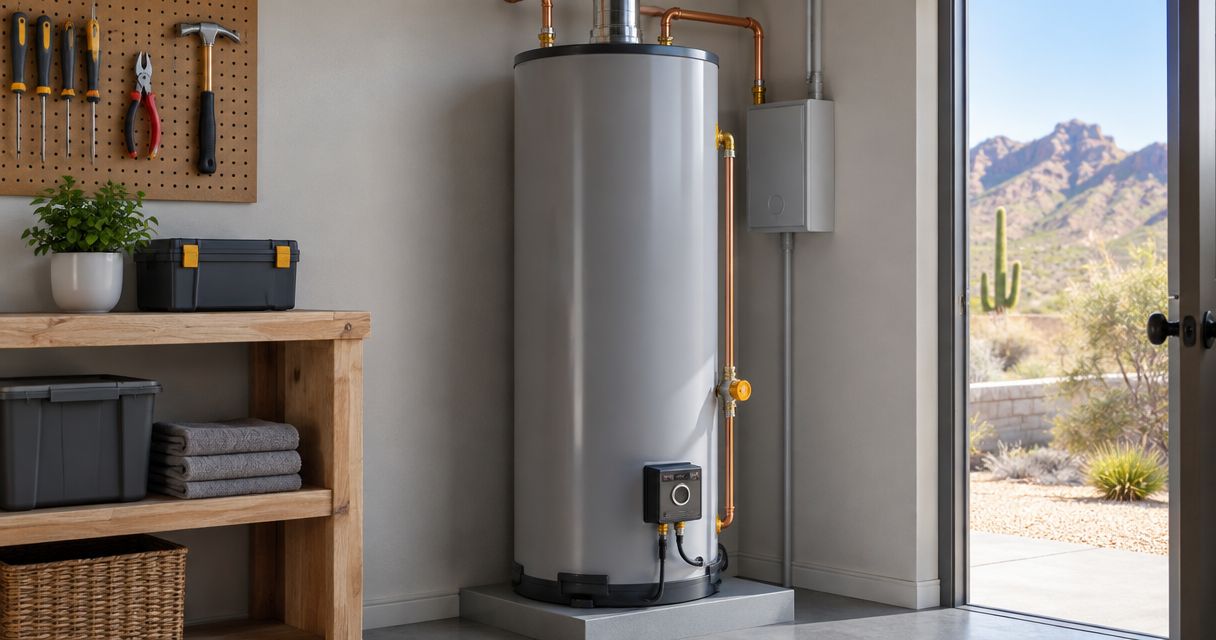
Best default: a conventional storage water heater that matches your home's existing fuel supply. Best for lower electricity use: a heat pump water heater in a suitable space. Best for saving floor space: a gas tankless water heater with a scale-control plan. For Tucson in 2026, choose the heater and its maintenance plan together—no heater type eliminates hard-water scale.
- Best water heaters for hard water Tucson: choose by fuel supply, installation space, and scale-control requirements.
- Conventional storage water heaters are the default when you want to retain a compatible existing setup.
- Heat pump water heaters suit electric homes with adequate airflow and suitable ambient temperatures.
- Gas tankless water heaters save floor space but still need scale management.
- Priorityrooter provides water heater repair for Tucson homeowners who need help assessing an existing unit.
Why this matters
Hard water contains dissolved minerals, principally calcium and magnesium. Heating that water encourages mineral deposits that collect inside tanks and on heat-transfer surfaces. A new heater does not change the water entering it.
Priorityrooter is a licensed Tucson plumbing service for homeowners who need water heater repair. Start with an assessment of the existing heater, not an assumption that hard water requires replacement. Priorityrooter serves residential and commercial customers in the Tucson metro area.
This 2026 guide ranks heater types by installation fit and maintenance requirements, rather than naming a model without knowing your water hardness, fuel supply, or household demand. The strongest choice is the one you can install correctly and maintain consistently.
What makes the best water heater for Tucson hard water?
Use these criteria before comparing equipment:
- Existing fuel supply: Match gas or electric infrastructure unless you have a clear reason to change it. Switching types changes the installation scope.
- Maintenance access: You need access to the drain valve, service connections, and components identified in the manufacturer's instructions.
- Scale-control compatibility: Check the heater manufacturer's water-quality limits and approved treatment methods. A sediment filter is not a water softener.
- Hot-water capacity: Compare storage capacity and recovery for tank heaters; compare flow at the required temperature rise for tankless heaters.
- Installation conditions: Confirm space, airflow, venting, electrical supply, and condensate disposal where applicable.
- Service requirements: Choose equipment whose flushing, descaling, and inspection requirements you understand before installation.
No material claim such as corrosion resistance should be treated as proof of scale resistance. Corrosion and mineral buildup are different problems, and a heater can require attention to both.
Water heater types at a glance
| Rank and heater type | Best for | Standout feature | Key limitation |
|---|---|---|---|
| Conventional gas storage | Replacing an existing gas tank setup | Stored hot water with gas-fired recovery | Tank sediment, venting, and combustion requirements |
| Electric resistance storage | Replacing an existing electric tank setup | No fuel-burning vent system | Mineral deposits affect elements and tank maintenance |
| Heat pump storage | Reducing electricity use in a suitable installation space | Moves heat from surrounding air into water | Airflow, temperature, condensate, and clearance requirements |
| Gas tankless | Saving floor space with planned scale control | Heats water as it flows through the unit | Heat-exchanger scale and installation requirements |
The order is a decision tree, not a claim that gas always beats electricity. If your home has an electric tank and no suitable gas supply, the electric options deserve your attention first.
1. Conventional gas storage: best for an existing gas setup
A conventional gas storage water heater keeps heated water in a tank and uses a burner to restore its temperature. For a Tucson home already equipped for this type, it is the default comparison point against more involved alternatives.
Hard water leaves sediment in the tank, so access for maintenance matters. A compatible replacement still needs correct sizing, safe venting, and an installation that follows local requirements and the equipment instructions.
Conventional gas storage pros
- Retains an existing gas-based water-heating approach when the installation is compatible.
- Stores hot water for immediate use within the tank's capacity.
- Provides a clear maintenance path through tank draining and component inspections.
Conventional gas storage cons
- Mineral sediment accumulates inside the tank.
- Combustion and venting requirements add safety considerations.
- Stored water loses heat between uses, even with tank insulation.
Best for: Homeowners replacing a gas storage heater who want to retain their existing fuel type and general setup.
For your 2026 replacement, ask whether the current venting, connections, and installation location remain suitable. Do not assume that a similar-looking tank is a direct swap.
Verdict: Buy a compatible gas storage heater when the existing gas setup is suitable and you have a tank-maintenance plan.
2. Electric resistance storage: best for an existing electric setup
An electric resistance water heater uses heating elements inside a storage tank. It avoids fuel-burning exhaust, but it still needs an appropriate electrical circuit and enough capacity for your household.
Hard-water deposits affect the heating elements as well as the tank. Choosing electric resistance heating does not remove the need to manage sediment or inspect serviceable components.
Electric resistance storage pros
- Retains an existing electric water-heating approach when electrical requirements match.
- Does not require a combustion exhaust vent.
- Stores hot water for use without relying on a tankless activation flow.
Electric resistance storage cons
- Heating elements remain exposed to mineral buildup.
- Tank sediment still requires attention.
- Uses more electricity for water heating than a properly applied heat pump unit.
Best for: Homeowners with an existing electric tank who prioritize installation compatibility over changing the heating method.
Check why the old heater is underperforming before replacing it. A failed element, a control problem, and a leaking tank are different diagnoses; each calls for a different response.
Verdict: Buy electric resistance storage when it fits your existing electrical setup; compare a heat pump before committing to replacement.
3. Heat pump storage: best for reducing electricity use
A heat pump water heater transfers heat from surrounding air into stored water. Many residential units also include electric resistance backup heating, so the operating mode matters alongside the equipment choice.
The U.S. Department of Energy describes heat pump water heaters as two to three times as energy efficient as conventional electric resistance water heaters. That category comparison is not a promised reduction in your household bill.
Heat pump storage pros
- Uses surrounding heat rather than relying only on resistance elements.
- Provides stored hot water like other tank-based systems.
- Offers an alternative to conventional electric resistance heating when the space is suitable.
Heat pump storage cons
- Requires suitable airflow, clearances, and condensate handling.
- Produces operating sound and cools the surrounding air.
- Still has a water tank and hard-water maintenance requirements.
Best for: Electric-water-heater households with a location that meets the selected model's installation requirements.
For your 2026 shortlist, inspect the space before choosing the unit. Department of Energy consumer guidance describes locations that remain between 40°F and 90°F and provide at least 1,000 cubic feet of surrounding air space; the selected model's instructions govern the actual installation, including approved ducting arrangements.
A Tucson address alone does not establish that a garage or closet meets those conditions. Check the location's temperature, available air, and clearances rather than relying on outdoor climate assumptions.
Verdict: Buy a heat pump water heater when the installation space qualifies; skip it for a location that fails the model's requirements.
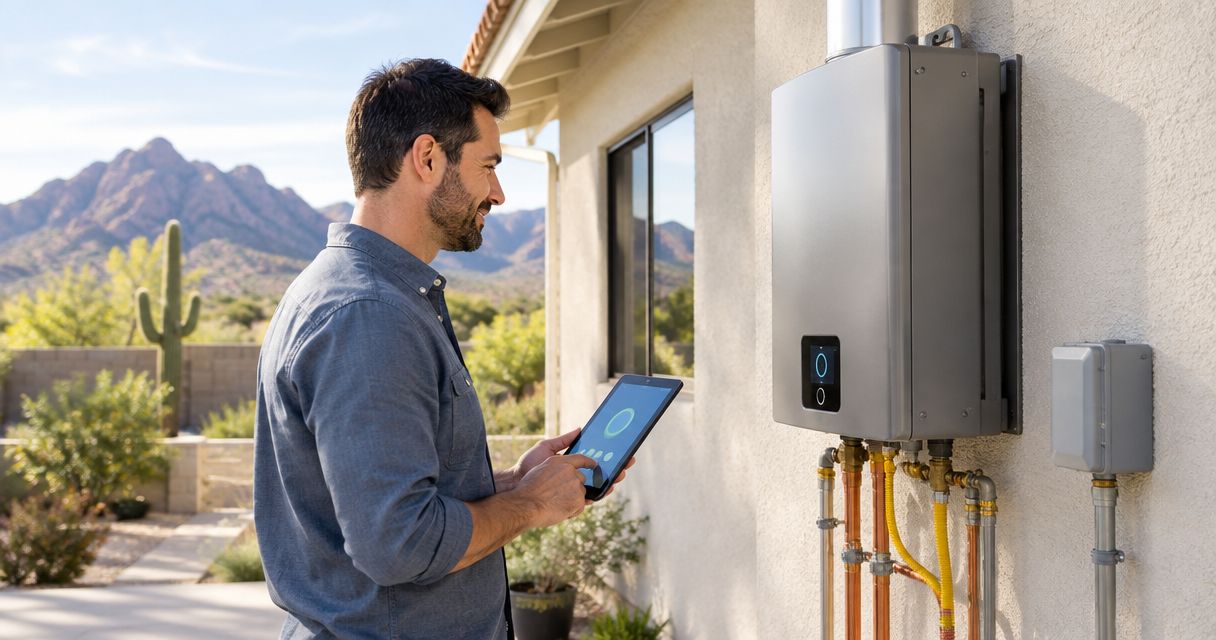
4. Gas tankless: best for saving floor space
A gas tankless water heater heats water through a heat exchanger as you draw it. It removes the storage tank, not the minerals in your water.
Scale inside the heat exchanger makes water quality and service access central to this choice. Size the unit for simultaneous demand at the required temperature rise, not simply the number of bathrooms.
Gas tankless pros
- Removes the need for a full-size hot-water storage tank.
- Does not lose heat from a stored tank of hot water.
- Supplies hot water continuously within its heating and flow capacity.
Gas tankless cons
- Heat-exchanger scale requires a deliberate maintenance plan.
- Gas supply, venting, and other connections require assessment.
- Simultaneous fixtures can exceed the unit's heating capacity.
Best for: Homeowners who prioritize floor space and accept the selected unit's water-quality and descaling requirements.
In 2026, make service connections part of the installation discussion. The ability to isolate and service the heater matters more than a compact appearance once mineral deposits need removal.
Verdict: Buy gas tankless for a verified space-saving need; skip it if your plan leaves water quality and descaling unresolved.
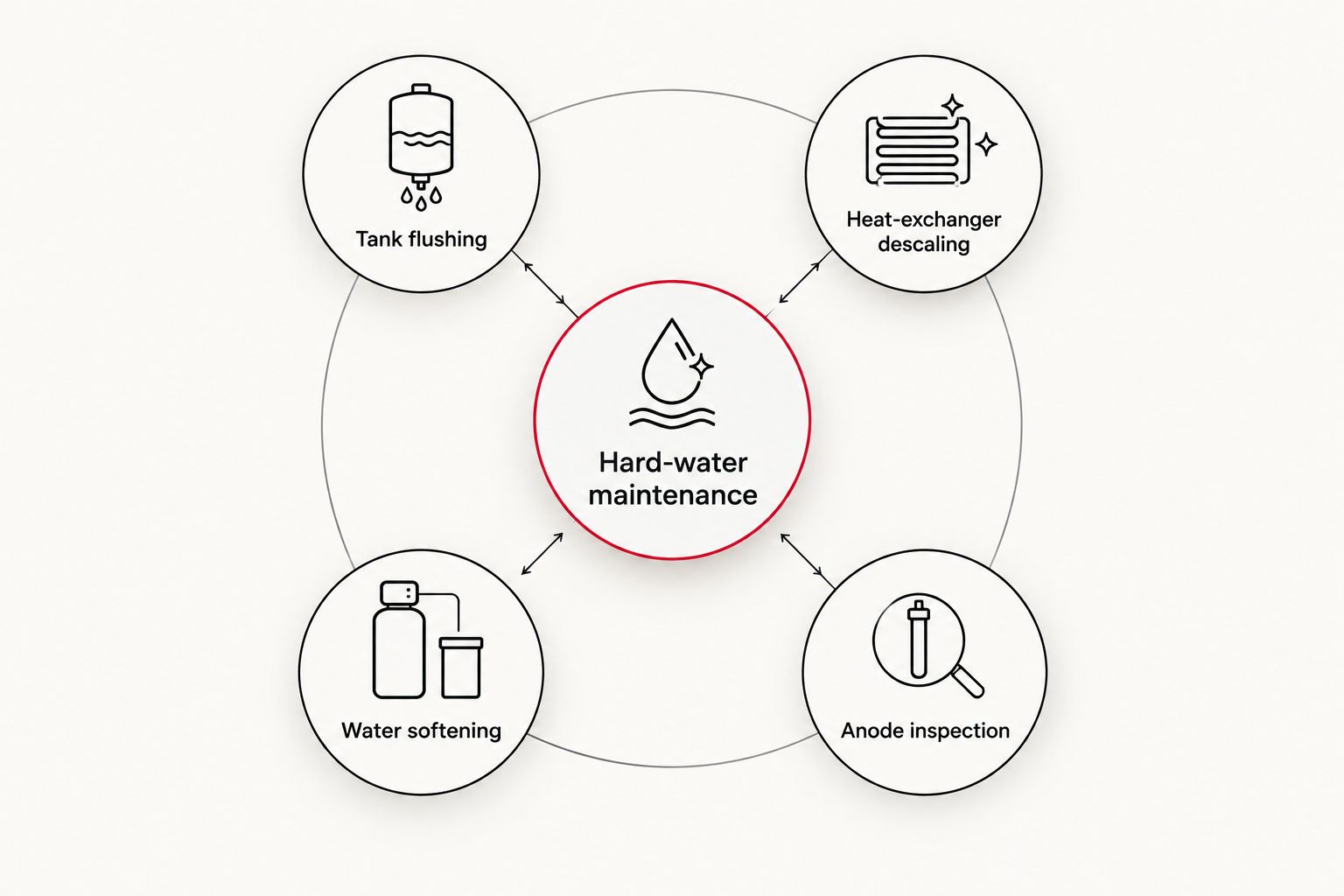
Hard-water maintenance: match the task to the problem
Sediment, scale, and corrosion are not interchangeable terms. Use the correct maintenance method for the heater and follow its manufacturer instructions; one treatment does not solve every problem.
| Task | Best for | What it addresses | What it does not do |
|---|---|---|---|
| Tank flushing | Storage heaters with accessible service points | Loose sediment collected in the tank | Guarantee removal of hardened deposits |
| Heat-exchanger descaling | Tankless units requiring this service | Mineral deposits on internal heat-transfer surfaces | Prevent future deposits by itself |
| Water softening | Reducing hardness minerals in incoming water | Dissolved calcium and magnesium | Repair an already damaged heater |
| Anode inspection | Storage tanks that use a serviceable anode | A component involved in corrosion protection | Remove hardness minerals |
Tank flushing addresses accumulated sediment; heat-exchanger descaling addresses deposits inside a tankless heater. Water softening changes incoming water, while anode inspection addresses corrosion protection in tanks that use that component.
Do not copy a maintenance interval from another household. Establish it from the equipment instructions, measured water hardness, usage, and findings during service. Keep the records so your next decision rests on the heater's condition rather than guesswork.
Before you order a replacement
Use this checklist to turn a broad recommendation into a suitable installation:
- Identify the fault. Distinguish a tank leak from a connection leak, and a heating failure from inadequate capacity.
- Measure water hardness. Use a water test rather than assuming every Tucson property receives identical water.
- Document demand. List fixtures you use together and whether the existing heater runs short.
- Check the location. Confirm service access, drainage, clearances, and the requirements of the proposed type.
- Choose scale control. Check treatment compatibility and establish the maintenance responsibilities before installation.
Ask for a diagnosis before replacing a functioning heater solely because of hard water. Priorityrooter offers water heater repair and leak detection in Tucson; those services address the existing system before you decide whether replacement is necessary.
Get help with your water heater
Discuss water heater repair or leak detection with a licensed Tucson plumbing company.
How the heater types were ranked
This ranking prioritizes compatibility with an existing installation, access for maintenance, and the ability to manage mineral deposits. It separates lower-electricity-use and space-saving options because those benefits answer different needs.
No specific model earns a recommendation without its installation instructions and your household requirements. A useful shortlist starts with the right heater type, then checks individual models against measured conditions.
Which water heater should you choose?
Keep a compatible storage setup as your default. Compare heat pump storage when reducing electricity use is the priority, and compare gas tankless when floor space is the priority.
For a Tucson purchase in 2026, require three clear answers: why the heater fits your demand, how the installation meets its requirements, and how mineral buildup will be managed. If any answer is missing, hold the purchase—not the necessary diagnosis or repair.
FAQ
What's the best water heater for hard water in Tucson?
A compatible storage water heater is the default starting point, with a maintenance plan for mineral buildup. Heat pump and gas tankless options suit different electricity-use, space, and installation needs.
Is a tankless water heater better for hard water?
Tankless water heating does not eliminate hard-water scale. Its heat exchanger still needs water-quality management and descaling according to the manufacturer's instructions.
Does a heat pump water heater prevent scale?
A heat pump water heater does not prevent scale. It changes how water is heated, but minerals still enter the storage tank with the water supply.
Should I install a water softener with a new heater?
Choose water treatment from measured hardness and the heater manufacturer's requirements. Water softening reduces hardness minerals, but treatment selection does not replace heater maintenance.
How often should I flush my water heater in Tucson?
Follow the heater manufacturer's instructions and adjust the service plan using water hardness, usage, and inspection findings. A universal schedule does not account for differences between properties or heater types.
What temperature should I set my water heater to?
The U.S. Department of Energy identifies 120°F as adequate for most households. Follow equipment guidance and address household health needs and scald protection before changing the setting.
Should I repair or replace a water heater affected by hard water?
Diagnose the fault before deciding between repair and replacement. Sediment, failed heating components, leaking connections, and a leaking tank are different problems and do not justify the same recommendation.
One last thing
A shorter shower is not proof that you need a bigger tank. Heating faults, sediment, or mixing problems can also affect usable hot water. Diagnose the change before increasing capacity or switching heater types.
Keep the model information, installation instructions, hardness test, and service records together. That simple file makes the next maintenance visit—and your next replacement decision—more useful.