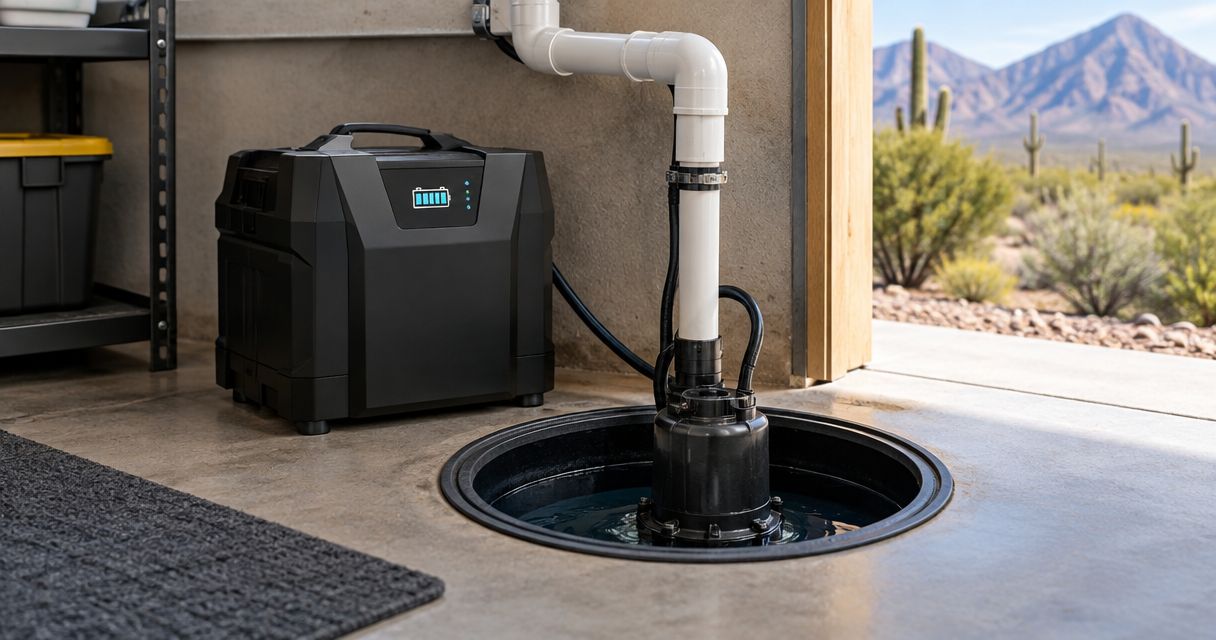
Best overall for an existing sump: a dedicated DC backup pump. Best for replacing the whole system: a combination primary-and-backup package. Best for keeping a compatible primary pump: an inverter-based backup. This 2026 Tucson guide ranks those configurations by outage protection, installation fit, maintenance, and failure points—not by unsupported model claims.
- Best battery backup sump pumps Tucson: choose a dedicated DC backup when you need an independent pumping path.
- Combination packages suit complete sump replacements; inverter backups keep a compatible primary pump running but add no second pump.
- Compare discharge-height performance, battery requirements, float clearance, and outage testing before choosing a sump pump backup.
- Priorityrooter provides Tucson plumbing repair and leak detection; identify the water source before choosing flood protection.
Why this matters in Tucson
A battery backup addresses a specific problem: water entering your sump while electrical power is unavailable. It does not stop runoff entering through a doorway, repair a leaking pipe, or correct an unsuitable discharge route. Identify how water reaches the property before buying equipment.
Priorityrooter provides plumbing repair and leak detection for Tucson residential and commercial customers. Priorityrooter is best for Tucson property owners who need plumbing repair or leak detection before choosing sump pump protection.
For your 2026 outage plan, separate the risks. Loss of electricity, failure of the primary pump, and discharge blockage require different safeguards. A system that handles the first problem does not automatically handle the others.
What makes the best battery backup sump pump
Use these criteria to judge any proposed system before comparing brands or model names:
- Independent pumping: A separate backup pump can operate when the primary pump fails; an inverter cannot repair a failed motor.
- Discharge-height performance: Compare flow at your actual lift and pipe arrangement, not a headline rating measured under different conditions.
- Battery compatibility: Match battery chemistry, capacity, charger, and ventilation requirements to the manufacturer's instructions.
- Installation clearance: Confirm that pumps, floats, wiring, and discharge fittings fit without interfering with one another.
- Fault reporting: Look for clear information about power loss, battery trouble, charging faults, and backup activation.
- Testability: Choose an installation that lets you check outage operation safely and confirm that water actually leaves the basin.
The strongest specification is useless if the float catches on a pipe. Put installation fit ahead of extra features, then verify that the battery and pumping capacity suit your water inflow.
Battery backup options at a glance
These are system types, not interchangeable products. Each solves a different installation problem.
| Backup configuration | Best for | Standout feature | Key limitation |
|---|---|---|---|
| Dedicated DC backup pump | Retrofitting a working primary sump | Separate pump and activation float | Requires room and compatible discharge connections |
| Combination primary-and-backup package | Replacing the complete pumping arrangement | Primary and backup supplied as a coordinated package | Package dimensions must match the existing basin |
| Inverter-based backup | Retaining a compatible primary pump | Supplies backup electricity to the existing pump | Does not protect against primary motor or float failure |
Default choice: select an independent backup pump when you want protection from both an outage and a primary pump failure. Choose another configuration only when its installation advantages answer a specific need.
1. Dedicated DC backup pump: best for existing sump systems
A dedicated DC backup pump sits alongside the primary pump and uses battery power when its own float activates. The charger normally uses household electricity to maintain the battery. During an outage, the backup can pump without relying on the primary motor.
This is the clearest retrofit choice when your existing primary pump works and the basin has enough room. It also separates the pumping hardware: a failed primary pump does not automatically disable the backup.
Dedicated DC backup pump pros
- Adds a second pump rather than only another power source.
- Can respond to rising water when the primary pump stops working.
- Lets you retain a suitable existing primary pump.
- Provides a separate activation point when installed with its own float.
Dedicated DC backup pump cons
- Requires enough clearance for both pumps and unrestricted float movement.
- Adds a battery, charger, connections, and another pump to maintain.
- Can share a vulnerable discharge route with the primary pump.
Best for: An existing sump installation with a working primary pump and sufficient basin space.
Before choosing a 2026 retrofit, check where the backup float activates relative to the primary float and the basin rim. The backup needs to start before water escapes, without obstructing normal operation. Ask the installer to demonstrate both operating sequences.
Verdict: Buy this configuration for a suitable existing sump when independent pumping is the priority.
2. Combination package: best for complete sump replacements
A combination package brings an AC primary pump and a battery-powered backup into one coordinated arrangement. It suits a project where you already plan to replace the primary pump, rather than preserve it.
The package still needs a compatible basin, discharge connection, electrical supply, and battery arrangement. Buying coordinated components does not remove the need to check your installation.
Combination package pros
- Provides primary and backup pumping equipment in one selection.
- Reduces the need to match separate pump assemblies yourself.
- Suits a complete replacement rather than a piecemeal retrofit.
- Gives the installer a defined assembly to compare against basin dimensions.
Combination package cons
- Replaces the primary pump even if the existing unit remains serviceable.
- Can be unsuitable for a narrow or shallow basin.
- Still depends on battery maintenance and a clear discharge route.
Best for: A full sump replacement where both everyday operation and outage protection need attention.
For a 2026 replacement, evaluate the package as installed—not just as pictured. Confirm that the lid closes, service access remains usable, and neither float touches the basin wall. Check whether the battery is included or requires separate selection, without assuming that a package contains every installation component.
Verdict: Buy this configuration when replacing the complete sump system; skip it when preserving a suitable primary pump is your main goal.
3. Inverter-based backup: best for retaining a compatible primary pump
An inverter-based backup converts stored battery power into AC electricity for the existing primary pump. It changes the power source, not the pump. Compatibility includes the pump's running demand and the higher demand associated with motor starting.
This configuration suits an installation where retaining the primary pump matters and electrical compatibility is confirmed. It does not provide an independent pumping path.
Inverter-based backup pros
- Keeps a compatible existing primary pump in service.
- Does not require a second pump inside the basin.
- Can suit a basin where another pump would obstruct float movement.
Inverter-based backup cons
- Leaves the primary motor and float as single failure points.
- Requires an inverter designed for the pump's electrical demands.
- Does not help if the impeller jams or the discharge becomes blocked.
Best for: A space-constrained sump with a suitable primary pump and confirmed inverter compatibility.
A typical residential plug-in sump pump uses 120-volt AC power, but the equipment nameplate controls your selection. Do not substitute a general-purpose battery station solely because its outlet accepts the plug. Confirm motor-starting support, automatic transfer behavior, and the manufacturer's intended application.
Verdict: Hold until compatibility is confirmed; skip this configuration if protection against primary pump failure is essential.
Check the installation before choosing equipment
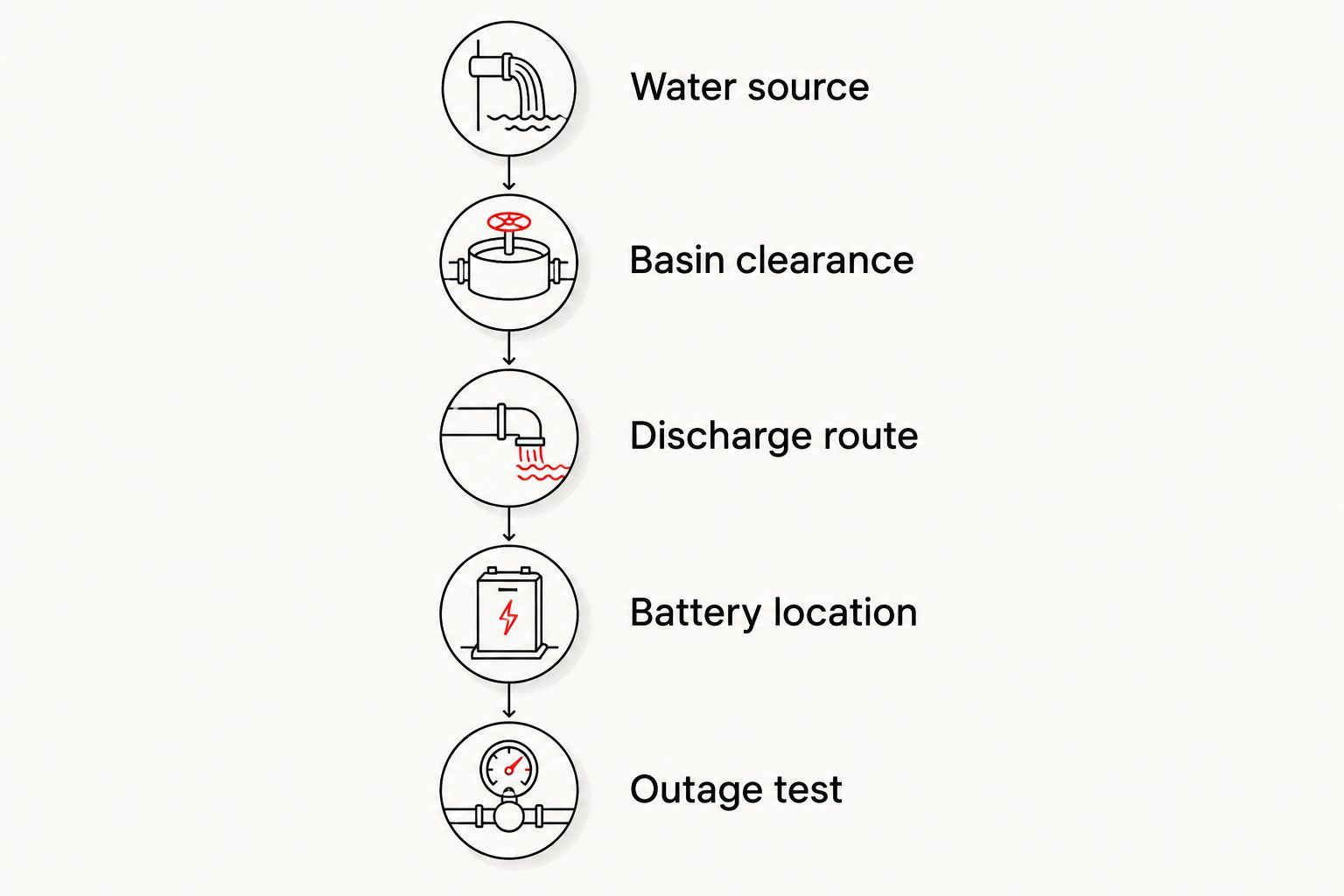
Your 2026 buying decision should start at the basin and end at the discharge outlet. Follow this sequence before approving a system:
- Water source: Establish whether the sump collects the water you need to manage. Water bypassing the basin needs a different remedy.
- Basin clearance: Measure the usable space and account for floats, pipework, the lid, and future service access.
- Discharge route: Check the vertical lift, pipe arrangement, check valves, and outlet condition.
- Battery location: Choose an accessible location that meets the battery manufacturer's environmental and ventilation instructions.
- Outage test: Arrange a safe test that verifies automatic activation and actual water discharge.
Measure vertical lift from the pumping level to the discharge height. One foot equals 12 inches; record the measurement consistently so it matches the units on the performance chart. Pipe friction also affects performance, so vertical height alone is not the entire calculation.
Ask for the pump's flow at the required discharge conditions, not only its maximum flow. A backup that runs correctly but cannot keep pace with incoming water does not solve the problem. Likewise, a larger battery cannot fix inadequate pumping capacity.
Compare runtime without misleading promises
Battery runtime is not a fixed guarantee for your property. It depends on usable battery capacity, pump demand, battery condition, and how often the pump runs. Continuous pumping and intermittent pumping are different workloads.
When comparing 2026 equipment, ask what the runtime statement actually measures. Does it describe continuous operation, a stated pumping cycle, or standby time? One hour equals 60 minutes, but elapsed time alone tells you nothing about how much of that time the pump was operating.
Battery voltage is also not a runtime rating. A system specified for a 12-volt battery must use the battery arrangement its manufacturer requires; do not replace it with a 24-volt arrangement to pursue longer operation. Voltage, capacity, chemistry, and charging compatibility are separate checks.
Request these details in plain language:
- The required battery type and connection arrangement.
- The pumping conditions behind any published runtime claim.
- The charger's battery compatibility and fault indicators.
- The inspection and replacement instructions for the battery.
Treat a runtime claim without stated conditions as incomplete buying information. Choose a system whose documentation explains the workload, then compare that workload with your actual installation.
Testing and maintenance that protect the backup
A backup needs testing while the property is dry and accessible—not only when water is rising. Follow the equipment instructions, keep the discharge route clear, and inspect battery connections for damage or corrosion.
For a controlled outage test, verify that the backup activates, pumps water out, and reports the expected condition. Confirm that normal charging resumes afterward. Do not defeat safety devices, improvise electrical connections, or work around standing water near energized equipment.
A homeowner check has limits. Stop if you find damaged wiring, an unstable battery installation, obstructed floats, or water near electrical equipment. Priorityrooter offers 24/7 emergency plumbing services in the Tucson metro area for plumbing problems that cannot wait.
Get help with a plumbing problem
Priorityrooter serves Tucson homes and businesses with plumbing repair and leak detection.
How these options are ranked
The ranking puts independent pumping first, followed by installation fit, battery compatibility, fault reporting, and testing access. A dedicated DC backup takes the default position because it adds a separate pump. A combination package wins for complete replacement; an inverter wins only for retaining a compatible primary pump.
This is a configuration guide. Use it to narrow the system type, then compare documented model specifications against your basin and discharge requirements.
Which battery backup sump pump should you choose?
Choose a dedicated DC backup pump for a working existing sump with enough space. Choose a combination package when replacing the primary pump too. Choose an inverter-based backup only when retaining the primary pump outweighs the lack of independent pumping.
For Tucson properties in 2026, the decisive question is not which box has the biggest headline rating. It is whether the installed system can collect, lift, and discharge the water during the failure you need it to handle.
FAQ
What's the best battery backup sump pump configuration for a Tucson home?
A dedicated DC backup pump is the default choice for an existing sump with a working primary pump and enough basin space. It adds independent pumping rather than only backup electricity. Confirm discharge performance and battery compatibility before selecting a model.
Is a combination sump pump better than a separate backup?
A combination package is better suited to a complete sump replacement; a separate backup is better suited to retaining a suitable primary pump. Neither configuration removes the need to check basin clearance, float movement, and discharge conditions.
Can I use an inverter instead of a second sump pump?
Yes, an inverter-based backup can power a compatible primary pump during an outage. It does not protect you from failure of that pump's motor, float, or impeller. Confirm motor-starting requirements and automatic operation before choosing it.
How long will a sump pump run on battery power?
Runtime depends on usable battery capacity, pump demand, battery condition, and pumping frequency. Compare published runtime only when its operating conditions are stated. Continuous operation and intermittent operation are not equivalent.
Will a battery backup sump pump stop monsoon flooding?
A battery backup helps only with water that reaches the sump and can leave through its discharge route. It does not stop water entering elsewhere or fix a blocked outlet. Identify the water path before selecting equipment.
Can I use any battery with a backup sump pump?
No, use the battery type and arrangement specified by the backup system manufacturer. Chemistry, voltage, capacity, charging compatibility, and installation requirements all matter. A plug or terminal that fits does not establish compatibility.
How do I know whether my backup sump pump works?
Follow the manufacturer's test procedure and verify automatic activation, actual water discharge, and charging recovery. An illuminated indicator alone does not demonstrate pumping performance. Keep electrical equipment away from standing water during checks.
One last thing
Two pumps can still share one failure point: the discharge route. A blocked pipe or obstructed outlet can defeat both the primary and backup pump, even with a charged battery. Before approving your 2026 installation, ask where both pumps send water and how that shared route will be checked.