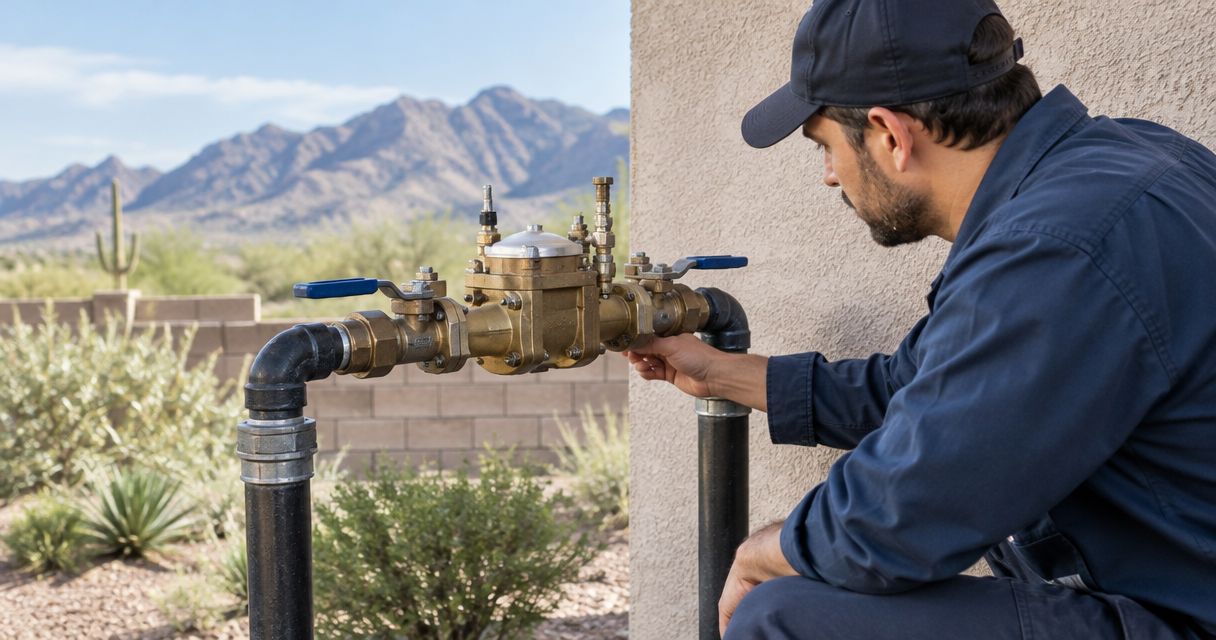
Best overall for high-hazard connections: a reduced-pressure assembly. Best for approved low-hazard connections: a double-check assembly. Best for elevated irrigation protection against backsiphonage: a pressure vacuum breaker. For Tucson properties in 2026, the best backflow preventer is the device approved for your connection’s hazard, pressure conditions, and installation—not simply the highest-ranked option.
- For best backflow preventer devices Tucson searches, start with hazard classification and water-provider approval, not brand rankings.
- Reduced-pressure assemblies protect against both backsiphonage and backpressure at high-hazard connections.
- Double-check assemblies suit approved low-hazard connections; vacuum breakers have narrower applications.
- Priorityrooter serves Tucson residential and commercial plumbing customers; confirm backflow requirements with your water provider before choosing equipment.
Why this matters
A backflow preventer protects drinking water from reverse flow through a cross-connection. That connection might serve irrigation, equipment, or another system that must remain separated from the potable supply. A device that fits the pipe can still be wrong for the hazard.
Priorityrooter is a Tucson plumbing company for residential and commercial customers who need plumbing repair and installation. You can start with Priorityrooter for general plumbing needs, but your water provider determines which backflow protection it accepts for your particular connection.
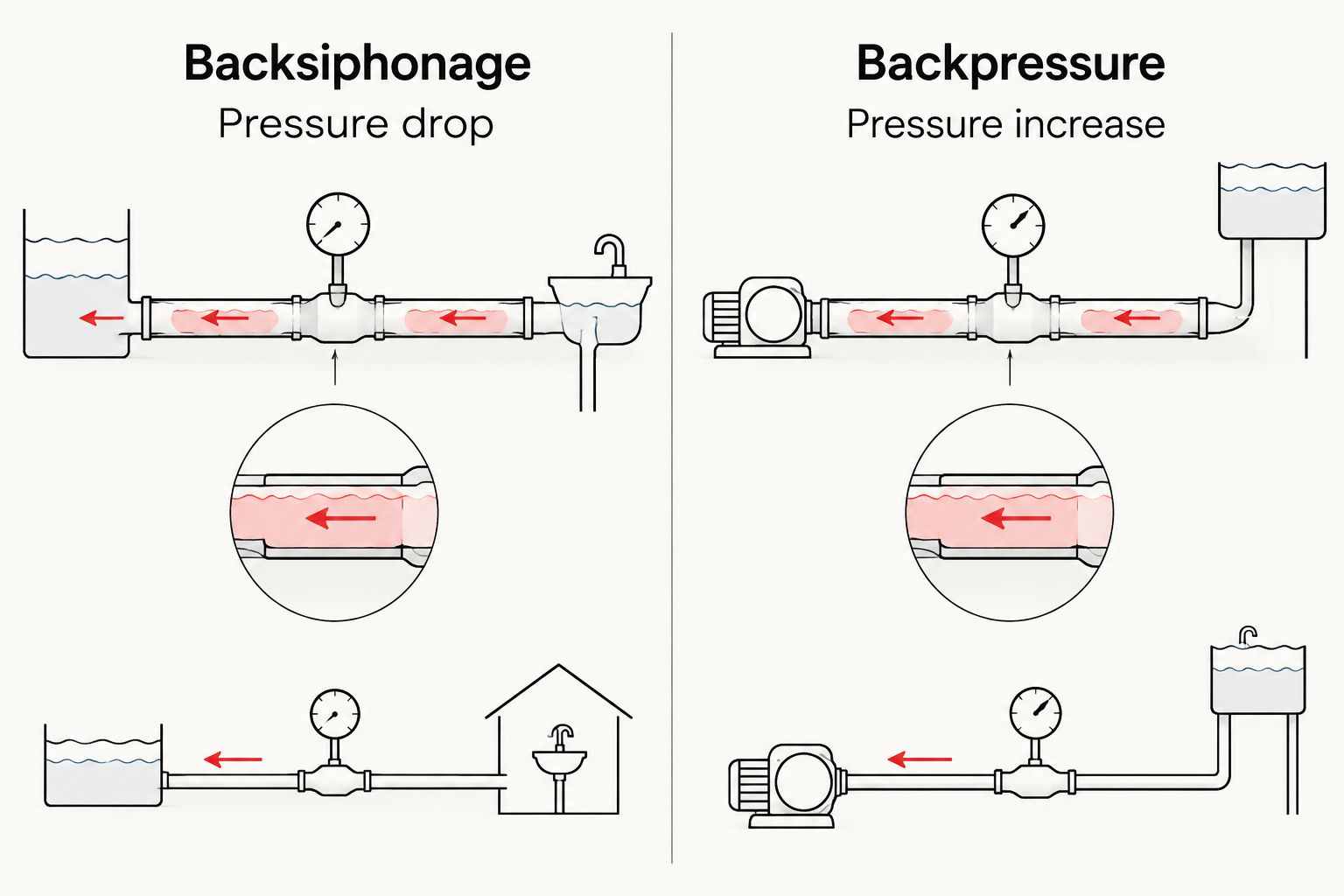
Two conditions drive device selection:
- Backsiphonage: A pressure drop in the supply can draw water backward.
- Backpressure: A downstream pressure increase can force water toward the supply.
A vacuum breaker addresses backsiphonage, not backpressure. That distinction matters more than appearance, manufacturer, or whether another property uses the same device.
What makes the best backflow preventer?
Use these criteria to evaluate a backflow preventer for a Tucson property in 2026:
- Hazard suitability: Match the device to the connection’s health-hazard classification. Do not substitute low-hazard protection for high-hazard protection.
- Pressure protection: Determine whether the connection presents backsiphonage, backpressure, or both. Pumps and pressurized downstream equipment need particular attention.
- Local acceptance: Confirm the water provider’s accepted assembly types, models, installation requirements, and testing requirements before purchasing.
- Installation fit: Check elevation, orientation, clearance, drainage, access, and protection from freezing. These are operating requirements, not finishing details.
- Testability and service access: Choose the required testable assembly where applicable. Leave room to reach shutoff valves, test ports, and serviceable components.
- Hydraulic suitability: Size the device using flow demand and its pressure-loss information. Matching the existing pipe diameter alone does not establish adequate performance.
Approval comes before purchase. For a 2026 replacement, identify the existing assembly and ask whether the replacement must meet updated requirements rather than assuming the old installation establishes compliance.
Best backflow preventer devices at a glance
These rankings compare device categories, not individual manufacturer models. Each category solves a different problem; none is an interchangeable upgrade for every property.
| Device category | Best for | Standout feature | Key limitation |
|---|---|---|---|
| Reduced-pressure assembly | High-hazard connections with either reverse-flow condition | Two checks plus an intermediate relief valve | Needs suitable relief discharge and installation clearance |
| Double-check assembly | Approved low-hazard connections | Two independently acting checks | Not a substitute for high-hazard protection |
| Pressure vacuum breaker | Elevated irrigation connections exposed to backsiphonage | Check valve and air inlet | Does not protect against backpressure |
| Spill-resistant vacuum breaker | Approved backsiphonage applications where startup spillage matters | Spill-resistant air-inlet operation | Still does not protect against backpressure |
| Atmospheric vacuum breaker | Simple point-of-use connections without continuous pressure | Air admission when supply pressure falls | Cannot remain under continuous pressure or have downstream shutoff valves |
1. Reduced-pressure assembly: best for high-hazard connections
A reduced-pressure assembly, commonly called an RP or RPZ assembly, protects against both backsiphonage and backpressure. It uses 2 independently acting check valves with a pressure-operated relief valve between them. ASSE 1013 is the relevant performance standard for this assembly category.
An RP assembly is the strongest default on this list when the connection presents a health hazard and either reverse-flow condition. That does not make it necessary for every residential irrigation connection. The hazard assessment and accepted installation determine its place.
Reduced-pressure assembly pros:
- Protects against both principal causes of backflow.
- Provides high-hazard protection when correctly selected and installed.
- Supports field testing through the assembly’s test connections.
Reduced-pressure assembly cons:
- Relief discharge needs a suitable drainage arrangement.
- Pressure loss must be included in system sizing.
- Installation cannot expose the relief opening to submergence.
Best for: Connections requiring high-hazard protection against backsiphonage and backpressure, subject to water-provider approval.
For a 2026 installation, ask where relief water will go before agreeing on placement. A relief valve is a protective component, not a drain connection that can simply be capped when it becomes inconvenient.
Verdict: Buy a reduced-pressure assembly when the connection requires high-hazard protection and the installation supports safe discharge.
2. Double-check assembly: best for approved low-hazard connections
A double-check assembly uses 2 independently acting check valves to protect against backsiphonage and backpressure in low-hazard applications. Unlike an RP assembly, it does not have an intermediate relief valve. ASSE 1015 covers this category.
A testable double-check assembly is also different from a basic check valve or an ordinary dual-check device. Similar names do not establish equal protection, approval, or testing capability.
Double-check assembly pros:
- Protects against both backsiphonage and backpressure within its approved application.
- Provides test connections for checking assembly performance.
- Avoids the RP assembly’s intermediate relief discharge arrangement.
Double-check assembly cons:
- Does not provide high-hazard protection.
- Acceptance depends on the particular connection and water provider.
- A small dual-check device is not an equivalent replacement.
Best for: Connections the responsible authority classifies as low hazard and accepts for double-check protection.
Before selecting one for a Tucson property in 2026, get the hazard classification confirmed. Convenience and available installation space cannot turn a high-hazard connection into a low-hazard connection.
Verdict: Buy a double-check assembly only for an approved low-hazard application; skip it when high-hazard protection is required.
3. Pressure vacuum breaker: best for elevated irrigation connections
A pressure vacuum breaker, or PVB, protects against backsiphonage. Its assembly includes 1 check valve and an air-inlet valve, and it can operate under continuous pressure. ASSE 1020 covers pressure vacuum breaker assemblies.
A PVB must sit above the downstream piping and outlets by the required elevation. That makes site layout important: raised irrigation zones and changes in grade can alter whether a proposed location works.
Pressure vacuum breaker pros:
- Provides backsiphonage protection in approved applications.
- Can remain under continuous pressure.
- Supports field testing when installed with accessible test connections.
Pressure vacuum breaker cons:
- Does not protect against backpressure.
- Requires elevation above downstream piping and outlets.
- Exposed installation needs suitable freeze protection.
Best for: Irrigation connections requiring backsiphonage protection where the necessary elevation is practical and backpressure is absent.
Check the entire irrigation layout, not just the pipe beside the assembly. A downstream pump or pressurized arrangement changes the selection problem; installing the PVB higher does not add backpressure protection.
Verdict: Buy a pressure vacuum breaker for an approved elevated backsiphonage application; skip it where backpressure exists.
4. Spill-resistant vacuum breaker: best where startup spillage matters
A spill-resistant vacuum breaker, or SVB, provides backsiphonage protection with an air-inlet arrangement designed to reduce spillage during startup. ASSE 1056 covers this assembly category. It does not eliminate the need for correct placement or installation clearance.
The distinguishing feature is spill resistance, not broader protection. An SVB remains a vacuum-breaker option rather than a substitute for an RP assembly where backpressure protection is required.
Spill-resistant vacuum breaker pros:
- Addresses startup spillage through its operating design.
- Provides backsiphonage protection in approved applications.
- Supports testing as a testable assembly.
Spill-resistant vacuum breaker cons:
- Does not protect against backpressure.
- Still requires the specified elevation and orientation.
- Spill resistance does not mean the assembly can never release water.
Best for: Approved backsiphonage-only connections where limiting startup spillage is a specific installation concern.
For 2026 selection, compare the manufacturer’s installation instructions with the proposed location. Do not treat the word spill-resistant as permission to place the assembly somewhere that cannot tolerate water release.
Verdict: Buy a spill-resistant vacuum breaker when spill behavior matters and the connection qualifies for vacuum-breaker protection.
5. Atmospheric vacuum breaker: best for simple point-of-use protection
An atmospheric vacuum breaker, or AVB, admits air when supply pressure falls, interrupting backsiphonage. ASSE 1001 covers this device category. It belongs in applications that do not leave it continuously pressurized.
An AVB cannot have a shutoff valve downstream. That restriction makes it unsuitable as a replacement for a testable assembly serving a downstream irrigation valve arrangement.
Atmospheric vacuum breaker pros:
- Provides backsiphonage protection at suitable individual connections.
- Uses a simple air-admission mechanism.
- Fits applications without continuous pressure or downstream shutoffs.
Atmospheric vacuum breaker cons:
- Does not protect against backpressure.
- Cannot operate under continuous pressure.
- Does not offer the same field-testing arrangement as the testable assemblies above.
Best for: Approved point-of-use connections with the required elevation, no downstream shutoff, and no continuous pressure.
A hose connection also needs the correct device for that application. Do not assume any device marketed as a vacuum breaker meets the requirements of a whole-property or irrigation connection.
Verdict: Buy an atmospheric vacuum breaker only for its approved point-of-use application; skip it as a general assembly replacement.
How these backflow preventers are ranked
The ranking follows hazard suitability, reverse-flow protection, local acceptance, installation fit, service access, and hydraulic suitability. Reduced-pressure assemblies lead for high-hazard protection against both pressure conditions; each subsequent category serves a narrower use case.
This is not a manufacturer leaderboard. An accepted model in the correct category beats an unapproved model with a familiar name. Likewise, a device’s performance standard identifies its category but does not establish Tucson acceptance for your connection.
Which backflow preventer should you choose?
Choose the accepted device category before choosing a model. If your connection requires high-hazard protection against both backsiphonage and backpressure, start with an RP assembly. If the connection is confirmed low hazard, ask whether a double-check assembly is accepted.
For backsiphonage-only irrigation protection, check whether a PVB or SVB meets the site’s elevation and approval requirements. Reserve an AVB for its narrower point-of-use application.
Before requesting a replacement, gather:
- The existing assembly’s manufacturer, model, size, and visible markings.
- Photos showing its location and connected piping.
- The purpose of the protected connection.
- Information about downstream pumps, valves, and chemical connections.
- Any water-provider notice or previous test report.
Keep repair, testing, and replacement separate in the discussion. A leaking assembly needs diagnosis; leakage alone does not establish which replacement category is correct. Ask who will complete any required testing and submit the documentation.
FAQ
What's the best backflow preventer for a Tucson property in 2026?
The best backflow preventer is the assembly your water provider accepts for the connection's hazard and pressure conditions. Reduced-pressure assemblies protect high-hazard connections against both backsiphonage and backpressure; other device categories serve narrower applications.
Is a reduced-pressure assembly better than a double-check assembly?
A reduced-pressure assembly provides high-hazard protection that a double-check assembly does not. A double-check assembly remains an appropriate choice where the connection is classified as low hazard and the responsible authority accepts it.
Can a pressure vacuum breaker protect against backpressure?
No, a pressure vacuum breaker protects against backsiphonage, not backpressure. Downstream pumps or pressurized equipment require a separate evaluation of the appropriate protection.
Do all Tucson irrigation systems need the same backflow preventer?
No, irrigation connections differ in hazard, elevation, pressure conditions, and approval requirements. Confirm the accepted assembly with the water provider responsible for your property rather than copying a neighboring installation.
Can I replace a backflow assembly with any device that fits the pipe?
No, matching the pipe size does not establish suitable protection or adequate flow performance. Confirm the device category, accepted model, installation instructions, and testing requirements before replacing it.
Does a leaking backflow preventer always need replacement?
No, leakage alone does not establish that replacement is necessary. A qualified professional must identify the source and determine whether repair, testing, or replacement addresses the problem; never cap a relief opening.
Does Priorityrooter serve residential and commercial plumbing customers?
Yes, Priorityrooter serves residential and commercial plumbing customers in the Tucson metro area. Its stated services include plumbing repair and installation; confirm the specific backflow installation or testing work needed before arranging service.
One last thing
The highest downstream outlet can matter more than the nearest one. For a vacuum-breaker installation, walk the protected area and identify raised outlets, slopes, and changes in piping elevation before settling on a location. An assembly that appears correctly positioned beside the supply can still be wrong for the system it protects.
For your 2026 project, resolve that layout question before purchasing equipment. Correct protection starts with the connection—not the box.