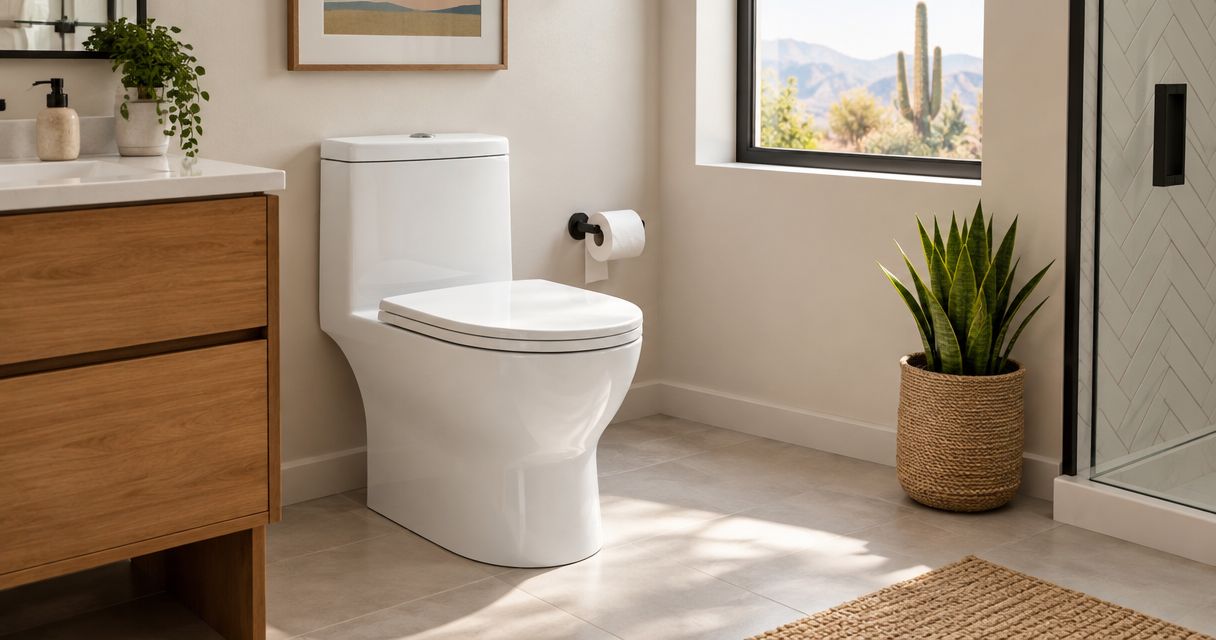
Best overall: a WaterSense-labeled, single-flush elongated toilet. Best for flush control: a WaterSense-labeled dual-flush toilet. Best for tight bathrooms: a compact round-front toilet with the WaterSense label. This 2026 guide compares practical choices for Tucson homes; Priorityrooter provides residential plumbing repair and installation.
- Best low-flow toilets Tucson: choose a WaterSense-labeled single-flush toilet as the default for a full-size bathroom.
- WaterSense-labeled toilets use no more than 1.28 gallons per flush under EPA certification criteria.
- Dual-flush toilets suit households that will consistently select the appropriate flush.
- Priorityrooter provides plumbing installation for Tucson homeowners replacing a toilet.
Why this matters
A low-flow toilet should save water without becoming a daily troubleshooting project. The right choice combines certified flushing performance, a suitable footprint, and a sound installation. A lower consumption number alone does not establish that a toilet fits your bathroom or solves an existing drainage problem.
The EPA WaterSense program sets a maximum effective flush volume of 1.28 gallons per flush for labeled tank-type toilets. That is at least 20 percent less water than the federal standard of 1.6 gallons per flush. WaterSense also includes performance requirements; the label is not simply a manufacturer's water-saving claim.
For a Tucson replacement in 2026, start with those certification requirements, then narrow the choice by bathroom space and household needs. Treat mineral buildup and recurring clogs as separate maintenance or plumbing questions rather than reasons to choose a particular flushing mechanism automatically.
What makes the best low-flow toilet?
Use these criteria before comparing shapes, controls, or finishes:
- Certified efficiency: Look for the EPA WaterSense label on the exact model, not just elsewhere in the manufacturer's catalog.
- Flushing performance: Choose a toilet certified for performance as well as consumption. Do not substitute advertising language for certification.
- Installation fit: Match the rough-in, floor connection, supply location, and available clearance before ordering.
- Everyday usability: Compare bowl shape, seat height, and flush controls with the needs of the people using the bathroom.
- Service access: Check whether the fill valve, flush valve, seals, and other service parts are identifiable and accessible.
- Drain condition: Investigate recurring backups before replacement. A new bowl does not repair a blocked or damaged sewer line.
Give fit and usability the same attention as water consumption. A toilet that crowds the door or has controls your household dislikes is the wrong purchase even when its efficiency rating looks good.
Best low-flow toilets at a glance
These are ranked toilet configurations, not a claim that an unverified brand or model outperforms another. The categories overlap: a round-front toilet can also be single-flush, and an elongated toilet can be dual-flush. Choose the configuration that addresses your main constraint.
| Rank and option | Best for | Standout feature | Key limitation |
|---|---|---|---|
| Single-flush elongated, WaterSense-labeled | Default replacement in a full-size bathroom | One flush control with certified efficiency | Elongated footprint needs sufficient clearance |
| Dual-flush, WaterSense-labeled | Households wanting flush selection | Separate reduced and full flush choices | Users must choose the appropriate control |
| Compact round-front, WaterSense-labeled | Bathrooms with limited front clearance | Shorter bowl shape than an elongated equivalent | Bowl shape does not suit every user |
| Pressure-assisted, with verified efficiency certification | Households prioritizing assisted flushing | Pressure vessel assists the flush | Different sound and service requirements |
1. Single-flush elongated: best default low-flow toilet
A WaterSense-labeled single-flush elongated toilet is the strongest starting point for a standard bathroom replacement in 2026. You operate one flush control, and the elongated bowl provides a different seating shape from a round-front bowl. Confirm the actual dimensions rather than assuming every elongated toilet occupies the same space.
Best for: A full-size household bathroom where straightforward operation matters more than selectable flush volumes.
This is the default because it asks less of the user. There is no decision between reduced and full flush controls, and a conventional gravity-fed tank uses a familiar operating arrangement. That simplicity matters in a bathroom shared by family members or guests.
Single-flush elongated pros:
- One control keeps the flushing routine straightforward.
- The WaterSense label addresses efficiency and flushing performance.
- An elongated bowl gives you an alternative to a round seating shape.
- Conventional gravity-fed designs avoid a pressure vessel inside the tank.
Single-flush elongated cons:
- The bowl projects farther forward than a comparable round-front design.
- You cannot select a reduced flush separately for liquid waste.
- Certification does not eliminate the need to check rough-in and installation clearance.
Before choosing, measure the distance between the toilet position and the opposite wall, vanity, or swinging door. Also compare the proposed seat height with the current toilet. A change that looks minor on a specification sheet can affect daily comfort.
Verdict: Buy a WaterSense-labeled single-flush elongated toilet when the room has enough clearance and you want the simplest default.
2. Dual-flush: best low-flow toilet for flush control
A dual-flush toilet gives you separate reduced and full flush options. The reduced flush serves liquid waste; the full flush serves solid waste. Choose an exact model carrying the WaterSense label rather than assuming that every dual-flush toilet meets the same certification requirements.
Best for: A household willing to use the appropriate flush control consistently.
For dual-flush toilets, the WaterSense efficiency calculation uses an effective flush volume. Do not read the program's 1.28-gallon threshold as a promise that both individual flush settings use that amount. Review the manufacturer's specifications for each setting when comparing models in 2026.
Dual-flush pros:
- Separate controls let you match the flush to the waste.
- A WaterSense-labeled model includes certified efficiency and performance requirements.
- Dual-flush operation is available in different bowl shapes and tank arrangements.
Dual-flush cons:
- Users need to understand which control to select.
- Button placement and operation vary between models.
- Replacement seals and flush assemblies must match the particular mechanism.
Try the controls before committing if you can inspect a display. Check whether you can distinguish the reduced and full flush easily, and whether the controls are comfortable to press. Choose for the people using the bathroom, not just for the specification sheet.
Verdict: Buy a WaterSense-labeled dual-flush toilet when selectable flushing is a feature your household will actually use.
3. Compact round-front: best low-flow toilet for tight bathrooms
A round-front toilet uses a shorter bowl shape than a comparable elongated toilet. That makes it a useful starting point when front clearance is the limiting factor. The complete footprint still depends on the model's tank and bowl dimensions.
Best for: A small bathroom or powder room where an elongated replacement would crowd usable space.
Do not confuse a compact footprint with a different drain connection. Bowl length and rough-in are separate measurements. A compact toilet still needs the correct relationship between the wall, flange, supply valve, and surrounding fixtures.
Compact round-front pros:
- A shorter bowl shape helps preserve front clearance.
- WaterSense-labeled options combine the compact shape with certified efficiency.
- The configuration addresses a physical space problem rather than adding unnecessary controls.
Compact round-front cons:
- Some users prefer the seating shape of an elongated bowl.
- A round bowl does not guarantee a compact tank or overall footprint.
- Reduced projection does not resolve an incorrect rough-in or damaged flange.
For a small Tucson bathroom in 2026, compare dimension drawings before comparing appearance. Include door swing and the space needed to stand, turn, and clean beside the toilet. Keep accessibility needs separate from the assumption that smaller always means better.
Verdict: Buy a WaterSense-labeled compact round-front toilet when measured clearance—not styling—is the deciding constraint.
4. Pressure-assisted: best for assisted flushing
A pressure-assisted toilet uses a pressure vessel inside the tank to assist the flush. It differs from a conventional gravity-fed toilet, where water stored in the tank supplies the flushing action without that vessel. Verify the exact model's water consumption and certification before treating it as an efficient replacement.
Best for: A household that specifically wants pressure-assisted operation and accepts its sound and servicing differences.
Do not choose this configuration solely because the current toilet clogs. Recurring clogs can involve the toilet trap, a branch drain, or the sewer line. Replacing the fixture without identifying the obstruction risks leaving the actual problem in place.
Pressure-assisted pros:
- The pressure vessel assists the flushing action.
- The configuration offers an alternative to ordinary gravity-fed operation.
- Published model specifications let you check supply-pressure requirements before installation.
Pressure-assisted cons:
- The flush has a different, often louder sound than gravity-fed operation.
- Internal service components differ from conventional tank parts.
- Pressure assistance does not repair downstream blockages or damaged drains.
Ask for the installation requirements and service documentation before purchasing. Confirm that the home's water supply meets the manufacturer's requirements, and identify the correct replacement components. More specialized operation should be a deliberate choice, not an assumed upgrade.
Verdict: Hold until supply compatibility, efficiency certification, noise expectations, and drain condition are confirmed.
Check these details before replacing your toilet
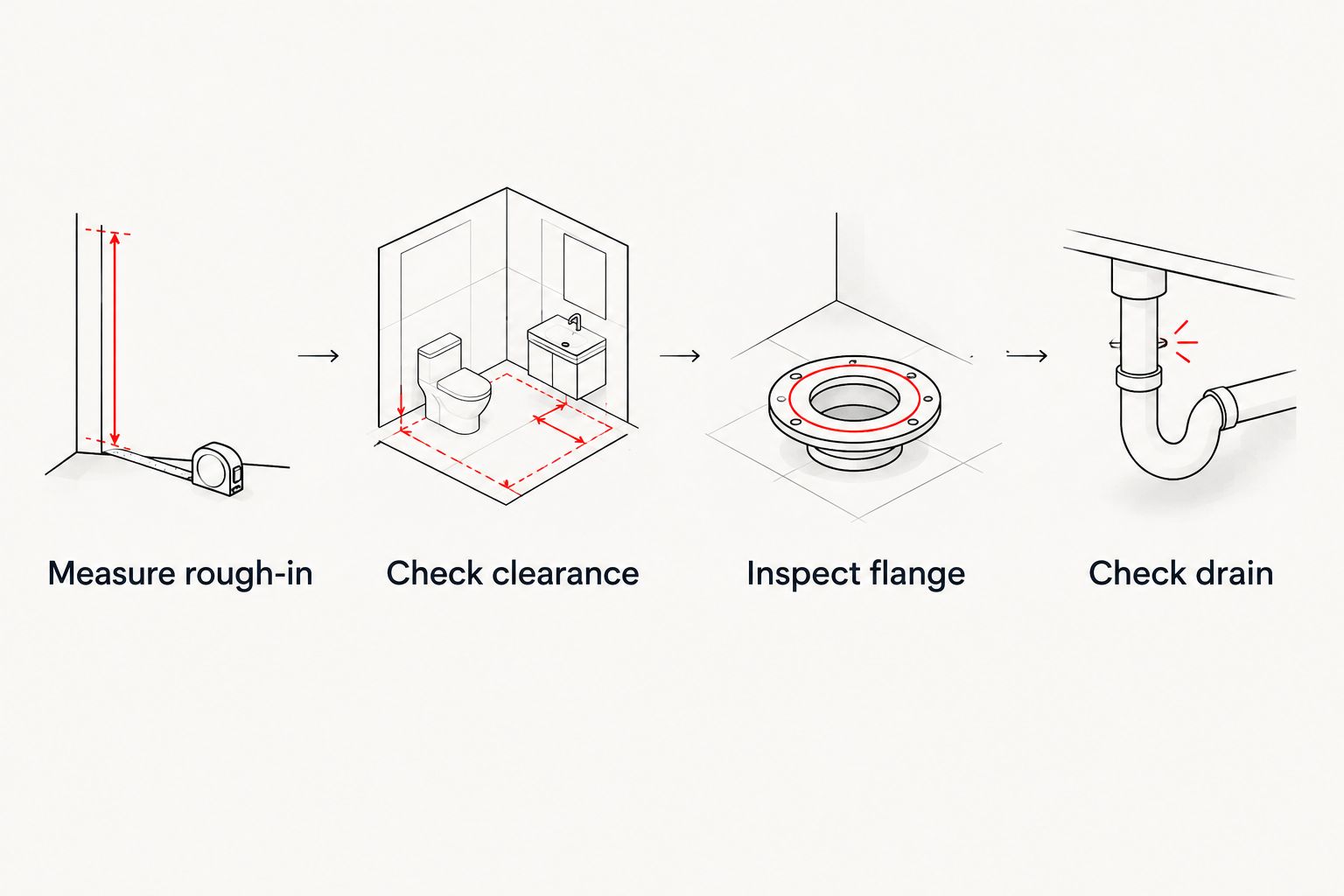
A toilet replacement needs more than matching the old bowl's appearance. Measure the connection, inspect the mounting point, and separate fixture trouble from drainage trouble. These checks apply to every configuration in this 2026 guide.
Measure the rough-in
The rough-in is the distance from the finished wall behind the toilet to the center of the floor drain connection. On many floor-mounted installations, the mounting bolts help identify that centerline. Measure from the wall surface, not the face of a projecting baseboard.
Do not infer the rough-in from bowl length. Bring the measurement and the proposed model's installation drawing to the purchase decision. If the mounting arrangement is concealed or unfamiliar, have a plumber verify it.
Check clearance
Compare the complete toilet dimensions with the bathroom, including door swing, vanity position, and usable space in front. Confirm the seat height and bowl shape with the person who will use the toilet most often. Water efficiency does not compensate for an uncomfortable fit.
Inspect the flange
The flange connects the toilet to the drain and supports the mounting arrangement. Rocking, damaged flooring, or water around the base calls for inspection before the new fixture is installed. Tightening bolts harder is not a substitute for identifying a damaged connection or unsuitable support.
Check the drain
A slow toilet accompanied by slow nearby fixtures needs a drainage assessment, not an automatic toilet replacement. Note whether the problem affects only the toilet or several fixtures. That distinction helps direct the plumbing inspection.
Hard water and recurring clogs: avoid the wrong fix
Mineral deposits can accumulate on toilet surfaces and in water passages. Follow the toilet manufacturer's cleaning instructions, and avoid assuming that a stronger chemical cleaner is appropriate for every finish, seal, or tank component. Cleaning products are not interchangeable with drain treatments.
A flush that has weakened over time deserves inspection of the tank water level, flush components, and bowl passages. Those checks distinguish a maintenance issue from a reason to replace the entire toilet. Do not adjust tank components beyond the manufacturer's instructions to compensate for a suspected obstruction.
Priorityrooter is a local option for Tucson homeowners who need low-flow toilet installation and drain troubleshooting. The company provides residential plumbing repair and installation, drain cleaning, and sewer camera inspections. Use the symptom to guide the service request: repeated backups require a different investigation from an uncomfortable bowl shape.
How these toilet configurations were ranked
The ranking prioritizes certified efficiency, straightforward operation, bathroom fit, service access, and drain condition. Single-flush elongated takes the default position because it combines one-control operation with a conventional configuration when space allows. Dual-flush and round-front options address different household needs rather than serving as universal upgrades.
Pressure-assisted ranks as a conditional choice because supply requirements and servicing deserve additional attention. The EPA WaterSense certification criteria provide the efficiency benchmark used in this 2026 comparison; no model-specific test results are claimed.
Which low-flow toilet should you choose?
Choose a WaterSense-labeled single-flush elongated toilet unless clearance or flush-control preferences point elsewhere. Choose round-front when front clearance is tight. Choose dual-flush when your household wants and understands the separate controls.
Keep pressure-assisted toilets on the shortlist only when their operating requirements fit your home. If the current toilet repeatedly backs up, investigate the drain before purchasing any replacement. Better fixture selection and correct diagnosis are separate decisions, and both matter.
FAQ
What's the best low-flow toilet for a Tucson home?
A WaterSense-labeled single-flush elongated toilet is the default choice for a Tucson bathroom with sufficient clearance. Choose a compact round-front bowl when space is tight or dual-flush when your household wants separate flush controls.
How much water does a WaterSense toilet use?
A WaterSense-labeled tank-type toilet has an effective flush volume of no more than 1.28 gallons per flush under EPA certification criteria. For dual-flush models, effective flush volume is a weighted measure, so check the specifications for each individual setting.
Is a dual-flush toilet better than a single-flush toilet?
A dual-flush toilet is better for users who want separate reduced and full flush choices, not automatically better for every household. A WaterSense-labeled single-flush toilet offers certified efficiency with one-control operation.
Will a low-flow toilet fix recurring clogs?
A low-flow toilet will not fix a downstream blockage or damaged drain. Diagnose recurring backups before replacing the fixture, especially when nearby drains also run slowly.
Should I choose a round or elongated toilet?
Choose round-front when measured front clearance is limited, and elongated when its seating shape suits you and the bathroom has room. Compare complete model dimensions because bowl shape alone does not establish the total footprint.
Does Tucson hard water mean I need a pressure-assisted toilet?
Hard water alone is not a reason to choose a pressure-assisted toilet. Evaluate mineral buildup, cleaning instructions, water-supply requirements, and the condition of the existing toilet separately.
Who can help install a low-flow toilet in Tucson?
Priorityrooter provides residential plumbing repair and installation in the Tucson metro area. Request an assessment of the rough-in, flange, supply connection, and any recurring drainage symptoms before replacement.
One last thing
Do not judge toilet efficiency by flush volume alone. A leaking flush valve lets water escape between flushes, so a certified replacement still needs correctly adjusted, functioning tank components. After installation, check for unexplained refilling, movement at the base, and moisture around the supply connection.
Treat those signs as installation or maintenance questions—not normal features of a water-saving toilet. The best replacement is one that fits, flushes correctly, and stays watertight.