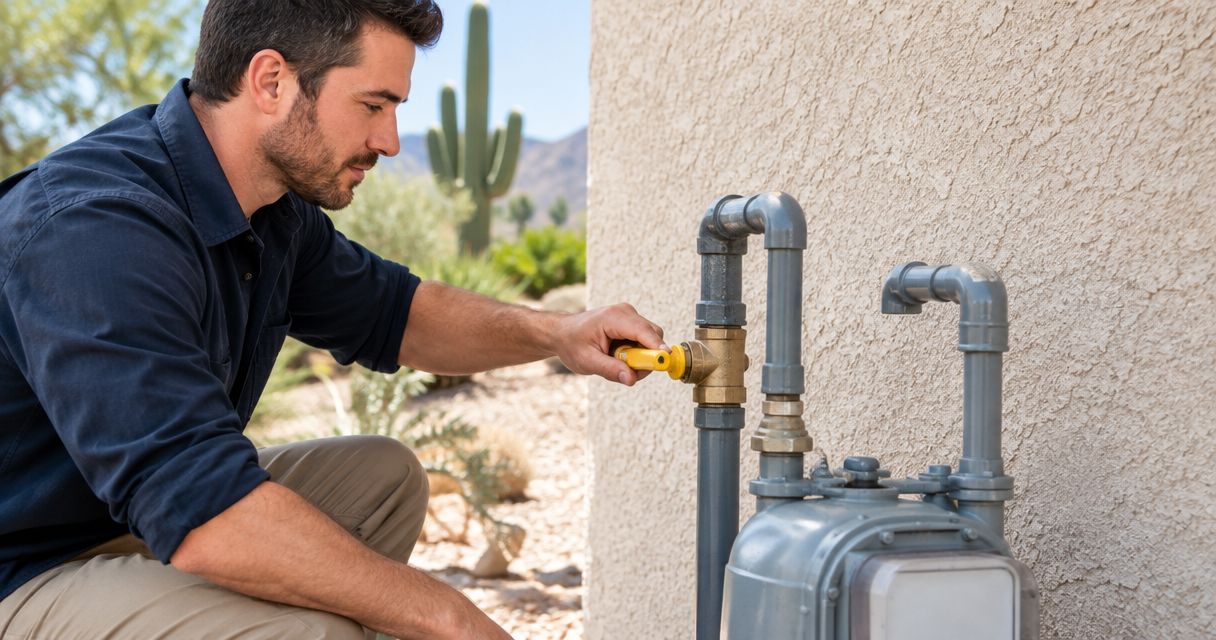
Best overall for routine appliance isolation: a gas-rated manual ball valve. Best for qualifying downstream line breaks: an excess-flow valve. Best for earthquake-triggered closure: a seismic shut-off valve. Best for detector-triggered closure: a compatible detector-linked automatic valve. This 2026 guide from Priority Rooter & Plumbing compares valve types, not interchangeable products: each responds to a different problem.
- For the best gas shut-off valves Tucson homeowners should compare, start with a gas-rated manual ball valve.
- Excess-flow valves respond to qualifying high-flow events, not every gas leak.
- Seismic valves respond to shaking; detector-linked valves require a compatible gas-detection system.
- Have a qualified gas professional verify suitability, installation requirements, and safe restoration after any automatic closure.
Why this matters
A shut-off valve is only useful when its function matches the hazard. A valve that responds to unusual flow does not provide the same protection as a valve connected to a gas detector. Neither eliminates the need for accessible manual isolation.
For a Tucson home in 2026, start with the appliance, piping, fuel, and installation location—not a product advertised as automatic. Natural gas and propane require equipment approved for the actual application. Local requirements and utility rules also affect what belongs on your system.
If you smell gas or suspect a leak, leave immediately. Do not operate switches, use a phone inside, search for the leak, or attempt a repair. From a safe location, contact your gas utility’s emergency service or call 911. Do not re-enter until responders say it is safe.
What makes the best gas shut-off valve?
Use these criteria before comparing features. A convenient handle or automatic trigger cannot compensate for an unsuitable valve.
- Gas approval: Documentation must identify suitability for the fuel, operating pressure, and intended installation. A valve sold for water service is not an acceptable substitute without explicit gas approval.
- Installation fit: Pipe connections, required orientation, exposure conditions, and available clearance must match the installation. Similar-looking fittings do not establish compatibility.
- Shut-off purpose: Decide whether you need routine appliance isolation, excess-flow protection, earthquake response, or detector-triggered closure. These are separate functions.
- Accessible operation: A manual valve needs usable handle clearance. Automatic equipment needs access for inspection and any manufacturer-required servicing or reset.
- Restoration procedure: Understand what happens after closure. Restoring gas service requires the underlying problem to be addressed and the applicable safety procedures followed.
Do not choose a valve from connection size alone. A 1/2-inch marking and a 3/4-inch marking describe different nominal connection sizes; neither tells you whether the valve has the right gas approval, pressure rating, or flow capacity. Have a qualified gas professional verify the complete specification.
Gas shut-off valves at a glance
This 2026 comparison ranks valve categories by their intended function. It does not rank individual manufacturers or claim that one automatic mechanism detects every dangerous condition.
| Rank and valve type | Best for | Standout feature | Key limitation |
|---|---|---|---|
| 1. Gas-rated manual ball valve | Routine appliance isolation | Direct manual control | Cannot close itself in response to a leak |
| 2. Excess-flow valve | Qualifying downstream line breaks | Responds to flow exceeding its operating threshold | Does not detect every leak |
| 3. Seismic shut-off valve | Earthquake-triggered isolation | Responds to qualifying shaking | Does not sense gas concentration |
| 4. Detector-linked automatic valve | Gas-detection-triggered isolation | Connects detection with valve closure | Depends on a compatible, maintained system |
Keep manual control and automatic protection conceptually separate. An automatic valve adds a particular response mechanism; it does not make all other isolation provisions unnecessary.
1. Gas-rated manual ball valve: best for appliance isolation
A gas-rated manual ball valve opens or closes a gas passage through movement of its handle. A quarter-turn ball valve moves through 90 degrees between its open and closed positions. That describes the mechanism—not permission to operate an unfamiliar utility valve.
For routine appliance isolation, this is the default category to discuss with a qualified installer. The valve must be approved for the application and positioned according to the applicable requirements. Handle movement also needs enough clearance to complete its travel.
Gas-rated manual ball valve pros:
- Provides direct control without a detector, controller, or electrical supply.
- Has a simple operating mechanism for intentional isolation.
- Offers a clear, specific role at an approved appliance shut-off location.
Gas-rated manual ball valve cons:
- Does not detect gas or close automatically during a leak.
- Depends on someone knowing its location and being able to reach it safely.
- An inaccessible or incorrectly specified installation defeats its practical purpose.
Best for: Homeowners having an appliance shut-off installed or replaced by a qualified gas professional.
Before approving replacement, ask the installer to identify what the valve isolates. An appliance valve, a building-level valve, and utility-controlled equipment do not have interchangeable responsibilities. Do not assume a handle near the meter is yours to operate or modify.
Verdict: Buy for routine appliance isolation, with professional specification and installation. Do not treat a manual valve as an automatic leak-protection device.
2. Excess-flow valve: best for qualifying line breaks
An excess-flow valve restricts gas flow when flow exceeds the device’s operating threshold. Its purpose is to respond to a qualifying high-flow event, such as certain downstream pipe breaks—not to measure gas concentration in a room.
Placement and sizing determine whether the valve suits the system. The professional assessing it needs to account for the connected equipment and the valve’s documented operating characteristics. Adding one without that assessment is not a sound safety upgrade.
Excess-flow valve pros:
- Provides an automatic response to qualifying excess-flow conditions.
- Responds to a flow condition rather than requiring someone to notice an odor.
- Has a defined protective role for compatible piping arrangements.
Excess-flow valve cons:
- A leak below its operating threshold does not necessarily trigger closure.
- Suitability depends on location, sizing, and system conditions.
- It does not replace gas detection or manual isolation.
Best for: Homeowners whose utility or qualified gas professional identifies a suitable excess-flow protection application.
Ask who owns and controls the proposed installation location before discussing equipment. Work involving a utility service line belongs within the utility’s procedures; a homeowner should not assume permission to modify that piping.
The distinction is simple: an excess-flow valve responds to flow, not to the mere presence of escaping gas. That limitation belongs in the buying decision, not in fine print after installation.
Verdict: Hold until the utility or qualified installer confirms the application. Choose this category for its specific flow-response function, not as an all-purpose leak shut-off.
3. Seismic shut-off valve: best for earthquake-triggered closure
A seismic shut-off valve closes when shaking meets the device’s specified activation conditions. It targets earthquake-related gas isolation rather than ordinary appliance servicing or gas-concentration monitoring.
For a Tucson property, the city name alone does not establish that a seismic valve is required or the first upgrade to make. Have the installer verify the property’s applicable requirements and whether earthquake-triggered closure addresses the protection you want.
Seismic shut-off valve pros:
- Provides automatic closure in response to qualifying shaking.
- Does not require a person to recognize the event and reach a valve.
- Separates earthquake response from routine manual operation.
Seismic shut-off valve cons:
- Does not detect a gas leak that occurs without qualifying shaking.
- Requires installation consistent with its mounting and orientation instructions.
- Closure creates a restoration task that needs the appropriate safety checks.
Best for: Homeowners specifically seeking earthquake-triggered gas isolation after a professional assessment.
Discuss the post-event plan before installation. Knowing that a valve has closed does not establish that downstream piping and appliances are safe to use. A reset mechanism is not a substitute for evaluating damage after an earthquake.
Verdict: Hold for an earthquake-specific assessment. Do not select a seismic valve merely because its automatic label sounds broader than its actual function.
4. Detector-linked automatic valve: best for sensed-gas closure
A detector-linked automatic valve closes in response to a signal from a compatible gas-detection system. Unlike an excess-flow valve, its trigger comes from detection equipment rather than a flow threshold.
The valve is only one part of the installation. Detector suitability, placement, control compatibility, power requirements, and the manufacturer’s maintenance instructions all matter. For a 2026 purchase, obtain documentation for the complete arrangement rather than assuming separately purchased components work together.
Detector-linked automatic valve pros:
- Connects a gas-detection event with an automatic isolation action.
- Addresses a different trigger from shaking or excess flow.
- Provides a defined response when the specified detection and control system operates.
Detector-linked automatic valve cons:
- Depends on correct detector selection, placement, and maintenance.
- Requires verified compatibility between detection, control, and valve components.
- Power-loss behavior and reset requirements differ by design.
Best for: Homeowners seeking detection-triggered isolation and prepared to maintain the complete system.
Ask the installer what happens during a power interruption, detector fault, alarm, and attempted reset. Get those answers from the equipment documentation. Do not infer fail-closed behavior, battery support, remote notifications, or automatic reopening from the word smart.
Verdict: Buy only as a professionally specified, compatible system. Skip an improvised combination of a generic actuator, household alarm, and existing valve.
Match the valve to the problem
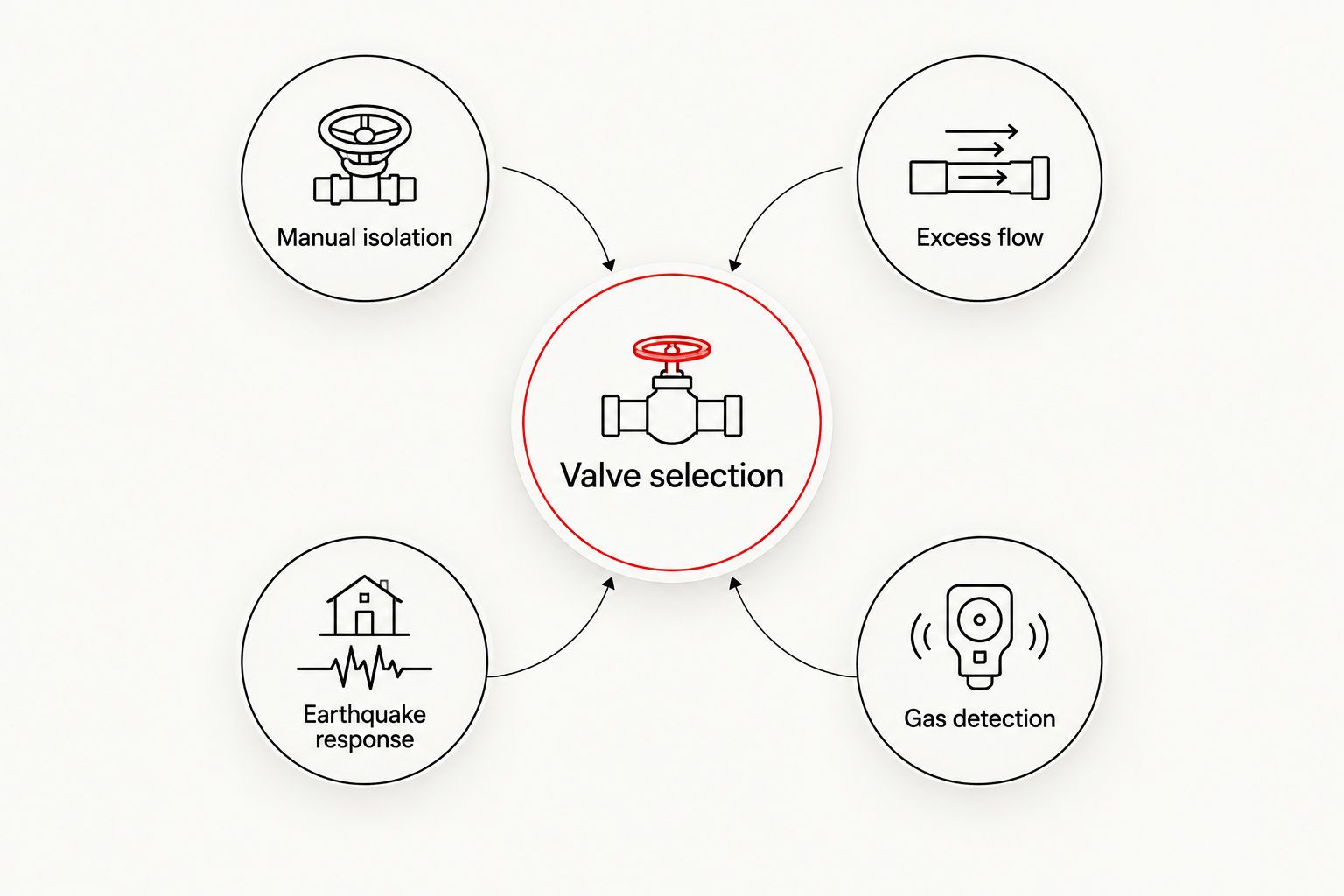
Before choosing equipment in 2026, write down the event you want the valve to address. Use the following distinctions during the installation discussion:
- Manual isolation: You need intentional control of an appliance’s gas supply.
- Excess flow: You want protection against qualifying downstream high-flow events.
- Earthquake response: You want closure triggered by qualifying shaking.
- Gas detection: You want a compatible detector to initiate closure.
A qualified professional should connect that objective to an approved installation. More automation does not automatically mean a better match.
Ask for the proposed valve’s documentation before work begins. The scope should identify the isolation location, intended function, compatibility, required testing, and responsibility for restoring service. Keep the operating instructions somewhere accessible without approaching a suspected leak.
For homes with a gas water heater, distinguish the gas supply valve from water-side valves and controls. They perform different jobs. A water leak detector or automatic water shut-off does not provide gas-leak protection.
How these valve types were ranked
Priority Rooter & Plumbing’s gas shut-off valve guide favors a gas-rated manual ball valve for routine appliance isolation. The remaining categories earn separate recommendations because their triggers solve different problems—not because automatic equipment is inherently better.
The ranking follows gas approval, installation fit, shut-off purpose, accessible operation, and restoration procedure. It is a function-based buying guide, not a hands-on product test or a statement that every Tucson property needs every category.
For a 2026 decision, verified application requirements outrank feature lists. Reject any recommendation that cannot explain both what triggers closure and what the valve does not detect.
Which gas shut-off valve should you choose?
Choose a gas-rated manual ball valve as the default category for routine appliance isolation. Have a qualified gas professional determine the actual specification and installation. Add automatic protection only when its trigger matches a defined need.
Choose an excess-flow valve for an approved excess-flow application, a seismic valve for earthquake-triggered isolation, or a detector-linked valve for a compatible gas-detection system. None is a universal substitute for the others.
Priority Rooter & Plumbing provides Tucson residential and commercial plumbing services, including water heater repair. When requesting help involving gas equipment, confirm the scope and qualifications for the specific gas work before authorizing it.
FAQ
What's the best gas shut-off valve for a Tucson home?
A gas-rated manual ball valve is the default category for routine appliance isolation. The exact valve must match the fuel, piping, operating conditions, and applicable installation requirements.
Is an automatic gas shut-off valve better than a manual valve?
An automatic gas shut-off valve adds a specific response function; it is not a universal replacement for manual isolation. Choose the trigger—excess flow, shaking, or gas detection—to match the intended protection.
Will an excess-flow valve stop every gas leak?
No. An excess-flow valve responds when flow meets its operating conditions, so a leak below its threshold does not necessarily cause closure.
Does a seismic shut-off valve detect gas leaks?
No. A seismic shut-off valve responds to qualifying shaking, not gas concentration. Gas-detection-triggered closure requires a compatible detection and valve system.
Can I install a gas shut-off valve myself?
Have a qualified gas professional handle gas valve selection and installation. Gas piping work requires application-specific knowledge, appropriate testing, and compliance with applicable requirements.
What should I do if I smell gas near a valve?
Leave immediately and contact the gas utility’s emergency service or call 911 from a safe location. Do not operate switches, use a phone inside, investigate the leak, or attempt a repair.
Can I reopen an automatic gas valve after it trips?
Do not reopen it simply because the reset control is accessible. Have the cause of closure addressed and follow the manufacturer’s instructions and applicable utility or professional restoration procedures.
One last thing
A closed valve identifies an interruption—not proof that the underlying problem is fixed. Before buying automatic equipment, ask who will investigate a trip and restore service safely. That answer is as important as the trigger mechanism, especially when occupants are unfamiliar with the system.
Keep emergency instructions separate from operating instructions. During a suspected gas leak, leaving safely takes priority over finding a handle, checking an app, or reading a valve label.