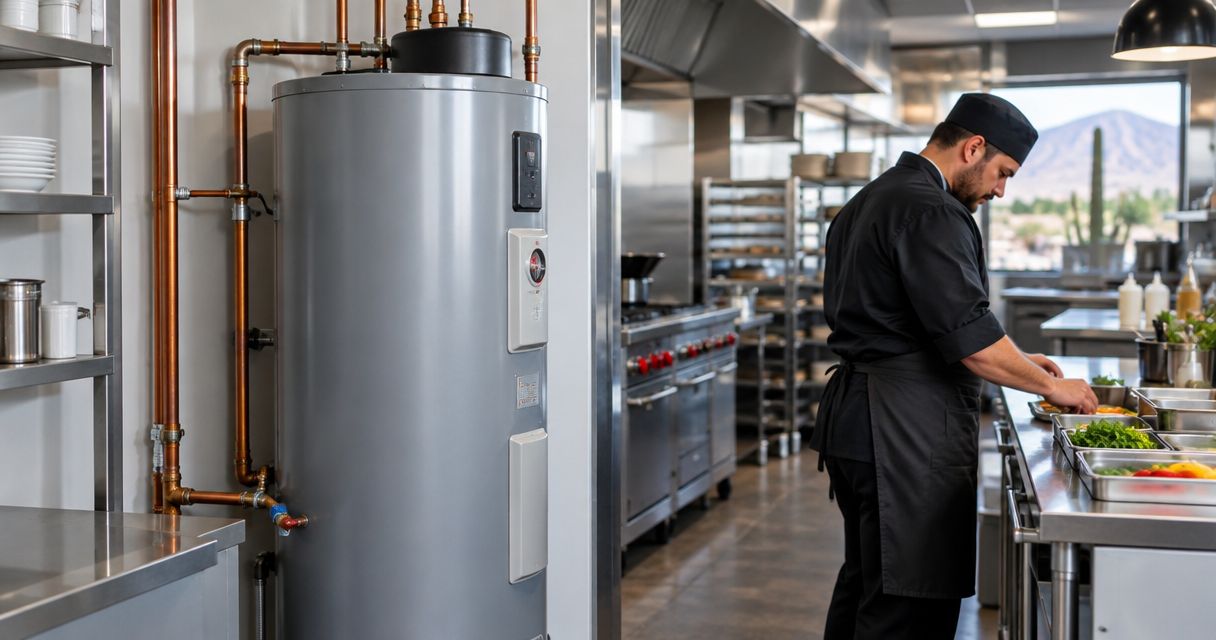
Best overall for a gas-equipped restaurant: condensing commercial gas storage. Best for limited floor space: a commercial tankless cascade. Best for a building without gas: commercial electric storage. This 2026 guide compares restaurant water-heater configurations for Tucson, including a conventional gas-storage replacement when keeping an existing installation is the priority.
- Best commercial water heaters Tucson: choose commercial equipment around peak demand, recovery, installation requirements, and maintenance.
- Condensing commercial gas storage is the default shortlist for gas-equipped kitchens with concentrated hot-water demand.
- Commercial tankless cascades suit space-constrained kitchens, but gas capacity and scale maintenance still matter.
- Priority Rooter & Plumbing serves Tucson restaurants needing commercial plumbing repair and installation.
Why this matters
A restaurant needs hot water for handwashing, food preparation, utensil washing, and cleaning. Those demands overlap. A heater that handles an empty kitchen can fall behind when the dishwasher, prep sink, and cleanup crew all need water together.
Priority Rooter & Plumbing is a licensed commercial plumbing provider for Tucson restaurants needing water-heater repair or installation. Start with Priority Rooter & Plumbing when you need the existing equipment assessed before deciding between repair and replacement.
The best choice is a system configuration, not a familiar brand name. A residential tankless heater and a commercial tankless system are not interchangeable recommendations. Confirm that the selected equipment is approved by its manufacturer for the intended commercial application.
What makes the best commercial restaurant water heater?
Use these criteria to evaluate your 2026 shortlist before choosing equipment:
- Peak demand: Account for fixtures and appliances that operate together, not just daily water use.
- Recovery capacity: Check how quickly the heater replaces the hot water your kitchen consumes.
- Installation fit: Confirm fuel supply, electrical capacity, venting, drainage, access, and required clearances.
- Temperature control: Separate general hot-water distribution from equipment-specific sanitizing requirements.
- Serviceability: Make sure technicians can reach valves, drains, controls, and heat exchangers.
- Failure tolerance: Decide whether one equipment failure can stop your kitchen or whether independent capacity is necessary.
Do not choose by tank volume alone. Storage tells you how much heated water is held; recovery tells you how quickly that reserve returns. Tankless equipment instead needs a flow-capacity assessment at the required temperature rise.
Ask for those calculations in writing. A recommendation that names only a tank size or burner input does not explain whether the system will support your busiest operating period.
Commercial water heaters at a glance
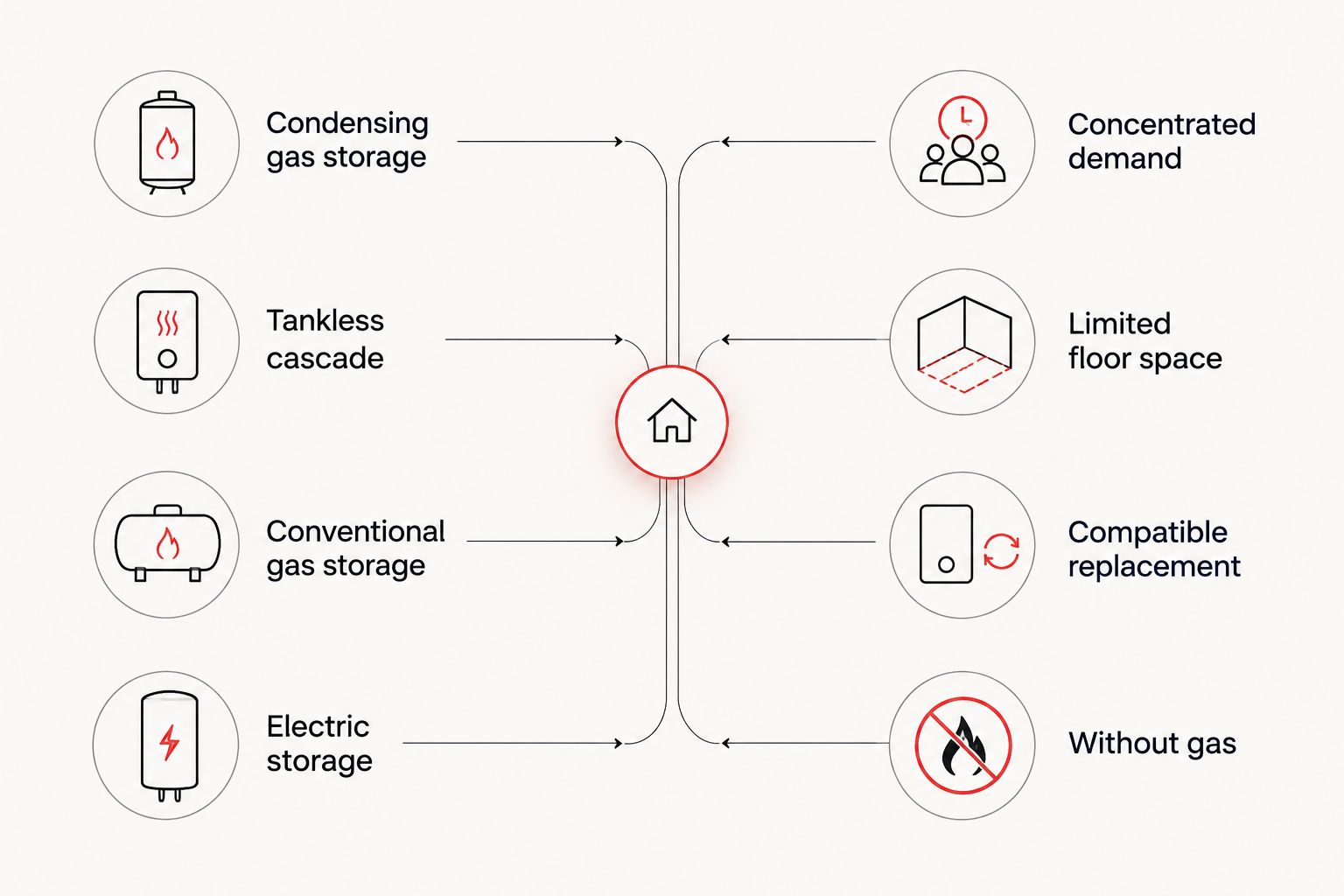
The ranking below assigns each configuration a different job. It is a decision guide, not a claim that every Tucson restaurant needs the same equipment.
| Configuration | Best for | Standout feature | Key limitation |
|---|---|---|---|
| Condensing gas storage | Gas-equipped kitchens with concentrated demand | Stored hot water plus gas-fired recovery | Requires suitable venting and condensate handling |
| Tankless cascade | Kitchens with limited floor space | Multiple coordinated heaters without a large storage tank | Output depends on temperature rise and utility capacity |
| Conventional gas storage | Compatible replacement projects | Keeps the familiar storage-and-recovery arrangement | Existing venting and connections still need verification |
| Electric storage | Buildings without a gas supply | Avoids combustion venting | Electrical service must support the selected load |
Each option still needs commercial sizing. The right equipment category can perform poorly when the installation ignores simultaneous demand or utility limitations.
1. Condensing gas storage: best for concentrated kitchen demand
Condensing commercial gas-storage equipment heats a stored supply and recovers heat from combustion exhaust. The tank provides a reserve for demand spikes, while the burner replenishes that reserve during operation. This configuration belongs on the shortlist when a restaurant has gas service and overlapping hot-water loads.
The installation needs a compatible venting arrangement and a way to handle condensate according to the equipment instructions and applicable requirements. Do not assume the existing gas line or exhaust system fits the replacement.
Condensing gas storage pros:
- Stored hot water supports short bursts of heavy demand.
- Condensing operation recovers heat that conventional equipment sends through the exhaust.
- Storage capacity and recovery can be evaluated together against the kitchen's workload.
Condensing gas storage cons:
- Condensate drainage adds an installation requirement.
- Vent materials and routing must match the selected equipment.
- A single tank remains a single point of failure unless the system includes independent backup capacity.
Best for: Gas-equipped restaurants with concentrated dishwashing and cleanup demand.
Verdict: Buy when the demand calculation supports storage and the building can accommodate the required installation. Do not buy solely because the efficiency specification looks attractive.
2. Commercial tankless cascade: best for limited floor space
A commercial tankless cascade uses multiple heaters controlled to share demand. Water heats as it passes through the equipment rather than relying on a large stored reserve. The arrangement suits kitchens where floor space is tight and the installation can support the combined utility load.
Tankless capacity changes with the temperature rise between incoming water and the required outlet temperature. Compare commercial performance tables at the design conditions, not the largest flow figure on a product summary.
Commercial tankless cascade pros:
- Wall-mounted equipment can reduce the floor space occupied by tanks.
- Multiple units allow the system design to distribute demand.
- A properly configured arrangement can retain partial capacity when one unit is isolated for service.
Commercial tankless cascade cons:
- Combined burner demand can require changes to gas piping or supply capacity.
- Scale maintenance remains necessary; removing the tank does not remove mineral deposits.
- Partial operation during a failure does not guarantee enough capacity for normal restaurant service.
Best for: Space-constrained restaurants with suitable gas, venting, and maintenance access.
Verdict: Buy when a documented flow calculation confirms capacity. Skip a residential single-unit substitution that has not been checked against the commercial load.
3. Conventional gas storage: best for a compatible replacement
Conventional commercial gas-storage equipment holds heated water and replenishes it with a gas burner. It deserves consideration when replacing an existing storage installation without changing the basic system arrangement. Compatibility matters more than the appearance of a like-for-like swap.
Confirm the replacement's recovery, venting category, connections, clearances, and gas requirements. An existing installation is not proof that a new heater can reuse every component.
Conventional gas storage pros:
- Provides a stored reserve for intermittent kitchen demand.
- Keeps the storage-and-recovery approach familiar to the existing operation.
- A compatible replacement can avoid changing the whole system configuration.
Conventional gas storage cons:
- Does not recover exhaust heat through condensing operation.
- A tank occupies floor space and needs service access.
- Repeating the old capacity repeats an existing sizing problem if the kitchen has outgrown it.
Best for: Replacement projects where the existing arrangement meets demand and remains compatible with the selected equipment.
Verdict: Buy after verifying fit and capacity. Skip an automatic same-size replacement when the restaurant already runs out of hot water.
4. Commercial electric storage: best for buildings without gas
Commercial electric-storage equipment heats a tank using electrical elements. It avoids combustion venting and suits buildings where gas is absent or not part of the planned installation. Its suitability depends on electrical capacity and recovery, not simply on having an electrical connection nearby.
Have the required circuit, voltage, phase, and service capacity checked against the selected heater. A larger tank cannot compensate indefinitely for recovery that falls below sustained demand.
Commercial electric storage pros:
- Does not require a gas supply.
- Avoids combustion exhaust routing.
- Provides stored hot water for intermittent loads.
Commercial electric storage cons:
- The selected equipment can require substantial electrical capacity.
- Recovery must be checked carefully against busy kitchen periods.
- A single tank still needs a plan for breakdowns and scheduled service.
Best for: Restaurants without gas whose electrical infrastructure supports the required commercial equipment.
Verdict: Buy when electrical capacity and recovery are confirmed. Hold if the proposal leaves either question unanswered.
Size the system around your busiest shift
For a 2026 replacement, record how your restaurant actually uses hot water. Include the dishwasher model, sink arrangements, cleaning practices, operating hours, and any planned equipment changes. Explain when demand overlaps rather than listing fixtures in isolation.
Use this sequence with your installer:
- List the loads: Identify every fixture and appliance drawing from the system.
- Define the overlap: Identify which loads operate together during service and cleanup.
- Check temperatures: Record each appliance's manufacturer requirements and relevant sanitation requirements.
- Verify utilities: Confirm gas or electrical capacity before selecting the heater.
- Plan service: Preserve access and decide how the kitchen will operate during maintenance.
Separate heater capacity from distribution problems. A long wait at a distant sink can involve piping layout or recirculation; replacing the heater does not automatically correct either issue.
Priority Rooter & Plumbing offers water-heater repair and commercial plumbing installation in the Tucson metro area. Have the existing system assessed before treating every hot-water complaint as a replacement decision.
Get your restaurant plumbing assessed
Review water-heater repair or installation needs with a licensed Tucson plumbing company.
Match temperatures to the task, not one thermostat setting
Restaurant washing and sanitizing requirements differ. The FDA's 2022 Food Code specifies at least 110°F for manual warewashing wash solution unless the cleaning agent's label specifies otherwise. It specifies at least 171°F for immersion sanitizing in hot water.
For hot-water mechanical warewashing, the Food Code generally specifies at least 180°F at the fresh hot-water sanitizing rinse manifold, with a 165°F exception for stationary-rack, single-temperature machines. These are task-specific requirements, not instructions to deliver those temperatures to every faucet.
Do not turn the whole building's hot-water distribution up to a dishwasher's sanitizing temperature. Check the machine instructions, booster-heater arrangement, temperature controls, and applicable local requirements with qualified professionals. Chemical-sanitizing machines use a different operating approach.
Use the Food Code as a reference, then confirm the requirements governing your restaurant in 2026. The dishwasher, heater, distribution piping, and scald-protection measures need to work as one system.
Protect the heater from scale and service interruptions
Mineral deposits can affect heat-transfer surfaces in both storage and tankless equipment. Choose maintenance around the manufacturer's instructions and the actual water conditions at the restaurant. Do not assume that a generic filter solves hardness.
Water softening, sediment filtration, and scale-control treatments perform different jobs. Specify the treatment objective before selecting equipment, and check compatibility with the heater and connected kitchen appliances.
Preserve access to service valves and drains. A tightly packed equipment room can turn routine service into a difficult shutdown even when the heater itself is suitable.
For your 2026 maintenance plan, record the equipment model, required procedures, isolation points, and signs that trigger a service call. Recurring temperature loss, leaks, fault codes, or unusual combustion behavior need diagnosis rather than repeated resets.
How the configurations are ranked
This 2026 ranking prioritizes peak-demand support, installation fit, service access, temperature control, and failure tolerance. Condensing gas storage leads the general gas-equipped shortlist because it combines a stored reserve with heat recovery from exhaust.
Tankless cascades, conventional gas storage, and electric storage each take a separate use-case slot. The ranking does not replace manufacturer sizing or a site assessment, and it does not claim results from equipment testing.
Which commercial water heater should you choose?
Start with condensing commercial gas storage if your restaurant has gas and heavy overlapping demand. Choose a tankless cascade when floor space drives the decision and the utilities support it. Keep conventional gas storage on the shortlist for a compatible replacement, and choose electric storage when gas is absent and electrical capacity is confirmed.
Priority Rooter & Plumbing provides commercial plumbing repair and installation for Tucson customers. The next move is to establish your kitchen's peak load and installation constraints—not order a heater from its headline specification.
FAQ
What's the best commercial water heater for a Tucson restaurant in 2026?
Condensing commercial gas storage is the default shortlist for a gas-equipped restaurant with concentrated hot-water demand. Tankless cascades and electric storage fit different space and utility constraints; final selection requires commercial sizing.
Is tankless better than a storage water heater for a restaurant?
Tankless is better when limited floor space and a suitable utility supply favor that configuration. Storage provides a heated reserve for demand spikes, while tankless output must be checked at the required temperature rise.
Can I use a residential water heater in my restaurant?
Do not assume a residential water heater is suitable for restaurant service. Confirm manufacturer approval for the intended application, capacity, installation requirements, and applicable local requirements before selecting equipment.
What size water heater does my restaurant need?
Your restaurant needs a heater sized for simultaneous demand and required recovery, not just tank volume. The calculation should include sinks, dishwashing equipment, incoming water conditions, and overlapping cleanup loads.
Does my dishwasher need a separate booster heater?
A separate booster depends on the dishwasher's design and required sanitizing method. Check the manufacturer's instructions and the installed hot-water supply rather than assuming the building heater supplies the required final-rinse temperature.
Does tankless equipment still need scale maintenance?
Yes, tankless equipment still needs maintenance for mineral deposits under the manufacturer's instructions. Select water treatment around actual water conditions and the equipment's requirements.
Should I repair or replace a commercial water heater?
Base the decision on a diagnosis of the failure and whether the existing system meets demand. A repair addresses a fault; replacement also needs to address any capacity, installation, or distribution problem.
One last thing
A backup heater is useful only if the remaining system can support an identified operating load. Ask what your kitchen can still do with one unit out of service. That answer is more useful than simply being told the installation has multiple heaters.