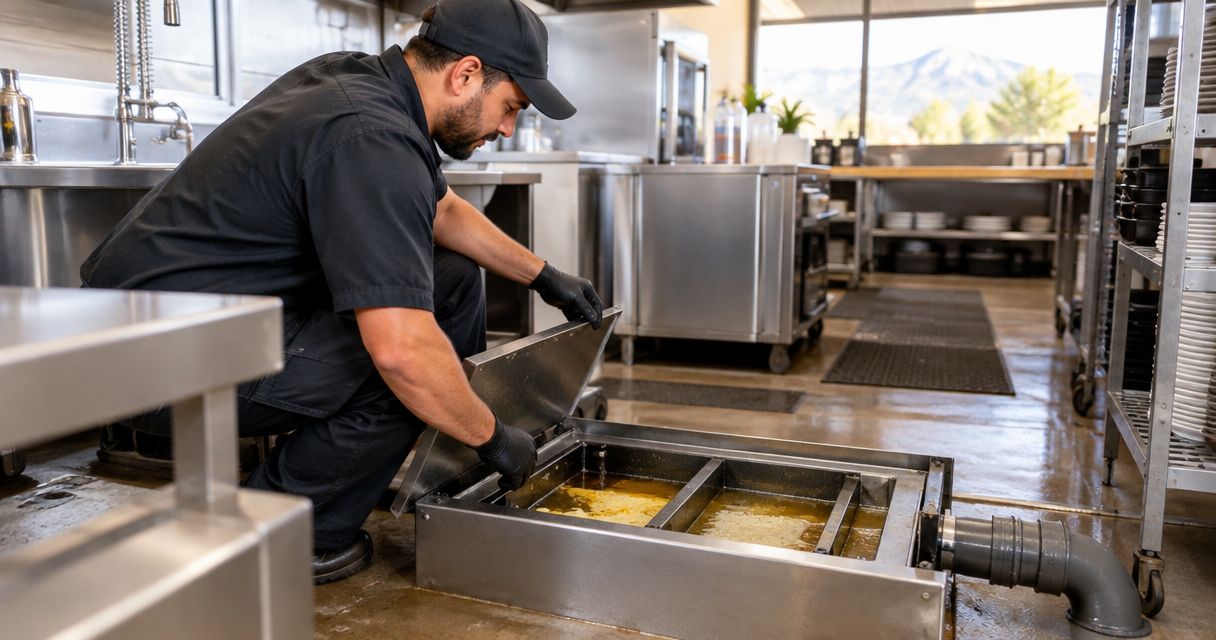
Best overall for a high-volume kitchen: a gravity grease interceptor. Best for a compact retrofit: a hydromechanical grease interceptor. Best for routine grease separation with mechanical removal: an automatic grease removal device. This 2026 guide compares grease trap systems for Tucson restaurants by kitchen load, installation space, maintenance access, and approval requirements.
- Best grease trap systems Tucson: choose gravity interceptors for high-volume kitchens with suitable installation space.
- Hydromechanical grease interceptors suit compact retrofits when rated capacity matches the connected fixtures.
- Automatic grease removal devices add mechanical removal but still need cleaning, inspection, and solids management.
- Priorityrooter provides commercial plumbing services in Tucson; confirm the proposed grease system's approval before buying.
Why this matters
A grease interceptor separates fats, oils, and grease from kitchen wastewater before that wastewater continues into the drainage system. It does not replace scraping food waste into the trash, cleaning connected fixtures, or maintaining the drain line.
The wrong choice creates a maintenance problem even when the equipment fits physically. A unit that cannot handle the connected discharge, or cannot be opened and serviced properly, is not a good restaurant installation.
Priorityrooter is a licensed Tucson plumbing company for restaurant operators who need commercial plumbing repair and installation support. You can start with Priorityrooter when a slow drain, backup, or plumbing change needs professional attention. Select grease-control equipment around the kitchen's actual fixtures and the applicable approval requirements—not around a product's footprint alone.
What makes the best grease trap system?
Use these criteria before comparing equipment. They determine whether a system belongs in your kitchen at all.
- Discharge capacity: Match the system to the connected fixtures and their wastewater discharge. Seat count alone does not describe the plumbing load.
- Grease and solids handling: Consider both floating grease and settled food debris. Separating grease does not eliminate solids maintenance.
- Installation fit: Check available space, pipe connections, access, and the work needed to install the system. A compact tank still needs service clearance.
- Maintenance access: Staff or service contractors must reach the covers, internal components, and waste collection points safely.
- Approval documentation: Confirm that the specific model, sizing method, and installation arrangement meet the requirements applicable to your Tucson property.
- Operating responsibility: Assign cleaning, inspection, recordkeeping, and service scheduling before the system enters use.
For a 2026 restaurant project, treat approval and maintenance access as selection gates. If either fails, remove that option from the shortlist rather than trying to solve the problem after installation.
Grease trap systems at a glance
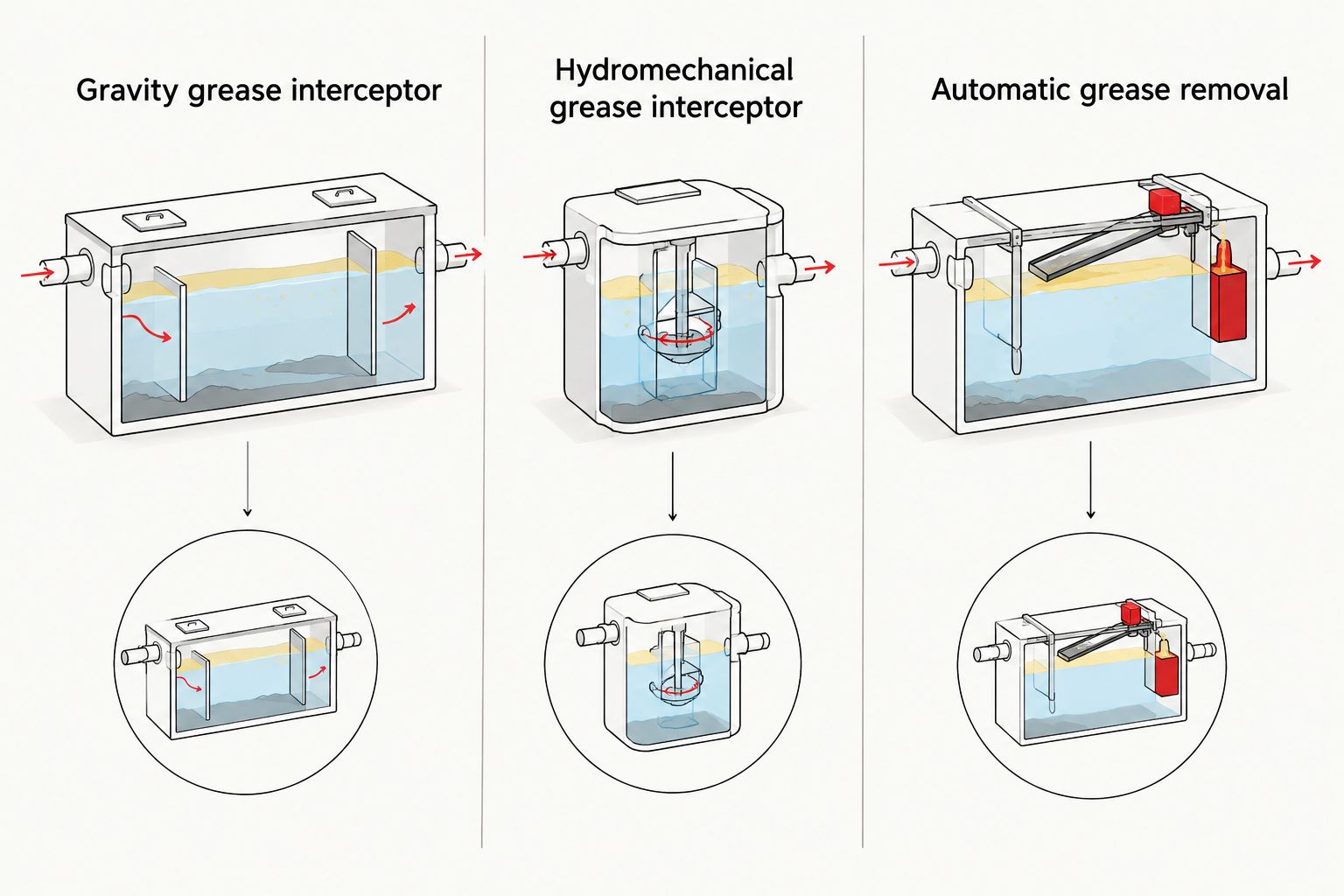
These are system types, not interchangeable product models. Automatic grease removal equipment can use hydromechanical separation, so the categories overlap; its distinct feature is the removal mechanism.
| System type | Best for | Standout feature | Key limitation |
|---|---|---|---|
| Gravity grease interceptor | High-volume kitchens with suitable site space | Larger-volume separation using retention and gravity | Site work and pumping access shape the installation |
| Hydromechanical grease interceptor | Compact retrofits with a defined fixture load | Separation in a comparatively compact assembly | Rated flow and grease capacity must match the application |
| Automatic grease removal device | Kitchens prepared to maintain powered grease removal | Mechanical transfer of separated grease to a collection container | Moving components and collected waste still need attention |
A large gravity interceptor is not automatically the best answer for every restaurant. Likewise, automatic removal does not make a small unit suitable for an oversized plumbing load. Choose the type first, then evaluate the exact equipment and installation.
1. Gravity grease interceptor: best for high-volume kitchens
A gravity grease interceptor uses a tank and separation compartments to let grease rise and solids settle as wastewater passes through. Restaurant installations commonly place larger interceptors outside or below ground, where site layout and service access become central to the decision.
This is the default shortlist choice for a high-volume kitchen with suitable installation space. It is not a recommendation to choose the largest tank available: the design still needs to match the kitchen and the applicable sizing requirements.
Gravity grease interceptor pros:
- Suits installations that need larger-volume grease separation.
- Separates floating grease and settled solids within the tank.
- Uses gravity separation without depending on a mechanical grease skimmer.
- Keeps a larger grease-control assembly out of the immediate sink workspace when installed outside.
Gravity grease interceptor cons:
- Excavation, pipe routing, and site access can complicate installation.
- Pumping and cleaning require suitable access to the interceptor.
- A buried installation can be difficult to change when the kitchen expands.
Best for: A restaurant with substantial kitchen discharge and a site that can accommodate the approved interceptor and its servicing needs.
Check the site before selecting the tank
Locate the proposed access covers, drainage connections, and service approach on the plan. Do not leave pumping access as a problem for the maintenance contractor to discover later.
Also check how a future fixture change would affect the design. Adding a sink or changing kitchen operations does not automatically fit within the existing interceptor's capacity.
Verdict: Hold until sizing, site access, and approval are confirmed; then choose gravity separation for the high-volume use case.
2. Hydromechanical grease interceptor: best for compact retrofits
A hydromechanical grease interceptor separates grease within a compact assembly designed for specified operating conditions. Equipment ratings, flow-control requirements, and installation instructions matter more than whether the enclosure fits under a sink.
This type belongs on your shortlist when you have limited installation space and a clearly defined fixture load. Some installations place the unit near the fixtures it serves, but location must follow the approved design and manufacturer instructions.
Hydromechanical grease interceptor pros:
- Offers a compact option where a larger tank is difficult to accommodate.
- Provides model-specific flow and grease-capacity information for selection.
- Can make covers and internal components accessible near the kitchen work area.
- Supports targeted evaluation of a defined group of connected fixtures.
Hydromechanical grease interceptor cons:
- A compact enclosure still needs clearance for opening and cleaning.
- Exceeding the equipment's rated conditions undermines the design.
- Cleaning inside the kitchen needs a practical plan for waste handling and work-area protection.
Best for: A compact kitchen retrofit where the connected discharge fits an approved hydromechanical unit.
Size the discharge, not the cabinet
For a 2026 retrofit, first document the fixtures and how they discharge. Then check the proposed unit's rating, connection arrangement, and any required flow-control components.
Dishwasher connections deserve specific review. Do not assume a dishwasher belongs on the same interceptor arrangement as a sink; confirm the permitted connection and the equipment's temperature and discharge limitations.
Verdict: Buy only after the exact model is approved for the fixture load; skip a compact unit selected solely because it fits.
3. Automatic grease removal device: best for mechanical removal
An automatic grease removal device separates grease and uses a mechanism to move collected grease into a container. Depending on the design, powered components support the removal process, while screens or other provisions manage food solids.
The useful distinction is removal—not freedom from maintenance. Your staff still need to handle the collected grease, clean the designated components, and recognize equipment faults.
Automatic grease removal device pros:
- Mechanically transfers separated grease to a collection point.
- Makes collected grease available for routine removal outside the separation chamber.
- Provides a defined equipment routine around grease collection and component checks.
- Suits kitchens prepared to assign responsibility for powered equipment.
Automatic grease removal device cons:
- Moving parts introduce additional inspection and repair needs.
- Grease containers and solids screens still require attention.
- Electrical and service-access requirements affect where the device can be installed.
Best for: A restaurant that wants mechanical grease removal and has staff responsible for the equipment's prescribed daily operation and maintenance.
Read the maintenance instructions before purchasing
Ask who empties the collection container, who cleans solids-handling components, and who responds when the removal mechanism stops working. Those tasks remain part of kitchen operations even when the device runs automatically.
Review the manufacturer's instructions for cleaning, service access, electrical connections, and fault response. A device that your staff cannot maintain reliably is the wrong operational fit.
Verdict: Buy when mechanical removal fits an approved design and a staffed maintenance routine; skip it as a maintenance-free substitute.
Before installation: check the plumbing and the paperwork
Your existing grease trap is only one part of the drainage system. A slow sink can reflect a local blockage, a downstream problem, or a grease-control maintenance issue. Replacing equipment without identifying the restriction does not establish that the drain problem is solved.
Priorityrooter offers commercial plumbing repair, drain cleaning, and sewer camera inspections in the Tucson metro area. Those services address plumbing conditions; equipment selection still needs its own sizing and approval review.
Use 2 checks before authorizing a replacement:
- Drain condition: Identify where wastewater is backing up and whether the connected piping needs attention.
- Design approval: Confirm the proposed equipment, fixture connections, and installation details with the applicable reviewing authority.
Keep 3 records together: the approved installation documents, the manufacturer's maintenance instructions, and the cleaning or service log. A folder that staff can find is more useful than paperwork scattered between a contractor, a manager, and an office drawer.
Ask these 4 questions about every 2026 proposal:
- Which fixtures does the system serve?
- What sizing method supports the selected equipment?
- How will someone open, clean, and service it?
- Who is responsible for routine maintenance and fault response?
Do not accept a proposal that answers only the first question. The other answers determine whether the installation can stay workable after opening day.
Maintenance matters more than an “automatic” label
Start with the manufacturer's instructions and the requirements applicable to your installation. Set the cleaning and inspection routine around those instructions and the grease and solids actually accumulating in the system.
Do not invent a universal cleaning interval for every Tucson restaurant. Menus, fixture loads, equipment designs, and operating patterns differ. Record service observations so the maintenance schedule responds to the installation rather than to guesswork.
Staff practices also affect what reaches the interceptor:
- Scrape food debris into the appropriate waste container before washing.
- Collect used cooking oil separately rather than pouring it into drains.
- Keep designated solids screens clean according to equipment instructions.
- Report slow drainage, unusual odors, leaks, and equipment faults promptly.
Chemical additives are not a substitute for removing accumulated grease and solids. Do not add a treatment unless it is permitted for the installation and consistent with the equipment instructions.
How the systems are ranked
This 2026 ranking assigns a distinct operating need to each system type. Gravity interceptors take the high-volume slot, hydromechanical interceptors take the compact-retrofit slot, and automatic removal devices take the mechanical-removal slot.
The ranking follows discharge capacity, installation fit, maintenance access, approval documentation, and operating responsibility. It does not treat one manufacturer's model as equivalent to every other model in the same category.
Which grease trap system should you choose?
Choose a gravity grease interceptor as the starting point for a high-volume restaurant with suitable site space. For a compact retrofit, evaluate an approved hydromechanical interceptor against the actual fixture load. Choose automatic removal only when its operating routine fits your staff and installation.
If your immediate problem is a backup, address the plumbing diagnosis first. Priorityrooter provides Tucson commercial plumbing services, including drain cleaning and sewer camera inspections, without turning a drainage symptom into an automatic equipment-replacement decision.
For your 2026 project, the final choice should be the approved system you can service—not simply the smallest enclosure or the equipment with the most automation.
FAQ
What's the best grease trap system for a Tucson restaurant?
A gravity grease interceptor is the starting choice for a high-volume restaurant with suitable site space. A compact hydromechanical interceptor or automatic grease removal device fits a different operating need; the exact equipment must match the fixture load and approval requirements.
Is a hydromechanical grease interceptor better than a gravity interceptor?
A hydromechanical grease interceptor is better suited to a compact installation when its rated capacity matches the connected discharge. A gravity interceptor is the starting choice for a larger-volume installation with room for the tank and servicing access.
Does an automatic grease removal device eliminate cleaning?
No, an automatic grease removal device still needs cleaning and maintenance. Staff must manage collected grease, solids-handling components, and the removal mechanism according to the manufacturer's instructions.
Can I size a restaurant grease trap by the number of seats?
Seat count alone is not enough to select a restaurant grease trap. Document the connected fixtures and discharge conditions, then apply the sizing method required for the installation.
Can my dishwasher connect to the grease interceptor?
Connect a dishwasher only when the approved design and equipment instructions permit it. Review discharge conditions, temperature limitations, and connection requirements before installation.
How often should a Tucson restaurant clean its grease interceptor?
Use the equipment instructions and applicable requirements to establish the cleaning schedule. Track grease and solids accumulation and service observations rather than applying the same interval to every restaurant.
Should I replace my grease trap when the kitchen drain backs up?
Diagnose the drainage problem before replacing the grease trap. A backup can involve the interceptor, connected piping, or a downstream restriction, so replacement alone does not establish the cause.
One last thing
Check whether the interceptor cover can be fully opened after the kitchen equipment is in place. A unit can fit on an installation drawing yet become difficult to clean once shelving, appliances, or stored supplies surround it. Service clearance belongs in the purchase decision, not on a future maintenance checklist.