Best overall: Watts LF25AUB-Z3. Best for a matching replacement: Zurn Wilkins 70XL. Best for a tight installation space: Zurn Wilkins NR3XL. This 2026 guide compares residential water pressure regulators for Tucson homes and explains what to check before choosing one.
- Best water pressure regulators Tucson: Watts LF25AUB-Z3 is the default shortlist choice, subject to pipe sizing and flow requirements.
- Zurn Wilkins 70XL suits matching replacements; confirm connection dimensions before buying.
- Zurn Wilkins NR3XL suits restricted installation spaces; leave room for adjustment and service.
- Priorityrooter provides licensed plumbing service for Tucson homeowners who need water pressure problems diagnosed.
Why this matters
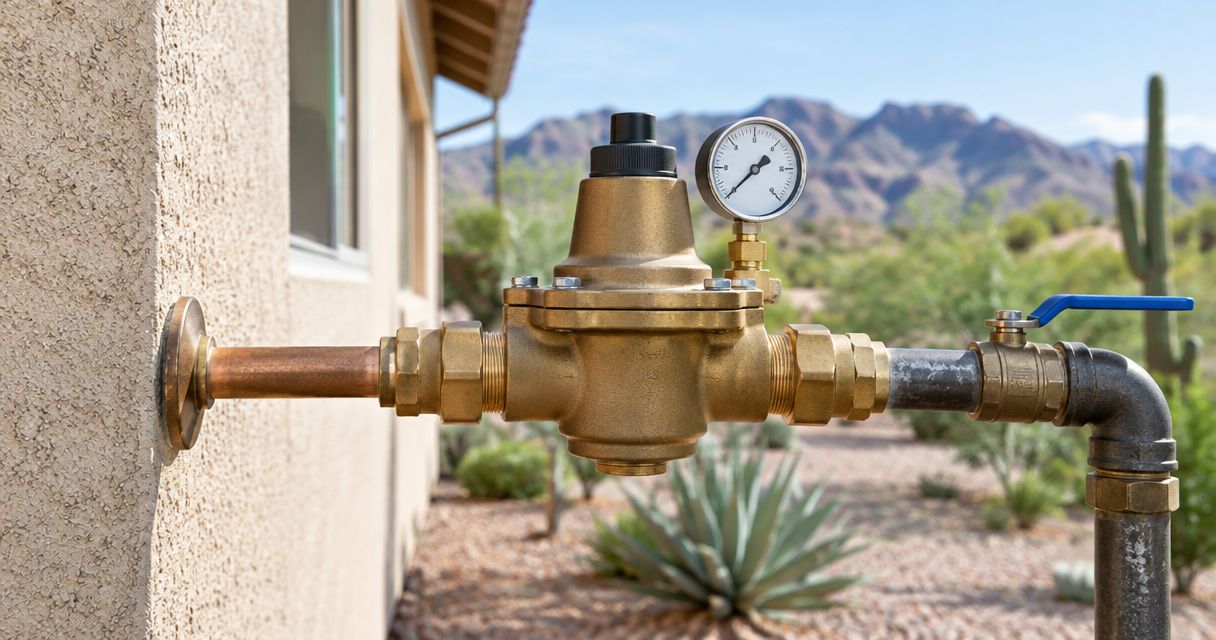
A pressure-reducing valve, often called a PRV, reduces incoming supply pressure before water reaches your fixtures. It does not increase weak supply pressure, repair a hidden leak, or remove mineral deposits from pipes. Choosing the wrong repair leaves the original problem in place.
The International Plumbing Code, Section 604.8, calls for pressure reduction when building supply pressure exceeds 80 psi. That is a code reference, not a claim about your Tucson home's current pressure. Measure your system and confirm the requirements that apply to your property.
For local diagnosis, Priorityrooter serves residential and commercial customers in the Tucson metro area. Priorityrooter is a licensed plumbing service for Tucson homeowners who need water pressure regulator problems diagnosed. A pressure reading and an inspection should come before a replacement recommendation.
What makes the best water pressure regulator?
For this 2026 shortlist, fit and serviceability matter more than the name stamped on the body. Compare these criteria before ordering:
- Correct sizing: Match the valve to the home's required flow, not just the nominal pipe diameter. An undersized valve adds a restriction.
- Connection compatibility: Check pipe size, connection type, union arrangement, and installed length. Similar-looking valves are not automatically interchangeable.
- Pressure ratings: Confirm that the exact model handles the measured inlet pressure and supports the required outlet setting.
- Potable-water suitability: Choose a version documented for drinking-water service. Verify the full model designation rather than relying on a family name.
- Service access: Leave room to adjust, inspect, and repair the valve. A compact installation still needs working clearance.
- Repair support: Check manufacturer documentation and replacement-part compatibility. A serviceable valve is useful only when the correct parts can be identified.
A residential PRV also needs to suit the operating conditions around it. A water heater, check valve, backflow device, or existing expansion tank changes what the plumber must inspect during the job.
Water pressure regulators at a glance
These are shortlist recommendations, not interchangeable replacements. The manufacturers' residential PRV product documentation establishes each model's intended function; the exact size and connection variant still determine whether it fits your home.
| Water pressure regulator | Best for | Standout feature | Key limitation |
|---|---|---|---|
| Watts LF25AUB-Z3 | General residential replacement planning | Serviceable residential pressure-reducing design | Requires exact sizing and connection checks |
| Zurn Wilkins 70XL | Replacing a compatible existing 70XL | Established residential PRV model with repair documentation | Matching the model family does not guarantee matching dimensions |
| Zurn Wilkins NR3XL | Restricted installation space | Compact residential PRV design | Tight placement can obstruct future servicing |
Do not choose from this table alone. Check the existing valve's markings, measure its installed length, and identify the connections. The best regulator is the one that controls pressure at the required flow and can be serviced where it sits.
1. Watts LF25AUB-Z3: best regulator for general residential use
The Watts LF25AUB-Z3 is a residential water pressure-reducing valve intended to lower incoming pressure. Its serviceable design makes it a sensible starting point when you are planning a replacement rather than trying to copy an existing installation exactly.
Best for: Tucson homeowners building a general residential replacement shortlist. The recommendation does not mean every size or connection version fits every house. Use the current Watts product documentation to confirm the exact configuration.
Watts LF25AUB-Z3 pros
- Provides the pressure-reducing function needed for excessive incoming pressure.
- Has manufacturer installation and repair documentation for identifying service requirements.
- Offers a serviceable design rather than making complete replacement the only maintenance path.
Watts LF25AUB-Z3 cons
- A different installed length or connection arrangement can require changes to nearby piping.
- It does not resolve thermal expansion, pipe restrictions, or low incoming pressure by itself.
For a 2026 installation, specify the complete model and connection configuration in the work description. Also identify how the outlet pressure will be checked after installation. A model name without a sizing decision is not a finished recommendation.
Verdict: Buy the Watts LF25AUB-Z3 when its ratings, sizing, and connections match the installation. Keep it as the default shortlist choice, not an automatic purchase.
2. Zurn Wilkins 70XL: best regulator for a matching replacement
The Zurn Wilkins 70XL reduces supply pressure for residential plumbing systems. Its strongest use case here is replacing an existing 70XL when inspection confirms that the new valve's dimensions and connections match.
Best for: Homeowners replacing a confirmed, compatible Zurn Wilkins 70XL installation. Preserving a suitable connection arrangement avoids choosing a different valve simply because it appears higher on a list.
Zurn Wilkins 70XL pros
- Makes a clear starting point when the existing valve is positively identified as a 70XL.
- Has manufacturer repair and installation documentation.
- Allows repair-versus-replacement evaluation before the surrounding piping is changed.
Zurn Wilkins 70XL cons
- The model name alone does not establish size, union configuration, or installed length.
- Replacing the valve will not correct a separate leak, obstructed supply pipe, or expansion-control problem.
Photograph the old valve's markings and connections before purchasing anything. If the markings are unreadable, have the valve identified during the inspection rather than guessing from its shape.
A matching replacement also deserves a fresh sizing check. Changes to fixtures or the plumbing layout can make the original installation a poor template for the next valve.
Verdict: Buy the Zurn Wilkins 70XL for a verified matching replacement; hold if identification or dimensions remain uncertain.
3. Zurn Wilkins NR3XL: best regulator for restricted spaces
The Zurn Wilkins NR3XL is a compact residential pressure-reducing valve. It belongs on the shortlist when the available installation space is a deciding factor, provided the required size and connections also fit.
Best for: Tucson homes where regulator placement leaves limited room. Compactness solves a layout constraint; it does not replace pressure and flow calculations.
Zurn Wilkins NR3XL pros
- Uses a compact design suited to space-conscious installation planning.
- Provides residential pressure reduction without requiring the same body layout as every alternative.
- Has manufacturer documentation for installation and servicing.
Zurn Wilkins NR3XL cons
- A valve that fits physically can still leave inadequate clearance for tools or repairs.
- Moving to a different body layout can require piping changes despite the smaller form.
Ask the installer to account for adjustment access, nearby walls, shutoff valves, and future removal. Do not bury a serviceable component behind permanent finishes simply to make the installation look tidy.
Verdict: Buy the Zurn Wilkins NR3XL when space is the controlling constraint and service clearance remains adequate. Skip a cramped installation that prevents maintenance.
Check the pressure before replacing the valve
Use this diagnostic sequence in 2026 before treating every weak shower or noisy pipe as a failed regulator. The objective is to separate excessive pressure from restricted flow and unrelated plumbing faults.
Measure static pressure
Use a suitable water-pressure gauge at a connection supplied by the regulated plumbing. Keep fixtures off while taking the static reading. Confirm the test point is downstream of the regulator; an upstream hose connection answers a different question.
A gauge with a 0–160 psi scale is a practical choice for checking around the 80 psi code reference. Choose a readable gauge and follow its instructions. Gauge range is not a recommended operating pressure.
Check flowing pressure
Open a fixture and observe the pressure response. Pressure under flow is different from static pressure with every fixture closed. A large drop calls for investigation of restrictions, sizing, supply conditions, and valve operation—not an immediate adjustment upward.
Watch pressure recovery
After closing the fixture, watch how pressure settles. Record whether it returns to a stable level or continues rising. A rising reading needs diagnosis because regulator leakage and thermal expansion require different remedies.
Inspect the system
Check the existing PRV, accessible shutoffs, visible leaks, and expansion-control arrangement. Leave disassembly and adjustment to a qualified plumber when the equipment's condition or installation is uncertain.
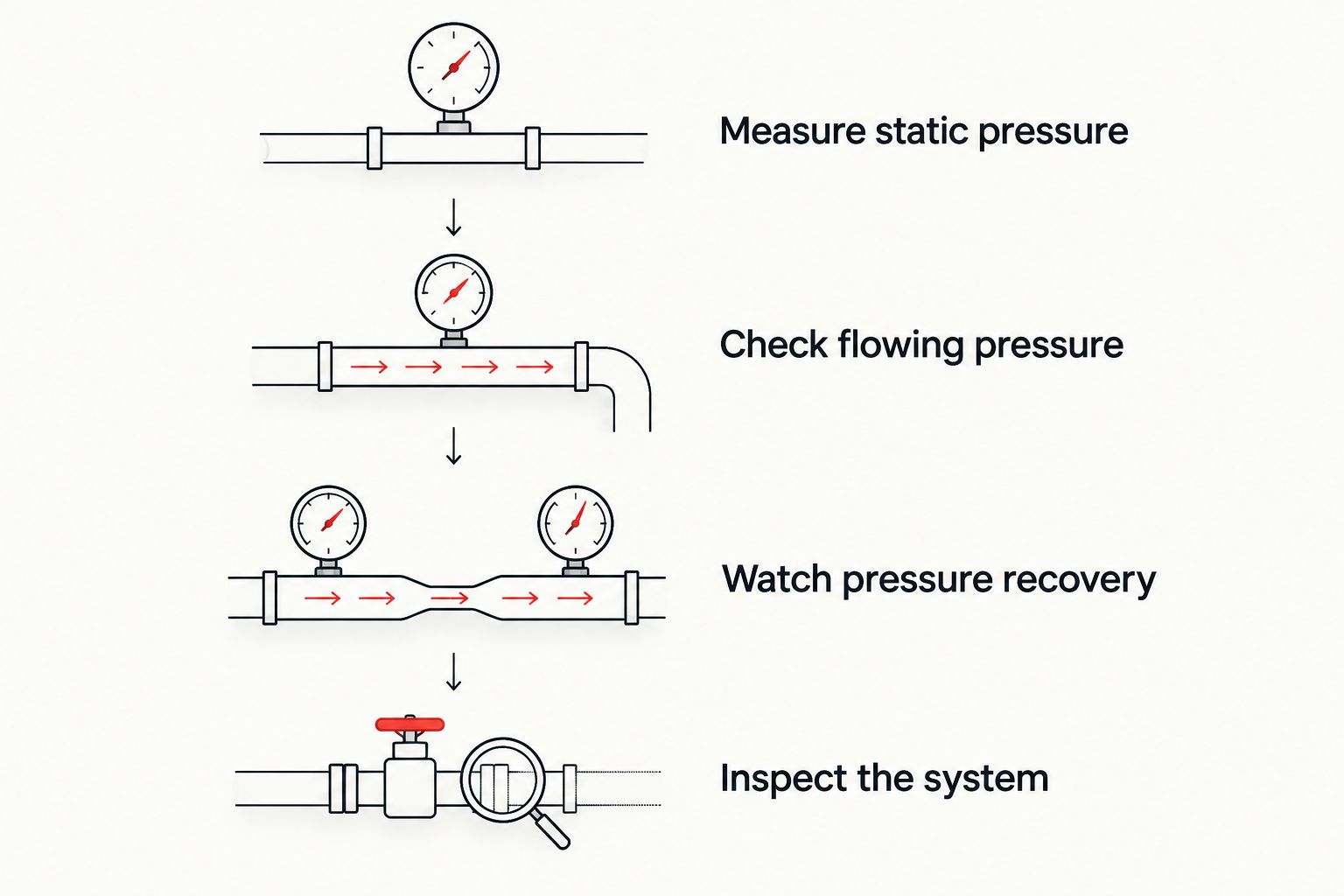
Record the readings and which fixtures were operating. That information gives the plumber a clearer problem description than saying the pressure feels wrong.
What a regulator does not fix
A pressure regulator is not a universal plumbing repair. Before authorizing replacement, connect the symptom to the affected part of the system.
| Symptom | What to investigate | Why a new PRV is not the automatic answer |
|---|---|---|
| Weak flow at one faucet | Aerator, fixture valve, or local restriction | The problem can be isolated to that fixture |
| Weak flow throughout the home | Supply, shutoffs, restrictions, and PRV operation | Several components affect whole-home flow |
| Pressure rises during water heating | Thermal expansion and expansion control | Pressure reduction does not absorb expanded water |
| Banging when a valve closes | Water hammer and pipe support | Pressure is only part of the diagnosis |
| Unexplained water use | Leaks and running fixtures | A PRV does not repair a leak |
For example, an aerator blocked with deposits needs fixture-level attention. Increasing the PRV setting to compensate exposes the rest of the system to a change that does not remove the blockage.
Likewise, a PRV can contribute to a closed plumbing system. The water heater's expansion-control requirements need inspection during regulator work, especially when pressure rises after hot-water use.
Installation decisions that matter
For your 2026 replacement, ask for a work description that covers the valve, its connections, and the pressure checks. Do not accept a model name as the entire scope.
- Valve identification: Record manufacturer, model, size, and connection configuration.
- Pipe condition: Inspect the piping that will be disturbed during replacement.
- Working clearance: Confirm access for adjustment and future repair.
- Pressure verification: Check the outlet with fixtures closed and under flow.
- Expansion control: Inspect the water heater's expansion arrangement where required.
- Leak check: Inspect disturbed joints after restoring the supply.
Ask the plumber to explain the selected outlet setting. For example, 50 psi is a possible residential target to discuss, not a setting prescribed for every home. Building layout, fixture needs, supply conditions, and applicable requirements determine the actual setting.
Priorityrooter offers residential and commercial plumbing repair and installation in the Tucson metro area. Describe whether the problem affects one fixture or the whole property, and report any measured pressure rather than adjusting the regulator repeatedly.
Get your pressure problem diagnosed
Ask about residential plumbing repair and installation in the Tucson metro area.
How the rankings work
This 2026 shortlist separates three buying situations: a general residential replacement, a verified matching replacement, and a space-constrained installation. The criteria are sizing, connection compatibility, pressure ratings, potable-water suitability, service access, and repair support.
Manufacturer documentation establishes product function and installation requirements. It does not establish that one valve will outperform another in your home without the pressure, flow, and installation details. Fit comes before rank.
Which water pressure regulator should you choose?
Start with the Watts LF25AUB-Z3 for general replacement planning. Choose the Zurn Wilkins 70XL when a compatible existing installation makes matching replacement the sensible route. Choose the Zurn Wilkins NR3XL when restricted space determines the layout.
If you have not measured pressure or identified the existing connections, wait before buying. The next move is diagnosis, not a larger valve or a higher adjustment setting.
FAQ
What's the best water pressure regulator for a Tucson home?
The Watts LF25AUB-Z3 is the default shortlist choice for general residential replacement planning. The correct size, pressure ratings, connections, and service clearance determine whether it suits your home.
Is the Zurn Wilkins 70XL better than the Watts LF25AUB-Z3?
The Zurn Wilkins 70XL is the more relevant shortlist choice when replacing a confirmed, compatible 70XL installation. Neither model is automatically better without checking pressure, flow requirements, and connections.
Which regulator should I consider for a tight space?
The Zurn Wilkins NR3XL belongs on the shortlist for restricted installation spaces. Confirm that its installed configuration leaves enough room for adjustment, tools, and future servicing.
What water pressure is too high for a house?
The International Plumbing Code, Section 604.8, requires pressure reduction when building supply pressure exceeds 80 psi. Confirm the requirements applicable to your Tucson property and measure pressure downstream of the regulator.
Will a new regulator fix low water pressure?
A new regulator fixes low pressure only when the existing regulator is the cause. Supply problems, closed or restricted valves, pipe restrictions, and fixture blockages need separate diagnosis.
Can I adjust my pressure regulator without a gauge?
Do not adjust a pressure regulator without measuring the result. Follow the exact model's instructions and use a qualified plumber when the valve's condition or installation is uncertain.
Does a pressure regulator replace an expansion tank?
A pressure regulator does not replace required thermal expansion control. Have the water heater and the system's check valves or backflow devices evaluated when installing or replacing a PRV.
One last thing
A hose connection does not always measure the pressure reaching your indoor fixtures. Its position relative to the regulator matters. Before trusting any reading, identify whether the test point is upstream or downstream of the PRV.
That check prevents you from replacing a working valve because you measured the unregulated supply. For your 2026 repair, make the test location part of the diagnosis.