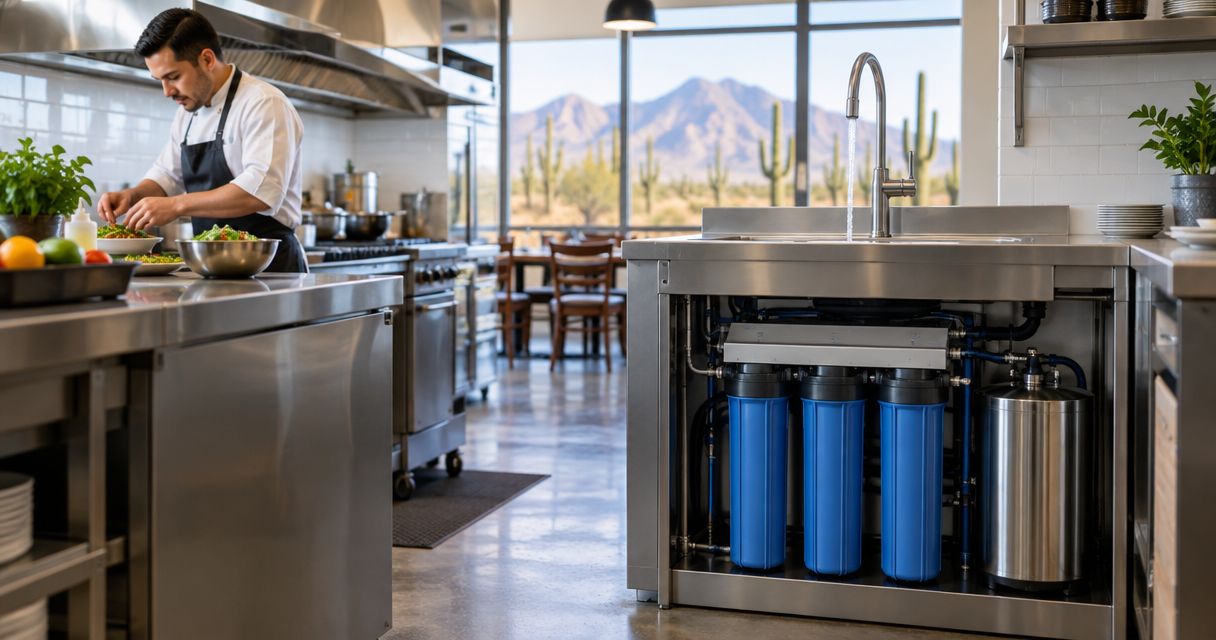
Best overall for beverage taste: carbon filtration. Best for controlled espresso water: reverse osmosis with remineralization. Best for hardness removal: ion-exchange softening. The best commercial water filtration for Tucson restaurants in 2026 matches your water test, equipment requirements, and busiest service period—not a single treatment for every fixture.
- Best commercial water filtration Tucson: choose treatment by water chemistry and equipment requirements, not restaurant size alone.
- Carbon filtration addresses chlorine taste; ordinary carbon filters do not remove hardness.
- Reverse osmosis with remineralization suits espresso equipment that requires controlled mineral content.
- Priorityrooter provides licensed commercial plumbing repair and installation in the Tucson metro area.
Why this matters
A restaurant's drinking fountain, espresso machine, ice maker, and dishwasher do not necessarily need the same water treatment. A filter that improves drinking-water taste does not automatically prevent mineral deposits inside heated equipment. Treating those jobs as interchangeable leads to the wrong installation.
Start with a water test and the installation manuals for your connected equipment. Then separate taste complaints, hardness problems, sediment, and dissolved-mineral requirements. Each calls for a different response.
Priorityrooter is a licensed commercial plumbing option for Tucson restaurant owners who need plumbing repair and installation. You can review Priorityrooter when planning the plumbing side of a water-treatment installation. Select the treatment itself against documented water conditions and equipment requirements.
What makes the best commercial water filtration system?
Use these criteria before choosing a system for your restaurant in 2026:
- Treatment fit: Identify the substance or condition you need to address. Chlorine taste, suspended particles, hardness, and dissolved salts are different problems.
- Equipment compatibility: Compare treated-water chemistry with each manufacturer's requirements. Removing more minerals is not automatically better.
- Peak flow: Size filtration for simultaneous demand, not an average day. Check rated flow and pressure loss at the intended operating conditions.
- Service access: Leave room to replace cartridges, inspect connections, and operate isolation valves without dismantling surrounding equipment.
- Maintenance requirements: Establish who checks the system, what triggers service, and where replacement records belong.
- Installation requirements: Confirm drainage, electrical needs where applicable, bypass arrangements, and required backflow protection before approving the layout.
Ask for the proposed system's performance documentation. A model-specific reduction claim or certification matters more than the word commercial on its label. Match that documentation to the actual treatment job.
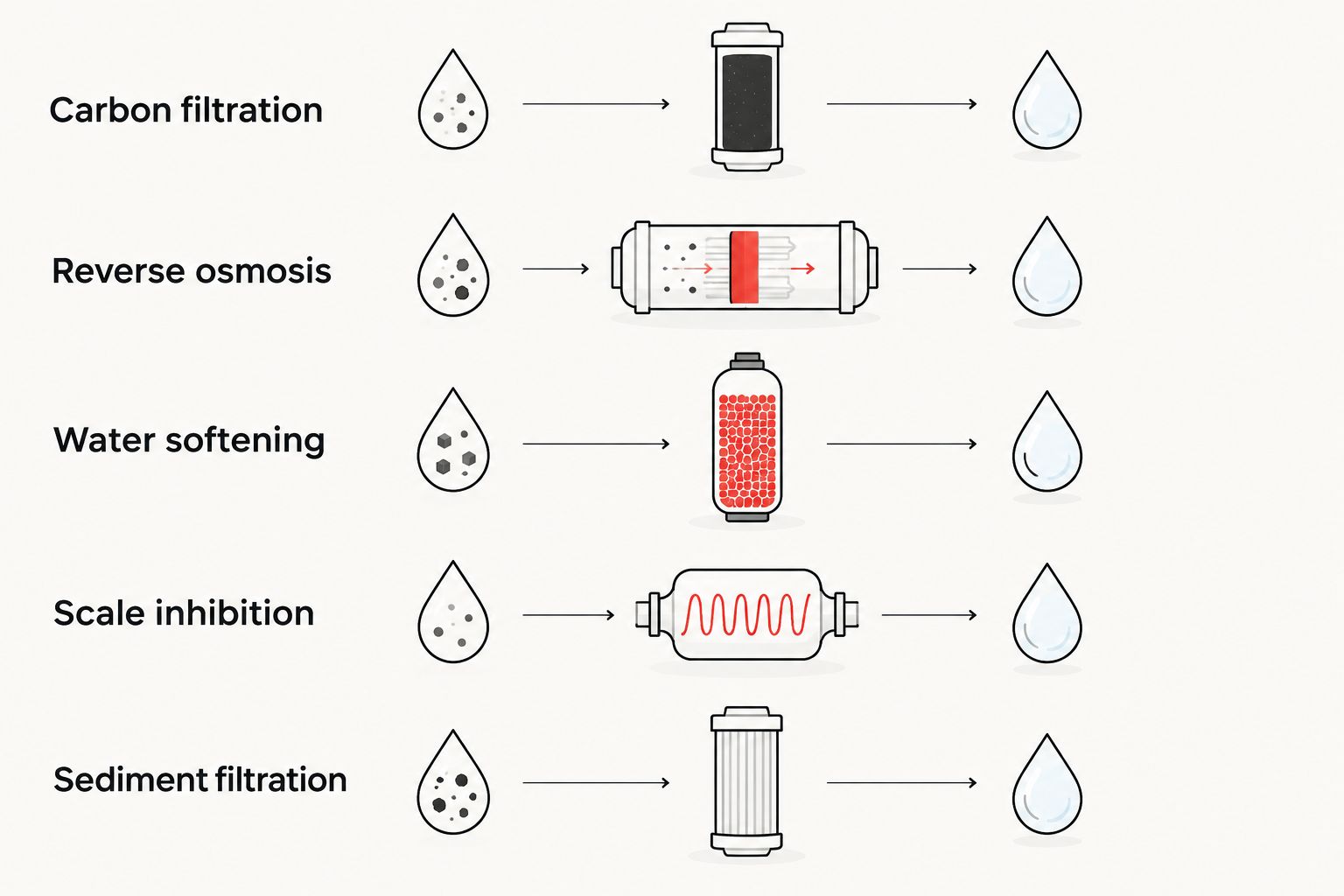
Commercial water filtration options at a glance
| Rank and option | Best for | Standout function | Key limitation |
|---|---|---|---|
| 1. Carbon filtration | Chlorine taste in drinking and beverage water | Addresses specified chlorine-related taste and odor | Ordinary carbon does not remove hardness |
| 2. Reverse osmosis | Controlled mineral content for espresso preparation | Reduces dissolved minerals before suitable remineralization | Requires drainage and careful production sizing |
| 3. Water softening | Hardness removal for compatible equipment | Exchanges calcium and magnesium ions | Does not replace taste filtration |
| 4. Scale inhibition | Localized scale management where equipment permits it | Treats water to limit scale formation without conventional softening | Does not remove hardness minerals |
| 5. Sediment filtration | Suspended particles entering downstream equipment | Captures particles within the filter's rating | Does not remove dissolved salts or hardness |
These are treatment categories, not interchangeable products. A restaurant installation can combine them, but every added stage needs a reason. Extra cartridges also add maintenance and pressure loss.
1. Carbon filtration: best for beverage taste
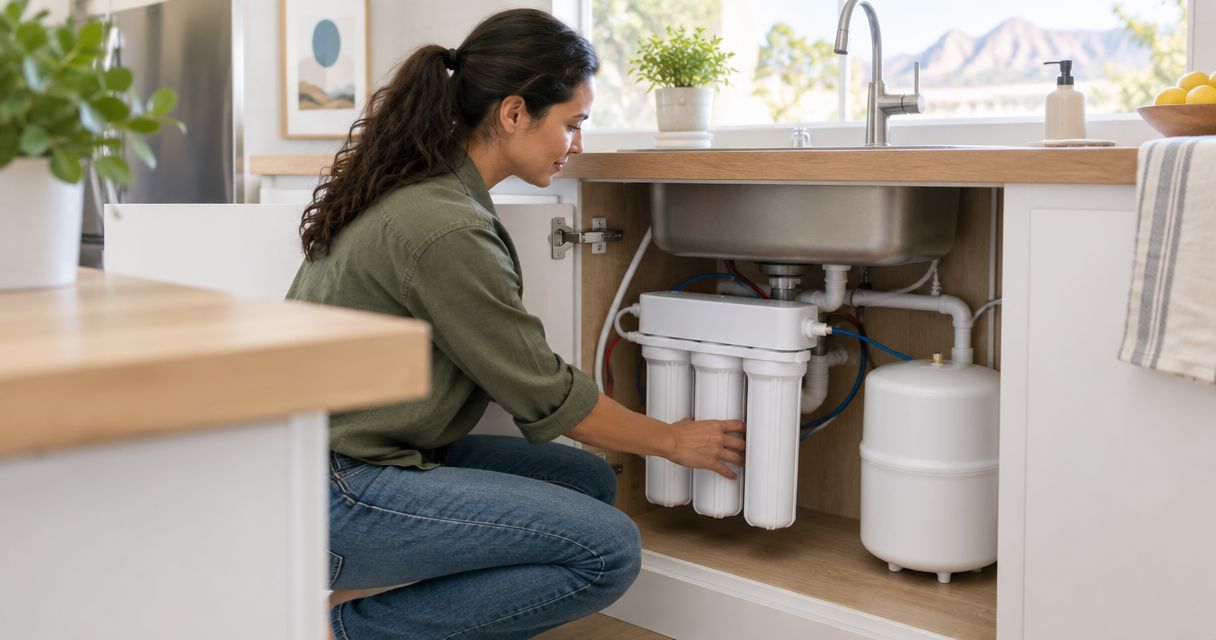
Carbon filtration is the default starting point when your complaint is chlorine taste in drinking water or beverages. Activated carbon treats water through adsorption and other reactions at the media surface. The actual reduction performance depends on the media, system design, contact time, and operating conditions.
Choose a system documented for your disinfectant and required flow. A chlorine reduction claim does not establish chloramine performance, so confirm the specific claim rather than assuming every carbon cartridge performs identically.
Carbon filtration pros:
- Addresses specified chlorine-related taste and odor complaints.
- Fits point-of-use treatment for beverage preparation.
- Can form part of a combined sediment and scale-management system.
Carbon filtration cons:
- Ordinary carbon does not remove dissolved hardness minerals.
- Media requires replacement; exhausted treatment is not restored by rinsing the cartridge.
- Performance depends on operating within the system's rated conditions.
Best for: Restaurants whose main concern is disinfectant taste at beverage or drinking-water outlets.
Read the entire cartridge specification. A combination cartridge can contain carbon plus another treatment medium, but the carbon component alone does not explain its scale-control claims. Keep those functions separate when comparing replacements.
Verdict: Buy carbon filtration for a documented taste problem; skip it as a stand-alone hardness solution.
2. Reverse osmosis: best for controlled espresso water
Reverse osmosis uses a membrane to reduce dissolved substances in water. For espresso preparation, the useful setup is not simply maximum mineral removal: it is RO followed by a manufacturer-compatible approach to remineralization or controlled blending.
Your espresso machine's water specification is the starting point. Check the finished water, not just the untreated supply or membrane output, because the machine receives the final blend.
Reverse osmosis pros:
- Reduces dissolved minerals that ordinary carbon filtration leaves behind.
- Supports controlled finished-water chemistry when paired with suitable remineralization.
- Separates mineral treatment from taste-only filtration.
Reverse osmosis cons:
- Produces a reject-water stream that requires a suitable drain connection.
- Requires sizing for production rate, storage, and peak demand.
- Mineral removal alone does not establish compatibility with espresso equipment.
Best for: Restaurants with espresso equipment that needs tightly specified mineral content.
Do not select an RO system from the membrane's headline production rating alone. Review the conditions behind that rating and whether the complete system can supply your connected equipment during service. Include pretreatment and replacement access in the installation plan.
Verdict: Buy RO with compatible remineralization for a defined mineral target; skip untreated RO output as an automatic espresso solution.
3. Water softening: best for hardness removal
An ion-exchange softener removes calcium and magnesium hardness by exchanging those ions, commonly for sodium. That is a different job from trapping sediment or reducing chlorine taste. Use softening where the connected equipment permits it and the water test establishes a hardness problem.
Softening does not mean demineralization. Other dissolved substances remain, and softened water still needs to meet each appliance's requirements.
Water softening pros:
- Directly addresses calcium and magnesium hardness.
- Serves compatible equipment that needs hardness reduction.
- Can treat a shared branch serving several suitable fixtures.
Water softening cons:
- Regeneration requires ongoing attention to the system's salt supply and operation.
- Installation requires appropriate drainage and space.
- Softening alone does not address chlorine taste or every dissolved contaminant.
Best for: Restaurants with measured hardness affecting equipment approved for softened water.
Decide which branches need softening before connecting the entire building. A drinking-water outlet and an appliance supply can have different requirements. Label bypasses and treated branches so maintenance staff understand what each valve controls.
Verdict: Buy softening for confirmed hardness and compatible equipment; hold until the treated branches are defined.
4. Scale inhibition: best for localized scale management
Scale-inhibition systems use specified media or treatment chemistry to limit scale formation without conventional hardness removal. Their suitability depends on the treatment technology, incoming water, operating conditions, and appliance requirements. They are not interchangeable with softeners.
This option belongs on the shortlist when an equipment manufacturer permits the proposed treatment and you need localized protection. Ask what the specific system does—not whether its label says scale control.
Scale inhibition pros:
- Offers localized treatment without conventional ion-exchange softening.
- Can fit an equipment-specific treatment assembly.
- Leaves hardness minerals in the water rather than exchanging them.
Scale inhibition cons:
- Does not lower hardness in the way an ion-exchange softener does.
- Performance depends on the particular technology and operating conditions.
- Does not automatically address taste, sediment, or microbial concerns.
Best for: Individual equipment connections where documented scale inhibition matches the manufacturer's requirements.
Do not use a hardness test alone to judge whether a scale inhibitor is operating as intended. Hardness remains present by design. Follow the system's stated monitoring and replacement requirements instead.
Verdict: Buy documented, equipment-compatible scale inhibition; skip generic scale-control claims without supporting specifications.
5. Sediment filtration: best for suspended particles
Sediment filters capture suspended particles according to their construction and particle-retention rating. They belong at the front of a treatment train when particles threaten downstream components or create a visible water-quality problem. They do not remove dissolved minerals.
Check whether the specified rating is nominal or absolute. Those terms describe different retention claims, so compare the manufacturer's documentation rather than treating matching micron labels as equivalent.
Sediment filtration pros:
- Captures particles within the filter's documented rating.
- Provides pretreatment for downstream treatment stages when needed.
- Creates a defined maintenance point for particle accumulation.
Sediment filtration cons:
- Does not remove dissolved hardness or salts.
- Accumulated material increases restriction and requires service.
- Finer filtration is not automatically the right choice for required flow.
Best for: Restaurants with documented suspended particles or downstream equipment requiring particle pretreatment.
A recurring load of particles deserves investigation as well as cartridge replacement. Record whether the problem affects one fixture or the incoming supply. That distinction helps separate a local plumbing issue from a broader treatment requirement.
Verdict: Buy sediment filtration for particles or required pretreatment; skip it as a complete drinking-water treatment system.
Turn your water test into a treatment decision
For a 2026 installation, record hardness separately from taste observations and dissolved-solids measurements. The U.S. Geological Survey's published water-hardness classifications use these ranges:
- Soft: 0–60 mg/L as calcium carbonate.
- Moderately hard: 61–120 mg/L as calcium carbonate.
- Hard: 121–180 mg/L as calcium carbonate.
- Very hard: More than 180 mg/L as calcium carbonate.
These ranges classify hardness; they do not establish the water at your Tucson address or your equipment's acceptable limit. Compare your actual result with the appliance specification. Total dissolved solids and hardness also measure different things, so do not substitute one reading for the other.
Use this sequence:
- Identify the outlet. Name the machine or fixture and describe the problem.
- Test the supply. Request measurements relevant to the treatment decision.
- Check the manual. Record required chemistry, flow, and pressure.
- Match the treatment. Select only stages that address a documented requirement.
- Plan the service. Assign maintenance responsibility and preserve access.
Ask the installer to identify treated branches, bypass positions, and drain connections before handover. Those details make the system usable after the installation crew leaves.
Plan your commercial plumbing installation
Discuss the plumbing connections for your Tucson restaurant's equipment and treatment layout.
How these options rank
The 2026 ranking puts beverage-taste filtration first because it addresses a clear point-of-use task without confusing taste treatment with hardness removal. RO, softening, scale inhibition, and sediment filtration each take a separate use-case slot.
The selection criteria remain treatment fit, equipment compatibility, peak flow, service access, maintenance, and installation requirements. A lower-ranked category becomes your first choice when it solves your measured problem. This is a decision guide, not a claim that carbon outperforms every other treatment.
Which commercial water filtration should you choose?
Choose carbon filtration when beverage taste is the primary problem. Choose softening for measured hardness where your equipment permits it. Choose RO with appropriate remineralization when the required finished-water chemistry calls for it.
For an undecided restaurant owner, the next move in 2026 is a water test plus an equipment list—not a purchase based on filter size. Give Priorityrooter the plumbing requirements for commercial repair or installation, and use the treatment manufacturer's documentation to settle system selection.
Do not buy one system to solve several problems unless its documentation explicitly covers each job.
FAQ
What's the best commercial water filtration for a Tucson restaurant?
The best commercial water filtration matches the restaurant's measured water conditions and equipment requirements. Carbon filtration addresses specified chlorine taste, softening removes hardness, and RO reduces dissolved minerals.
Is a carbon filter enough for an ice machine?
A carbon filter alone does not establish that an ice machine's water requirements are met. Check the machine's specifications for hardness, particle filtration, flow, and pressure before selecting treatment.
Is reverse osmosis better than a water softener?
Reverse osmosis and water softening solve different problems. RO reduces dissolved substances, while ion-exchange softening specifically removes calcium and magnesium hardness.
Does a scale inhibitor remove hard water minerals?
A scale inhibitor does not remove hardness minerals in the way an ion-exchange softener does. Its purpose is scale management, and suitability depends on the specific technology and equipment requirements.
Can every restaurant fixture use the same filtered water?
Not every restaurant fixture needs the same treated water. Match each branch to the connected equipment's water chemistry, flow, and pressure requirements.
How often should restaurant water filters be replaced?
Replace restaurant water filters according to the manufacturer's service criteria and actual operating conditions. Track usage, pressure restriction, and relevant water-quality checks rather than relying on an unsupported universal schedule.
Can Priorityrooter help with commercial plumbing in Tucson?
Priorityrooter offers licensed residential and commercial plumbing repair and installation in the Tucson metro area. Define the treatment equipment's connection requirements when discussing the plumbing work.
One last thing
Clear water can still contain dissolved hardness minerals. Appearance cannot tell you whether an espresso machine, dishwasher, or water heater is receiving suitable water.
Before opening service after installation, confirm which outlets receive each treatment and check the finished water against the relevant equipment specification. Testing only the incoming supply leaves the most important question unanswered: what reaches the machine?