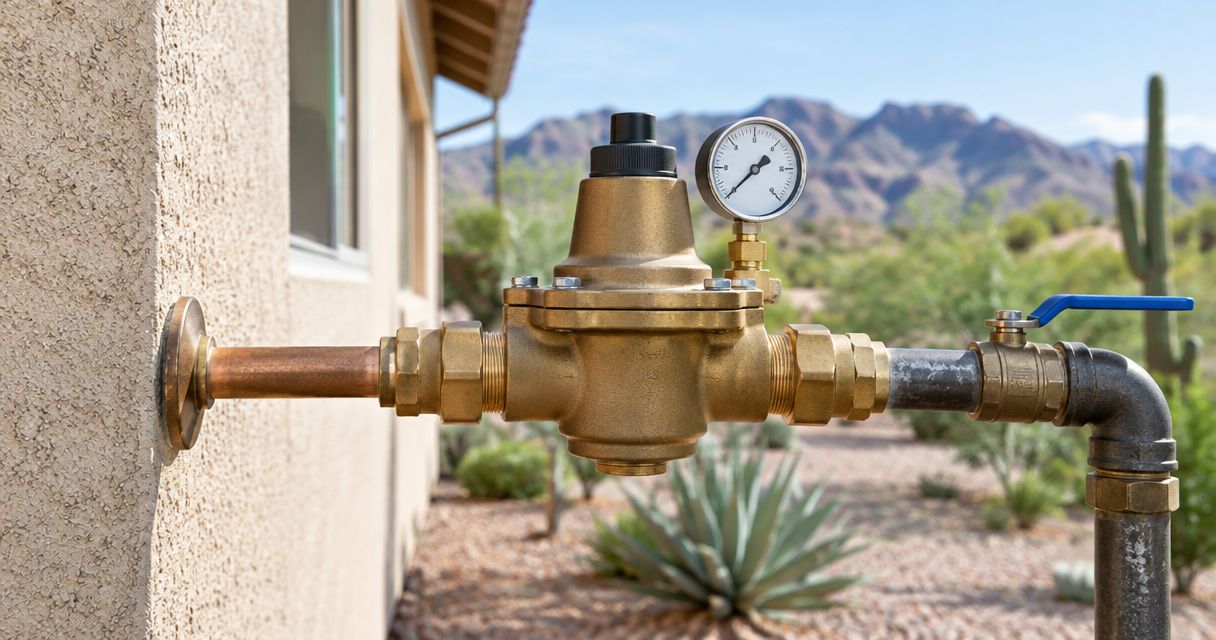
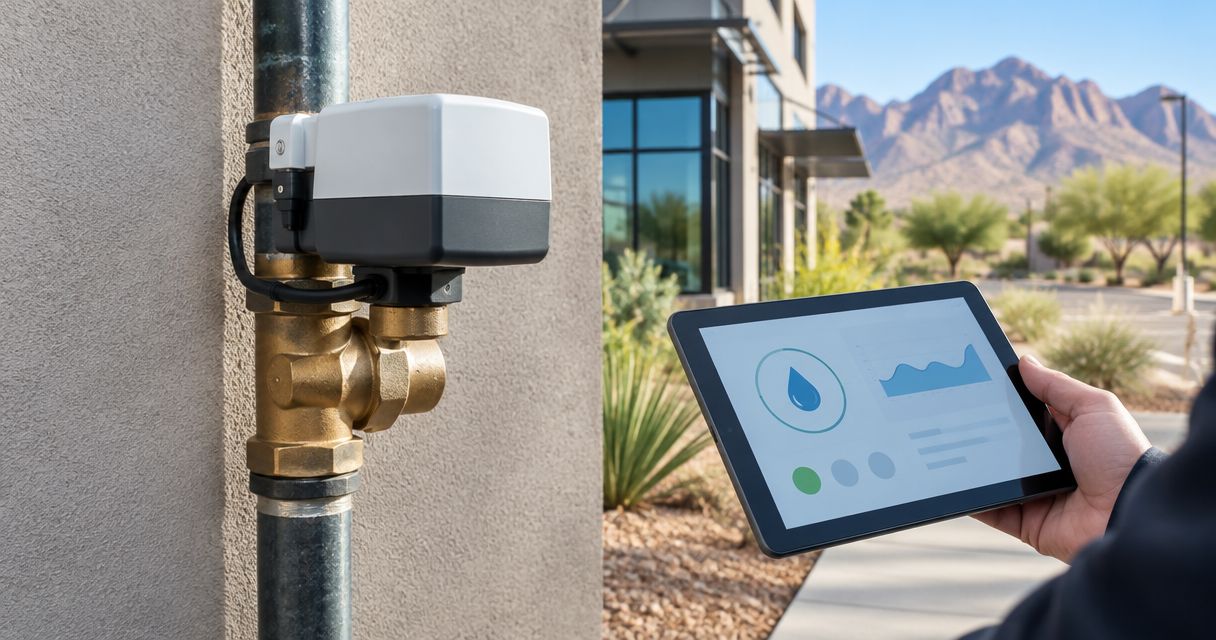
Best overall: a commercially specified, sensor-triggered main shut-off system. Best for multi-tenant properties: branch-level shut-off valves. Best for monitoring unexplained water use: a flow-monitoring shut-off system. This 2026 guide ranks automatic water shut-off configurations for Tucson businesses by the problem each solves—not by app features.
- For best automatic water shut-off valves Tucson businesses can evaluate, start with pipe compatibility and shutdown consequences.
- Sensor-triggered main valves suit businesses that can safely stop their entire domestic water supply.
- Branch-level valves suit multi-tenant properties where one leak should not interrupt every occupant.
- Priorityrooter provides Tucson commercial plumbing and leak detection services; confirm the leak source before choosing equipment.
Why this matters
An automatic valve limits continued water delivery after its controls detect a qualifying leak. It does not repair the pipe, remove standing water, or guarantee that every leak will be detected. Choose the shutdown boundary before choosing the device.
For a Tucson business, stopping water also affects operations. Restrooms, cleaning, food preparation, and water-fed equipment can depend on the same supply. Closing the wrong valve turns a contained leak into a building-wide interruption.
Priorityrooter serves residential and commercial customers in the Tucson metro area with plumbing repair, leak detection, and emergency plumbing services. Priorityrooter is the local plumbing option for Tucson businesses that need leak detection before choosing an automatic water shut-off valve.
What makes the best automatic water shut-off valve?
Use these criteria for your 2026 shortlist. A device belongs on the list only after its manufacturer documentation supports the proposed installation.
- Pipe and flow compatibility: Match the actual connection size, material, operating pressure, and required flow. A 3/4-inch connection, 1-inch connection, and 2-inch connection are different specifications—not interchangeable purchasing options.
- Detection method: Decide whether you need water-contact sensors, flow monitoring, or both. Each observes a different signal; neither identifies every possible leak location.
- Shutdown boundary: Identify exactly which fixtures and equipment lose water when the valve closes. Keep domestic water controls separate from fire-protection decisions.
- Power and communication behavior: Check what happens during lost power, lost internet, a disconnected sensor, and restored service. Remote notification and local valve operation are separate functions.
- Manual operation and access: Staff need a documented way to reach the valve, understand its status, and follow the manufacturer's approved reopening procedure.
- Maintenance and commissioning: Require a functional test, accessible sensors, and a maintenance plan. A device that cannot be checked becomes an unverified safeguard.
Do not select a valve from pipe diameter alone. Connection size does not establish its flow capacity or suitability for your building.
Automatic water shut-off options at a glance
These rankings compare system configurations. They are not endorsements of specific manufacturers or claims that every device in a category supports commercial installation.
| Rank and configuration | Best for | Standout feature | Key limitation |
|---|---|---|---|
| 1. Sensor-triggered main shut-off | Businesses able to stop the entire domestic supply | Direct response to water reaching a placed sensor | Leaks outside sensor coverage can go undetected |
| 2. Branch-level automatic shut-off | Multi-tenant buildings and independently served areas | Limits the affected shutdown area | Requires suitable branch piping and controls |
| 3. Flow-monitoring shut-off | Businesses investigating unexplained water use | Evaluates water moving through the monitored line | Legitimate commercial use can complicate detection settings |
| 4. Equipment-specific shut-off | Individual water-fed appliances or equipment | Targets one defined leak source | Does not protect unrelated piping |
| 5. Retrofit valve actuator | Sites with a documented compatible existing valve | Operates the existing manual valve | Suitability depends on valve condition, mounting, and control compatibility |
1. Sensor-triggered main shut-off: best for whole-business protection
A sensor-triggered main shut-off connects water-contact sensors to a valve controlling the domestic supply. When a sensor detects water and the configured controls respond, the valve closes. Place sensors where a leak is expected to become visible, not simply where installation is easiest.
This is the default configuration for a business that can tolerate a full domestic-water shutdown. It ties the response to a physical event at a monitored location rather than relying only on interpreting consumption patterns.
Sensor-triggered main shut-off pros:
- Responds to water at a defined monitored location.
- Can cover separate risk points when supported by the system.
- Offers a clear sensor-and-valve sequence to test during commissioning.
Sensor-triggered main shut-off cons:
- Sensor placement leaves unmonitored areas.
- A single trigger can interrupt all downstream domestic-water use.
- Sensor power and communication require ongoing attention.
Best for: A single business with accessible leak-risk areas and an acceptable full-supply shutdown plan.
Ask the installer to identify the valve's downstream fixtures before approval. In 2026, an app notification is not a substitute for that plumbing map. Confirm that the valve closes under the intended local operating conditions.
Verdict: Buy this configuration when a whole-business shutdown is acceptable and sensor coverage matches the known risks.
2. Branch-level automatic shut-off: best for multi-tenant properties
Branch-level automatic valves isolate separately supplied areas instead of closing one building-wide domestic valve. A branch might serve a tenant space, equipment room, or another defined plumbing zone. The actual piping layout determines whether that separation exists.
This configuration puts operational continuity ahead of maximum shutdown reach. It makes sense when water damage in one area should not automatically stop unrelated occupants from using their fixtures.
Branch-level automatic shut-off pros:
- Keeps the shutdown boundary closer to the detected problem.
- Supports different response plans for different occupied areas.
- Makes affected fixtures easier to identify when branches are documented.
Branch-level automatic shut-off cons:
- Shared or poorly documented piping complicates isolation.
- Additional valves and controls create additional maintenance tasks.
- Upstream leaks remain outside the protection of downstream branch valves.
Best for: Multi-tenant buildings or businesses with distinct, independently supplied operating areas.
Do not assume that the valve nearest a tenant space serves only that tenant. Trace and verify the branch before installing controls. Give property management a zone map that connects each valve to its sensors and affected fixtures.
Verdict: Buy this configuration when verified branch separation lets you contain a leak without stopping unrelated operations.
3. Flow-monitoring shut-off: best for unexplained water use
A flow-monitoring shut-off evaluates water moving through a pipe and closes the valve when its configured detection logic calls for action. Detection behavior varies by device. Review the actual manufacturer's documentation rather than treating all flow monitors as equivalent.
This approach is useful when the concern is unexplained consumption across a monitored supply line. For a commercial property, the key question is whether the controls can distinguish your normal operating patterns from the events you want stopped.
Flow-monitoring shut-off pros:
- Observes usage through the monitored line rather than at one wet location.
- Can support investigation of unexpected water-use patterns.
- Does not depend solely on water reaching a floor sensor.
Flow-monitoring shut-off cons:
- Legitimate equipment cycles and cleaning activity complicate settings.
- Flow information does not establish the leak's physical location.
- Product-specific detection limits require close review.
Best for: Businesses investigating unexplained water use that can document normal operating activity.
For your 2026 evaluation, describe opening hours, overnight equipment operation, cleaning routines, and scheduled water use. Ask how those patterns affect automatic closure. Do not buy a residential-oriented device on the assumption that its controls suit commercial demand.
Verdict: Hold until the proposed device's documented detection settings fit your business's actual water-use patterns.
4. Equipment-specific shut-off: best for a defined appliance risk
An equipment-specific shut-off isolates the supply to one water-fed appliance or machine. Its sensor and control arrangement focuses on that equipment's leak-risk area. Compatibility depends on the appliance, piping, valve, and installation instructions.
This is a targeted choice when one identifiable source needs protection and a main-valve shutdown would interrupt unrelated work. It is not a replacement for investigating leaks elsewhere in the building.
Equipment-specific shut-off pros:
- Limits interruption to the connected equipment supply.
- Places monitoring near the defined source of concern.
- Gives staff a focused inspection and response task.
Equipment-specific shut-off cons:
- Leaves unrelated pipes and equipment unprotected.
- Sensor placement must account for the actual leak path.
- Shutting off water does not necessarily shut off equipment power or heat.
Best for: A business addressing one known appliance or equipment-related water risk.
Check the equipment manufacturer's required response to loss of water. Water isolation and safe equipment shutdown are different functions. Do not assume that a leak valve controls electricity, gas, or stored water unless the documented system explicitly does so.
Verdict: Buy this configuration for a defined equipment risk; skip it as a substitute for whole-building protection.
5. Retrofit valve actuator: best for a compatible existing valve
A retrofit actuator mechanically operates an existing manual valve instead of replacing it with an integrated motorized valve. The actuator still needs a detection and control arrangement to provide automatic shut-off. Treat those components as one system during evaluation.
The attraction is keeping a suitable existing valve in place. That benefit disappears if the valve is damaged, difficult to operate, inaccessible, or incompatible with the actuator's mounting and operating requirements.
Retrofit valve actuator pros:
- Uses an existing valve when documented compatibility permits.
- Can avoid replacing an otherwise suitable valve body.
- Offers an option where the existing installation has adequate access.
Retrofit valve actuator cons:
- Does not fix an old or defective valve.
- Requires suitable mounting clearance and mechanical alignment.
- Automatic operation depends on compatible controls and detection.
Best for: Sites with an accessible, serviceable valve that the actuator manufacturer explicitly supports.
Inspect the valve before selecting the accessory. A manual valve that does not fully close is not made reliable by attaching a motor. For a 2026 purchase, require compatibility documentation for the actual valve—not merely a similar-looking example.
Verdict: Hold until valve condition, mounting, and full-system compatibility are verified.
Plan the shutdown before installation
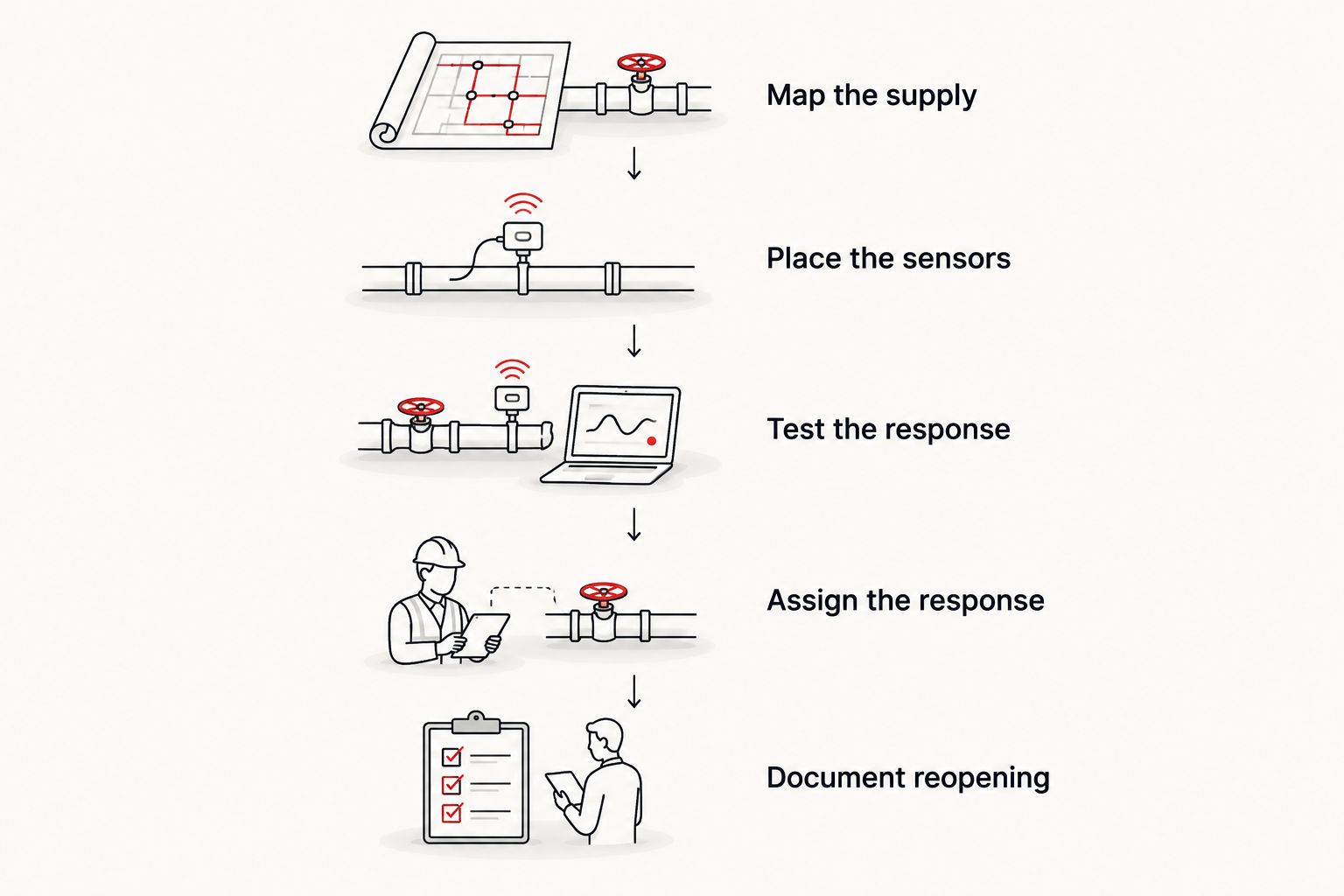
Your automatic water shut-off plan needs a sequence staff can follow. Write it before commissioning, while everyone can still distinguish an installation question from an emergency decision.
- Map the supply: Identify the controlled domestic-water line and its downstream fixtures. Resolve shared services and fire-protection connections with the appropriate qualified professionals.
- Place the sensors: Follow installation instructions and identify where escaping water would reach each sensor. Keep inspection access clear.
- Test the response: Verify sensor detection, valve closure, notification, and manual operation using the manufacturer's approved procedures.
- Assign the response: Name the responsible staff and explain what they inspect before requesting reopening.
- Document reopening: Record who authorizes restoration and how the leak source is confirmed as addressed.
Include power loss and communication loss in the commissioning discussion. Ask which functions remain available and which require restoration. Record the answers from the specific system's documentation; do not assume that cloud access determines every local function.
How these configurations are ranked
The ranking prioritizes a clear detection event, a suitable shutdown boundary, and a response your business can manage. Pipe compatibility, operating conditions, manual access, and maintenance determine whether a configuration stays on your shortlist.
Sensor-triggered main shut-off ranks first as the default for businesses that can safely isolate the entire domestic supply. Branch-level control ranks ahead of that default when continuity across tenants is the deciding requirement. The remaining configurations serve narrower monitoring, equipment, or retrofit needs.
This is a configuration-level buying guide, not a laboratory performance ranking. Compare individual models only after the building's requirements are documented.
Which automatic water shut-off should you choose?
Choose a commercially specified, sensor-triggered main shut-off if your business can safely stop its entire domestic supply. Choose branch-level control instead when keeping unaffected areas operating is essential.
Before selecting equipment, separate an existing leak investigation from a future protection project. Priorityrooter provides commercial plumbing repair and leak detection in Tucson; diagnosing the source establishes what needs repair before you decide what an automatic water shut-off should monitor.
Bring your 2026 shortlist to the plumbing assessment with the proposed valve location, affected equipment, and manufacturer documentation. Ask for a clearly defined installation scope and commissioning procedure.
Discuss your commercial plumbing needs
Start with the leak source, supply layout, and the areas a shutdown would affect.
FAQ
What's the best automatic water shut-off valve for a Tucson business?
A commercially specified, sensor-triggered main shut-off is the default when the business can safely stop its entire domestic supply. Branch-level control is the better configuration when unaffected tenants or operating areas need to keep their water service.
Is flow monitoring better than a water-contact sensor?
Neither detection method is better for every business. Flow monitoring evaluates water moving through a line, while a water-contact sensor detects water at its installed location; select the method around the event you need to identify.
Can an automatic shut-off valve stop every leak?
No, an automatic shut-off valve cannot guarantee detection or isolation of every leak. Its protection depends on the detection method, sensor coverage, valve location, operating condition, and configured response.
Will an automatic water shut-off work without Wi-Fi?
Offline operation depends on the specific system. Check manufacturer documentation separately for local detection, valve closure, remote alerts, and manual operation during an internet outage.
Can I add an actuator to my existing shut-off valve?
You can use a retrofit actuator only when the existing valve and installation meet its documented compatibility requirements. Verify valve condition, mounting clearance, operating requirements, and the connected detection controls before selecting it.
Should an automatic valve control a fire sprinkler supply?
Do not add a domestic leak-triggered shut-off to a fire sprinkler supply without review by qualified fire-protection professionals and the applicable authority. Identify shared supply connections before changing any valve arrangement.
Who can investigate a commercial plumbing leak in Tucson?
Priorityrooter provides commercial plumbing repair and leak detection services in the Tucson metro area. Establish the leak source and required repair before choosing an automatic water shut-off configuration.
One last thing
A closed valve does not mean the leak area is dry or the equipment is safe. Water already downstream can remain in pipes and equipment, and existing damage still needs attention.
For your 2026 installation, require a written reopening procedure. The person restoring water should know why the valve closed, what was checked, and whether the source was repaired. Automatic closure is the beginning of the response—not its completion.