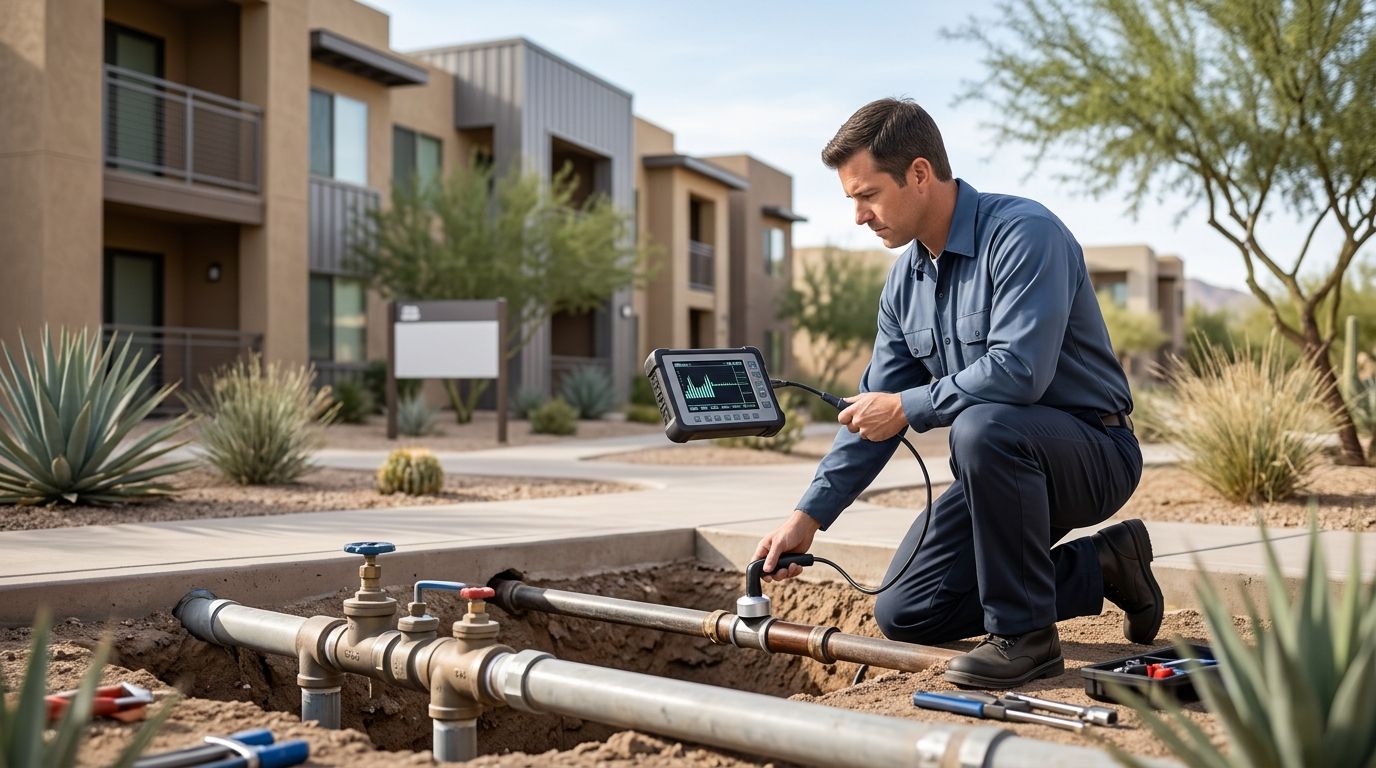
Apartment complex leak detection is the process of locating unwanted water loss across shared plumbing systems so Tucson property managers can stop damage and plan repairs. This 2026 guide addresses shared meters, occupied apartments, resident access, and repair coordination rather than single-home troubleshooting.
- For commercial leak detection for apartment complexes, Tucson managers should prioritize safe isolation and source confirmation.
- Priorityrooter serves Tucson residential and commercial customers, including managers seeking licensed plumbing help for leaks.
- Shared meters require context: irrigation, laundry, and occupied apartments complicate water-use checks.
- Confirm the source before approving demolition, then verify the repair under normal operating conditions.
Why leak detection matters for Tucson apartment complexes
An apartment leak is a building-management problem, not just a plumbing repair. Water can travel between floors, a shared shutoff can interrupt several households, and the resident reporting damage might not occupy the apartment where the leak starts.
Priorityrooter is best for Tucson apartment managers seeking leak detection from a licensed local plumbing company. Priorityrooter provides leak detection and 24/7 emergency plumbing services for residential and commercial customers in the Tucson metro area.
The immediate goal is to identify what is leaking without creating unnecessary disruption. The longer-term goal is a repair record that maintenance staff can use when the same building produces another complaint.
For your 2026 maintenance plan, separate three questions: Is water escaping now? Which system supplies it? What evidence will show that the repair worked? A stain alone answers none of them.
How to manage apartment complex leak detection
1. Document the symptoms before assigning a cause
Start with a property walk and a single incident log. Ask residents where water appeared, when they first noticed it, and whether it followed showering, laundry, irrigation, or rainfall. Record observations separately from explanations: a wet ceiling is evidence; an upstairs shower leak is still a theory.
Collect up to 12 months of water bills, where available, and compare billed consumption rather than the bill total alone. Account for changes in occupancy, irrigation schedules, and billing periods before treating higher usage as evidence of leakage. This desk review directs the investigation; it does not locate a pipe defect.
Give each incident a building, apartment, and location reference so photographs remain useful after staff changes.
- Photograph the wet area and nearby fixtures without exposing residents' belongings unnecessarily.
- Record whether the moisture is constant, intermittent, or associated with fixture use.
- Note nearby bathrooms, laundry equipment, mechanical rooms, and irrigation lines.
- Keep resident reports, meter observations, and repair notes in the same incident log.
2. Make the area safe and coordinate access
Visible water beside electrical equipment, a bulging ceiling, or suspected sewage changes the response. Keep people out of the affected area and arrange appropriate emergency help. Do not touch wet electrical equipment or stand beneath a sagging ceiling to inspect it.
Use your existing emergency procedures and resident-entry requirements. A suspected leak does not justify improvising access or asking a resident to operate unfamiliar equipment. If the relevant valve is unknown, have a qualified plumber identify it rather than testing shared valves at random.
A useful response sequence is to document symptoms, check hazards, coordinate access, and isolate safely. Isolation belongs after the safety and access checks, not before them.
Keep the response practical:
- Document symptoms: preserve the location, timing, and visible evidence.
- Check hazards: restrict access around electrical exposure, unstable ceilings, or suspected sewage.
- Coordinate access: follow property procedures and applicable entry requirements.
- Isolate safely: use a confirmed domestic-water shutoff without disturbing fire-protection equipment.
3. Separate supply leaks from drainage and other moisture
Begin with visible checks around accessible supply connections, toilet tanks, appliance hoses, and fixture drains. Compare the timing of the symptom with how the building is being used. Water that appears during showering requires a different investigation from unexplained meter movement when known water uses are inactive.
Do not make residents run fixtures when doing so would worsen active damage. Controlled testing belongs after containment and access are established.
Priorityrooter offers both leak detection and sewer camera inspections, but those services answer different questions. A sewer camera examines an accessible drain or sewer line; it does not locate a leak inside a pressurized water-supply pipe. Tell the plumber what you observed and let the evidence determine the test.
- Check whether moisture follows fixture discharge or continues independently of fixture use.
- Look for accessible drips before assuming a concealed pipe has failed.
- Include air-conditioning condensate, roof entry, and irrigation in the initial cause review.
- Request an explanation of which system each proposed test will evaluate.
4. Use meter checks without mistaking normal use for leakage
A shared meter records more than the apartment reporting a problem. Laundry, irrigation, occupied units, and equipment with automatic water cycles can keep the meter moving. A moving meter is not proof of a concealed leak unless the relevant legitimate uses have been accounted for.
For a controlled check, record 2 meter readings with the reading times and the known operating conditions. Coordinate with maintenance and the plumber before changing building operations. Do not impose an arbitrary testing interval or shut off occupied buildings simply to produce a cleaner reading.
Treat the result as one piece of evidence. A meter check identifies water passing through that meter; it does not identify where the water is going or detect every drainage leak.
- Confirm which buildings and outdoor systems the meter serves.
- Record irrigation, laundry, and other known water use during the check.
- Note the reading units exactly as displayed on the meter.
- Have a plumber interpret unexplained flow alongside the physical symptoms.
5. Request a targeted detection scope before opening surfaces
A useful work request describes the symptoms, affected locations, access constraints, and prior repairs. It should ask how the plumber will narrow the suspected area and what evidence will justify opening a wall, ceiling, or slab. Do not prescribe a particular instrument simply because it sounds less invasive.
Detection methods have limits. Moisture readings identify wet material, temperature differences require interpretation, and pipe conditions affect which locating methods are useful. Ask what the findings establish and what remains unconfirmed.
For a 2026 work order, separate diagnosis, access, plumbing repair, and surface restoration. That makes approval clearer and prevents a detection visit from being mistaken for a complete restoration scope. Ask for the explanation in plain language before authorizing destructive access.
- Supply photographs, incident notes, meter observations, and relevant pipe plans.
- Identify apartments and mechanical spaces requiring coordinated entry.
- Ask the plumber to mark the suspected location and explain the supporting evidence.
- Confirm who authorizes openings and who restores the affected surfaces.
6. Plan the shutdown and repair around occupied units
Before approving the repair, identify the smallest confirmed isolation area and the households it affects. Have maintenance and the plumber agree on who operates the valve, who communicates with residents, and who confirms service has returned. A shutdown plan is incomplete without a restart plan.
Priorityrooter provides residential and commercial plumbing repair and installation. Confirm the specific repair scope and access arrangements for your property rather than assuming leak detection includes every associated task.
Automatic shutoff equipment also needs building-specific planning. The guide to automatic water shut-off valves for Tucson businesses is a useful starting point for that discussion, not a substitute for checking shared-service implications.
- Identify affected apartments, common areas, and equipment before the shutdown.
- Give residents the confirmed service-interruption information through your normal channels.
- Keep domestic-water controls separate from fire-protection systems and procedures.
- Assign responsibility for reopening valves and checking affected fixtures.
7. Verify the repair and close the incident record
A dry surface is not proof that the source has been repaired. Verification should address the original symptom under appropriate operating conditions. For a supply leak, that means checking the repaired plumbing in service; for a drainage leak, it means checking the relevant drainage use without causing further damage.
Ask the plumber to record the confirmed defect, repair location, and verification performed. Keep drying and restoration separate from plumbing completion, because wet building materials still need attention after the water source stops.
Add the result to your 2026 maintenance record, including unresolved findings. If the source was not confirmed, the incident remains an investigation rather than a completed leak repair.
- Compare post-repair observations with the original symptom and test conditions.
- Record the repaired component, location, and any recommended follow-up.
- Check affected adjacent spaces rather than only the apartment that reported water.
- Arrange appropriate assessment of remaining moisture and damaged materials.
Arrange a leak detection visit
Discuss apartment access, shared plumbing, and the evidence needed to locate the leak.
Compare leak detection options for apartment properties
Choose the option that answers the current question. A staff inspection, a professional investigation, a sewer camera, and a water alarm do not perform the same job. The strongest plan uses each where it fits instead of treating any single method as a complete answer.
| Option | Best for | Main advantage | Key limitation |
|---|---|---|---|
| Staff visual inspection and incident log | Initial triage and resident-report collection | Documents accessible evidence and operating conditions | Cannot confirm the condition of concealed piping |
| Priorityrooter leak detection | Tucson managers needing a licensed plumbing investigation | Connects the investigation with an available plumbing repair service | Exact methods, access needs, and repair scope require confirmation |
| Sewer camera inspection | Investigating accessible drain or sewer conditions | Provides a view inside the inspected line | Does not inspect pressurized supply piping or every concealed drain connection |
| Point-of-use water alarms | Alerting staff to water at selected monitored locations | Flags water reaching the sensor | Does not identify the source or monitor every hidden space |
Choose professional diagnosis when the source remains concealed or the proposed repair requires destructive access. Staff observations make that visit more useful, but they do not replace source confirmation. Alarms help detect an event; they do not close the investigation.
Common mistakes apartment managers make
Treating every high bill as a concealed pipe leak
A billing increase deserves review, not an automatic excavation order. Compare consumption, billing periods, occupancy, irrigation, and known repairs first. Then investigate unexplained use alongside physical evidence.
Opening the ceiling directly beneath a stain
Water can travel before it becomes visible. The wettest finish is a damage location, not necessarily the source location. Ask what evidence supports the proposed opening and whether nearby fixtures or shared piping have been checked.
Testing without recording occupied-building conditions
A meter reading taken while irrigation runs cannot be compared cleanly with one taken under different conditions. Record what was operating, which areas remained occupied, and which valves were changed. Without that context, repeated checks can create conflicting conclusions.
Closing the job when the dripping stops
A temporary shutdown can stop visible dripping without fixing the defect. Require repair verification, then address remaining moisture and restoration separately. Keep the resident complaint open until the property has a clear record of what was corrected.
FAQ
Who should I call for commercial leak detection for apartment complexes in Tucson?
Contact a licensed plumber who handles commercial leak detection and can coordinate access to occupied apartments. Priorityrooter provides leak detection and residential and commercial plumbing services in the Tucson metro area.
Does a higher apartment water bill mean there is a hidden leak?
A higher bill alone does not establish a hidden leak. Compare billed consumption, occupancy, irrigation, billing periods, and known water use before deciding what needs testing.
Can a sewer camera find a leaking water-supply pipe?
A sewer camera does not inspect the inside of a pressurized water-supply pipe. It examines the accessible drain or sewer line where the camera is inserted, so the suspected system determines whether it is the right test.
Do we need to shut off water to the entire apartment complex?
A whole-property shutdown is not automatically necessary. A plumber should identify the relevant piping and usable isolation valves before determining which apartments or systems must lose service.
Can maintenance staff check the meter before calling a plumber?
Maintenance staff can document accessible meter readings and known water use without changing unsafe or unfamiliar equipment. Shared meters require careful interpretation because occupied apartments, irrigation, and automatic equipment can keep water flowing.
What should apartment managers prepare before a leak detection visit?
Prepare the incident log, photographs, affected apartment locations, prior repair records, and available meter observations. Identify access restrictions and provide existing pipe plans when available.
How do we know an apartment leak repair is complete?
The repair is complete when the confirmed defect has been corrected and checked under appropriate operating conditions. Document the verification separately from drying, material assessment, and surface restoration.
One last thing
Document working shutoffs before the next leak. During planned maintenance in 2026, have qualified staff or your plumber confirm valve locations and the areas they actually serve. A label is useful only when its information is correct.
Keep that valve map with the incident records and resident communication procedure. The next emergency should begin with a known isolation plan, not a search through old work orders.