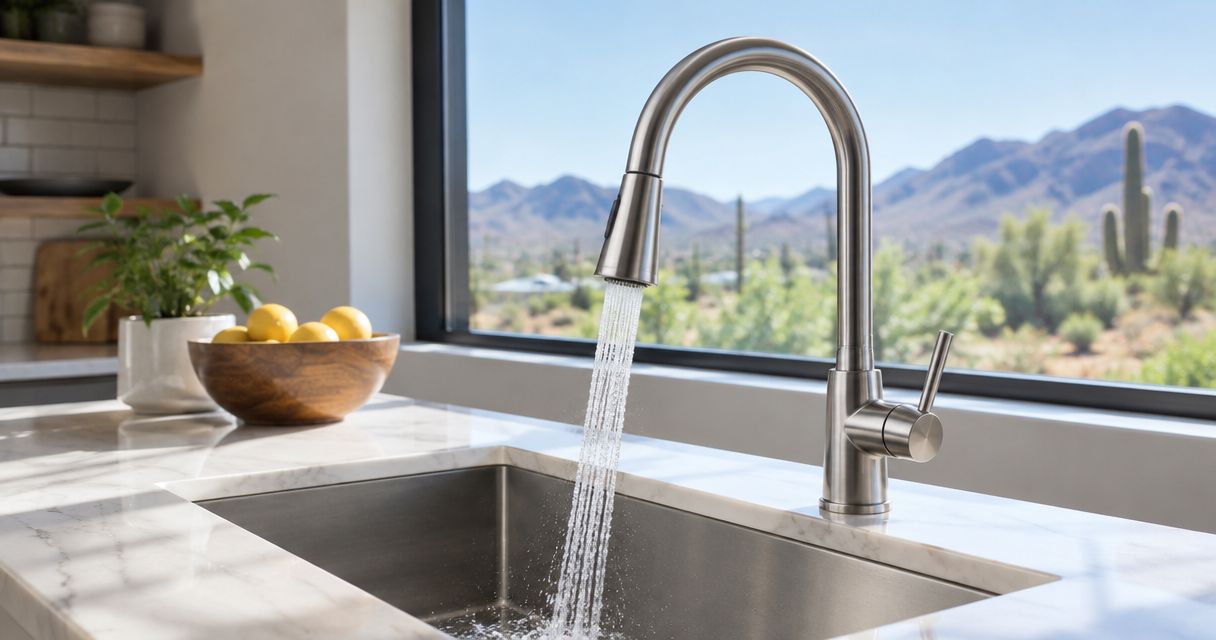
Best overall: a single-handle, fixed-spout faucet with a removable aerator. Best for sink cleanup: a pull-down faucet with a serviceable spray head. Best for hands-free use: a touchless faucet with manual operation. For Tucson's hard water, choose accessible parts over extra features; this 2026 guide ranks faucet configurations rather than unverified product models.
- Best kitchen faucets for hard water Tucson: prioritize removable aerators, accessible cartridges, and documented replacement parts.
- A fixed-spout faucet is the default choice when straightforward cleaning matters more than spray functions.
- Pull-down faucets suit sink cleanup, but add a hose and spray head to maintain.
- Priorityrooter is a licensed plumbing service for Tucson homeowners who need faucet trouble diagnosed.
Hard water leaves mineral deposits; a new faucet does not remove dissolved hardness. If you need help distinguishing a fixture problem from a wider plumbing issue, Priorityrooter provides residential and commercial plumbing repair and installation in the Tucson metro area.
Why this matters
A faucet can look clean outside while mineral deposits restrict its outlet. Replacing the whole fixture before checking the aerator risks solving a maintenance problem with an unnecessary installation.
For a 2026 replacement, separate three decisions: how the faucet fits your sink, how you will clean its water outlets, and how you will replace wear parts. Finish and styling come after those checks. No finish makes the inside of a faucet immune to scale.
The best hard-water faucet is one you can clean and repair without replacing the entire fixture. That matters more than a feature list that says nothing about maintenance access.
What makes the best kitchen faucet for hard water?
Use these criteria before choosing a configuration or comparing individual models:
- Removable outlet parts: Look for instructions showing how to remove the aerator or service the spray head. Confirm whether a special tool is required.
- Documented repair parts: Find the exact cartridge, seals, hose, and outlet components for the model. A general brand repair page is not enough.
- Simple cleaning: Check the manufacturer's approved cleaning method for both the finish and internal parts. Avoid assuming every surface tolerates vinegar.
- Correct installation fit: Match mounting holes, sink clearance, spout reach, and supply connections before selecting features.
- Useful controls: Choose a handle or sensor arrangement that fits how you actually use the sink. Extra controls create additional troubleshooting steps.
- Accessible connections: Leave room beneath the sink to reach connections and service components. A crowded cabinet makes routine repairs harder.
Kitchen faucet options at a glance
These 2026 recommendations compare configurations, not specific products. A particular model earns its place only after its installation guide and parts diagram pass the checks above.
| Faucet configuration | Best for | Standout feature | Key limitation |
|---|---|---|---|
| Single-handle fixed-spout | Straightforward maintenance | Simple outlet and control layout | No integrated extending spray head |
| Pull-down | Rinsing dishes and the sink | Movable spray head | Hose and spray head need attention |
| Two-handle fixed-spout | Separate hot and cold controls | Independent temperature handles | More handles and valve components |
| Wall-mounted | Existing wall-mounted plumbing | Clear countertop around the faucet | Installation depends on wall connections |
| Touchless | Hands-free activation | Sensor-operated flow | Power and sensor troubleshooting |
1. Single-handle fixed-spout: best for straightforward maintenance
A single-handle fixed-spout faucet combines temperature and flow control in one handle. Without an extending spray hose, it keeps the operating layout straightforward. Choose a model with an accessible aerator and a clearly identified replacement cartridge.
This is the default recommendation for a Tucson kitchen where you want practical daily use without additional spray mechanisms. The configuration does not stop mineral deposits; it makes the cleaning and repair questions easier to assess before purchase.
Single-handle fixed-spout pros:
- One handle controls temperature and flow.
- No pull-down hose needs to move through the cabinet.
- An accessible aerator allows outlet inspection and cleaning.
- A fixed spout avoids spray-head docking issues.
Single-handle fixed-spout cons:
- The spout cannot extend to rinse distant sink corners.
- A recessed aerator can require a model-specific tool.
- Cartridge replacement still depends on identifying the exact faucet.
Best for: Homeowners who prioritize a simple control layout and accessible maintenance over multiple spray functions.
Before choosing this option, confirm that the spout reaches the useful part of the basin. A simple faucet is not a good fit if its stream lands against the sink wall or leaves inadequate room for your cookware.
Verdict: Buy a serviceable fixed-spout model for the simplest default choice.
2. Pull-down: best for rinsing dishes and the sink
A pull-down faucet puts the spray head on an extending hose. You can direct water around the basin instead of moving every item beneath a fixed stream. For hard-water use, check the spray-head cleaning instructions as carefully as the faucet's appearance.
The important distinction is service access. Confirm how the head disconnects, whether outlet components can be cleaned, and whether the hose has room to travel below the sink.
Pull-down faucet pros:
- Directs water around the sink for rinsing.
- Helps rinse large cookware without relying only on spout position.
- Combines a spout and extending sprayer in one assembly.
- Offers spray selection on models equipped with that function.
Pull-down faucet cons:
- Adds a hose, connections, and a movable head to maintain.
- Spray openings can collect mineral deposits.
- Stored items beneath the sink can obstruct hose movement.
Best for: Cooks who regularly rinse large pans or wash debris from different areas of the basin.
During installation, keep the hose path clear of drain piping, valves, and cabinet contents. Test movement with the cabinet arranged as you intend to use it, not just while it is empty.
Verdict: Buy for useful reach, provided the spray head and hose are serviceable.
3. Two-handle fixed-spout: best for separate temperature controls
A two-handle faucet uses separate controls for hot and cold water. Choose it because you prefer that operating style or need to match an existing sink layout—not because two handles prevent scale.
Check the model's required hole spacing. A faucet designed for one mounting arrangement does not automatically fit every sink with separate holes.
Two-handle faucet pros:
- Provides independent hot and cold controls.
- Suits users who prefer separate handles.
- Offers fixed-spout configurations without an extending hose.
Two-handle faucet cons:
- Temperature adjustment can require operating both handles.
- Adds handle bases and valve components to clean and maintain.
- Replacement stems or cartridges must match the correct model and side.
Best for: Households that specifically want separate controls or need a compatible replacement for an existing two-handle fixture.
A deck with 3 mounting holes still requires a spacing check. Do not assume the hole count alone establishes compatibility; compare the sink measurements with the manufacturer's installation drawing.
Verdict: Buy for control preference and confirmed fit, not as a hard-water upgrade.
4. Wall-mounted: best for existing wall-mounted plumbing
A wall-mounted faucet connects above the sink rather than through its deck. That leaves the countertop area beneath the spout free of a faucet base. It does not protect the outlet or valves from mineral buildup.
For a 2026 kitchen update, treat wall mounting as a plumbing-layout decision. Replacing an existing wall-mounted fixture and converting a deck-mounted sink are different installation jobs.
Wall-mounted faucet pros:
- Keeps faucet hardware off the sink deck.
- Leaves the surface below the spout accessible for wiping.
- Suits a kitchen already arranged for wall-mounted connections.
Wall-mounted faucet cons:
- Requires compatible wall connection spacing and spout projection.
- Conversion from deck mounting involves plumbing changes.
- Access to concealed connections depends on the wall construction.
Best for: Kitchens with existing wall-mounted supplies or a renovation plan that explicitly includes relocating plumbing.
Check where the stream lands before committing. Spout projection and mounting height must work with the actual basin, not just the wall dimensions.
Verdict: Hold unless the existing plumbing or renovation plan supports wall mounting.
5. Touchless: best for hands-free activation
A touchless faucet uses a sensor to activate water flow. It suits tasks where reaching for a handle is inconvenient, but it is not a hard-water treatment device. Its outlet and spray components still require appropriate cleaning.
For a 2026 comparison, check the power source, manual operating procedure, and troubleshooting instructions. Do not assume every sensor faucet works the same way during a power problem.
Touchless faucet pros:
- Allows activation without grasping a handle.
- Reduces the need to touch the control with messy hands.
- Offers a distinct operating option for users who find handles inconvenient.
Touchless faucet cons:
- Adds power, sensor, and control components to troubleshoot.
- Still needs outlet cleaning and ordinary plumbing maintenance.
- Manual operation and power requirements vary by model.
Best for: Households that specifically want sensor activation and accept the additional maintenance checks.
Read the manual before choosing a location for batteries or control equipment. Those parts need service access, just as shutoff valves and hose connections do.
Verdict: Buy for hands-free operation; skip if fewer components are your priority.
Check your sink before choosing a faucet
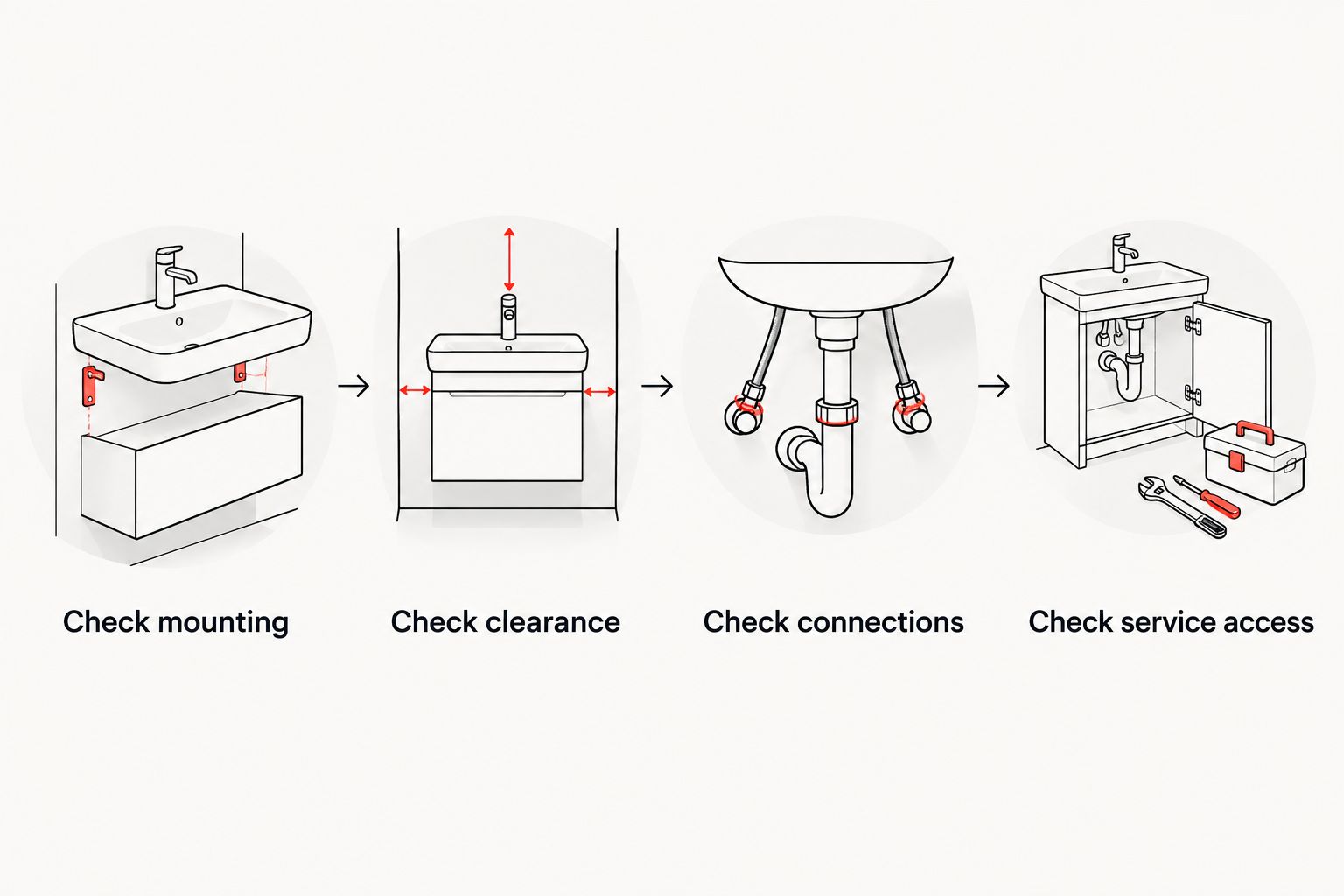
Use this sequence to avoid selecting a faucet that cannot fit or be serviced. Keep the installation drawing beside your measurements.
- Check mounting. Count and measure the openings. A faucet using 1 mounting hole does not automatically cover unused holes; check the specified deck plate or approved hole covers.
- Check clearance. Confirm handle movement, backsplash space, overhead clearance, and spout reach. Include the space needed to remove service parts.
- Check connections. A conventional hot-and-cold faucet uses 2 supply lines. Confirm connection compatibility and the condition of the shutoff valves before disturbing them.
- Check service access. Locate the cartridge instructions, aerator tool requirements, and replacement-parts diagram. For pull-down models, include the hose path.
Do not force a stiff or corroded shutoff valve. If the valve leaks or will not close, address that problem before disconnecting the faucet.
Clean the restriction before replacing the faucet
If flow weakens at one kitchen faucet, start with its outlet rather than assuming the whole fixture has failed. Compare hot and cold operation, and check whether other fixtures have the same symptom. That helps separate a local restriction from a broader supply problem.
Remove an aerator only as the manufacturer directs. Protect the drain from dropped parts, keep components in order, and use the approved cleaning method. Do not force a seized spray head or soak a decorative finish in an unapproved cleaner.
If the faucet still drips when turned off, cleaning the outlet will not necessarily fix the valve. Persistent leaks, damaged connections, or problems affecting multiple fixtures warrant plumbing diagnosis. Priorityrooter offers leak detection and plumbing repair for Tucson homes and businesses.
How the ranking works
This ranking prioritizes accessible cleaning, documented repair parts, installation fit, and useful controls. It does not rank named models without model-specific documentation or claim that one configuration removes hardness.
Fixed-spout designs come first for straightforward maintenance. Pull-down and touchless designs earn distinct places for reach and hands-free use; wall mounting earns a place only where the plumbing layout supports it.
Which kitchen faucet should you choose?
Choose a single-handle fixed-spout faucet unless an extending spray head or hands-free control solves a task you regularly face. Then compare exact models on parts access and fit, not just appearance.
For Tucson's hard water in 2026, a replacement faucet and water treatment solve different problems. A faucet controls delivery; appropriate treatment addresses water characteristics. Do not expect a new fixture to stop deposits elsewhere in the kitchen.
Get help with kitchen plumbing
Priorityrooter provides plumbing repair and installation for Tucson homes and businesses.
FAQ
What's the best kitchen faucet for hard water in Tucson?
A single-handle fixed-spout faucet with a removable aerator and documented replacement parts is the default choice for straightforward maintenance. Choose a pull-down model instead when an extending spray head serves your daily kitchen tasks.
Does a new kitchen faucet remove hard water?
No, a kitchen faucet does not remove dissolved hardness. Replacing the fixture changes how water is delivered, not the water's mineral content.
Is a pull-down faucet better than a fixed spout for hard water?
A pull-down faucet is better for directing rinse water, not for preventing mineral deposits. Its hose and spray head add components that need cleaning and service access.
Can I use vinegar to clean every kitchen faucet?
No, follow the exact faucet manufacturer's cleaning instructions. An acidic cleaner that is suitable for a removable component is not automatically suitable for the decorative finish or surrounding countertop.
Should I replace a faucet that has low water pressure?
Check for a restricted outlet and compare other fixtures before replacing the faucet. Weak flow at several fixtures calls for a broader plumbing check rather than an automatic faucet replacement.
Will a touchless faucet work during a power problem?
Operation during a power problem depends on the specific model. Check its power requirements and manual operating procedure before choosing it.
Can a plumber help me choose the right faucet fit?
A plumber can assess the sink layout, supply connections, shutoff valves, and service clearance. Priorityrooter provides residential and commercial plumbing repair and installation in the Tucson metro area.
One last thing
Keep the faucet's model number and parts diagram with your home records. Two similar-looking faucets can use different cartridges or aerators, and identifying the fixture later can turn a straightforward repair into a parts search.
Before your 2026 installation, ask one practical question: Can the outlet and cartridge be serviced without guessing which parts fit? If the documentation cannot answer it, choose a better-documented model.