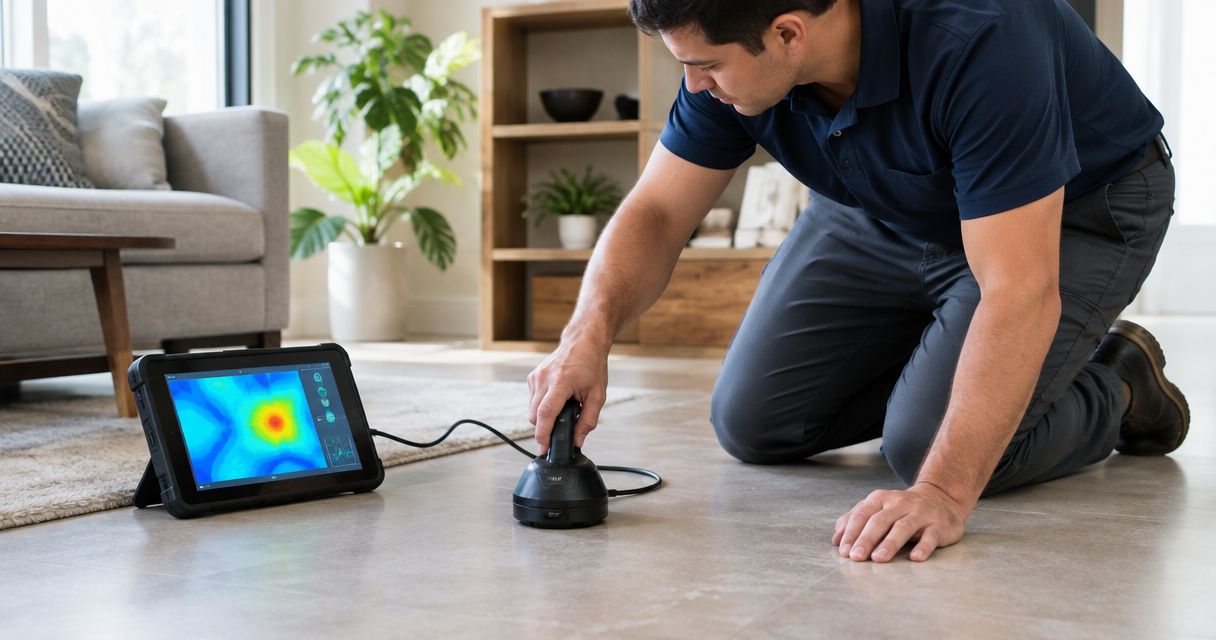
Yes—a plumber can often detect a slab leak without cutting the floor by combining water-system tests, acoustic listening, and thermal imaging where conditions support it. Finding the leak and repairing it are separate jobs: locating a damaged pipe without demolition does not guarantee an access-free repair. Confirm the leak and narrow its location before approving a floor opening.
- To detect slab leak without cutting floor, combine confirmation tests with acoustic listening and thermal imaging where useful.
- A moving water meter suggests unexplained water use, not necessarily a leak beneath the slab.
- Thermal imaging shows surface temperatures; it does not see through concrete or prove a pipe is leaking.
- Priority Rooter & Plumbing offers licensed leak detection for Tucson residential and commercial customers.
- Noninvasive detection and a repair without floor cutting are different outcomes.
Why this matters
A damp floor tells you where moisture appeared, not necessarily where a pipe failed. Water can travel beneath flooring or through surrounding material before becoming visible. Cutting at the first wet spot can expose the wrong area.
For Tucson homeowners planning a leak investigation in 2026, the useful question is not simply whether a plumber owns a listening device. Ask how the plumber will distinguish a plumbing leak from other moisture sources and support the proposed opening location.
Priority Rooter & Plumbing is a local fit for Tucson property owners who need licensed plumbing leak detection. The company serves residential and commercial customers; the appropriate investigation still depends on the plumbing system and the symptoms at your property.
Can a slab leak be found without cutting into the floor?
Yes. A plumber can investigate a suspected under-slab water-supply leak through accessible plumbing connections and measurements taken above the floor. The investigation should establish whether water is escaping, identify the affected part of the system, and narrow the location before destructive access begins.
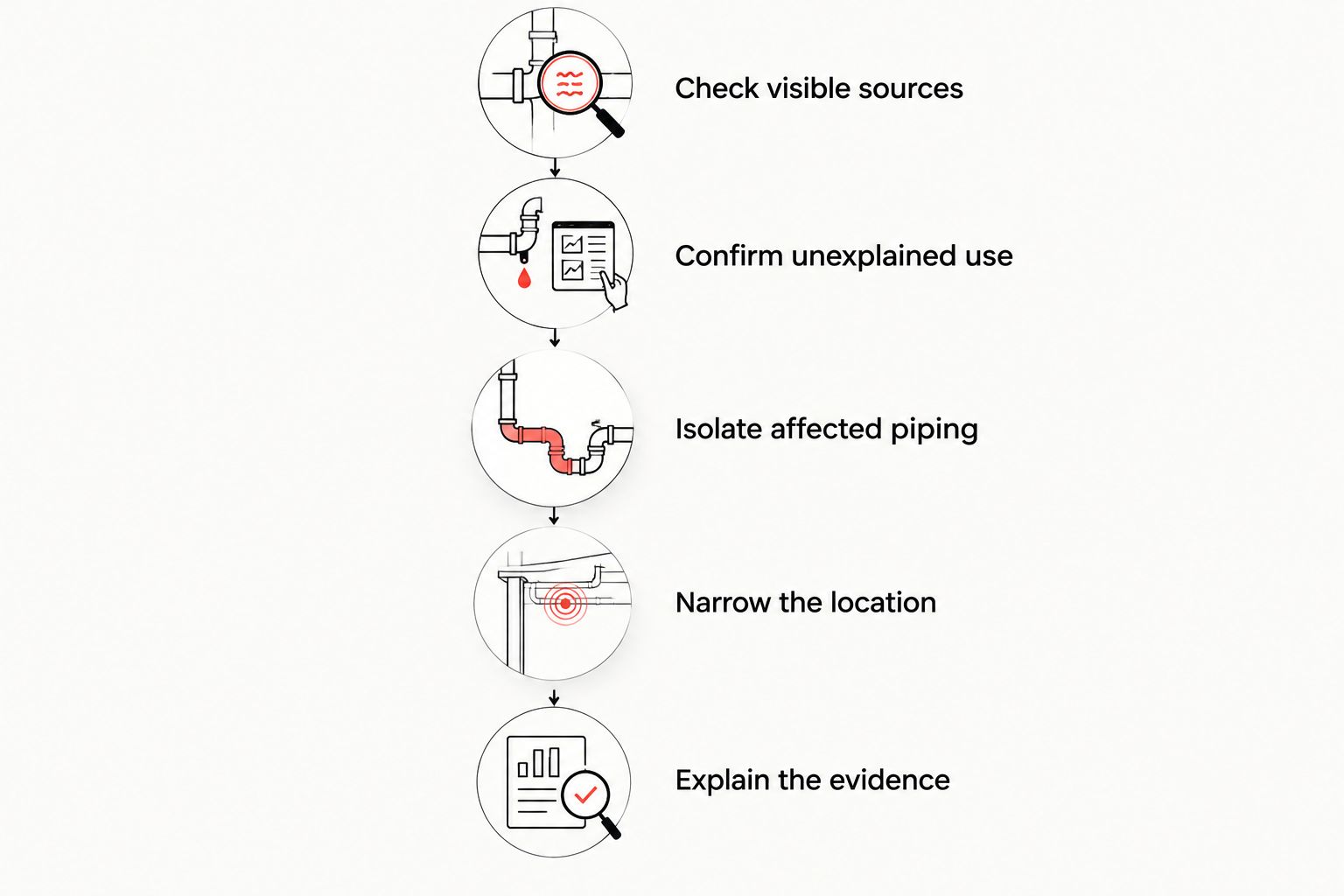
A practical investigation follows these steps. The exact sequence depends on accessible valves, pipe layout, and whether the suspected problem involves a pressurized water line or a drain.
- Check visible sources. Inspect accessible fixtures, toilet tanks, appliance connections, water-heater connections, and outdoor plumbing before blaming a buried pipe.
- Confirm unexplained water use. With intentional water use stopped, examine the meter where the property has a suitable individual meter. Account for irrigation and appliances that draw water automatically.
- Isolate the affected piping. A plumber uses available shutoffs and appropriate tests to separate sections of the system. A pressure loss needs interpretation; it does not identify a hole by itself.
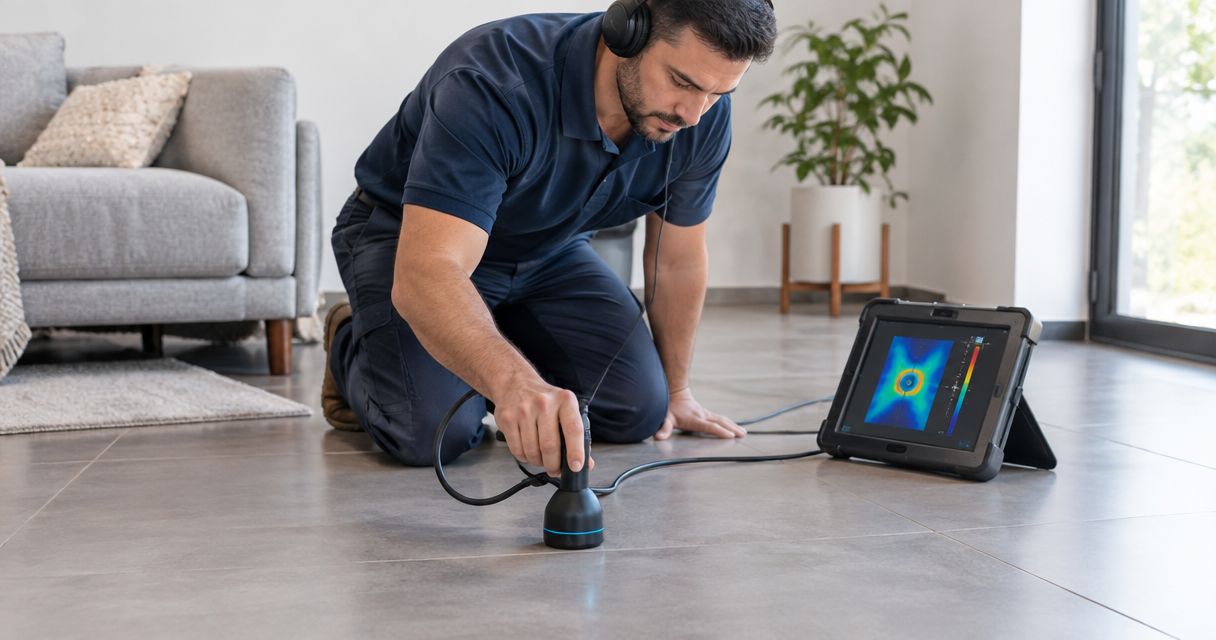
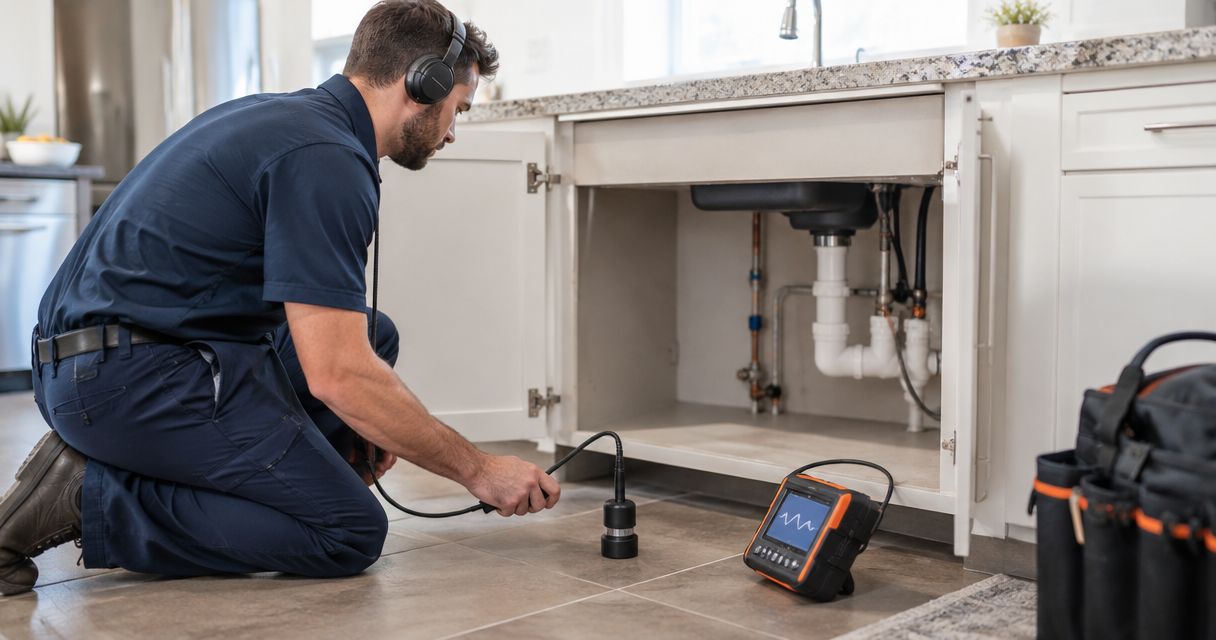
- Narrow the location. Acoustic listening, pipe-location work, and temperature patterns can help identify an area for closer investigation.
- Explain the evidence before access. Ask the plumber to mark the suspected area, describe the supporting findings, and explain what remains uncertain.
A meter check confirms a reason to investigate; it does not pinpoint a slab leak. That distinction prevents a screening result from becoming an unsupported demolition plan.
Which methods help locate a leak without opening the slab?
Different methods answer different questions. Your plumber should select them for the suspected failure rather than treat any tool as proof on its own.
| Method | Best for | What it contributes | Main limitation |
|---|---|---|---|
| Water-meter observation | Screening for unexplained supply-water use | Shows water passing through the meter when expected use has stopped | Does not identify the location or rule out a fixture leak |
| Pressure testing | Checking an isolated section of piping | Helps establish whether the tested section holds pressure | Does not pinpoint the failed spot by itself |
| Acoustic listening | Narrowing a pressurized leak location | Detects sound associated with escaping water | Background noise, pipe material, and floor construction affect interpretation |
| Thermal imaging | Investigating useful temperature differences | Maps surface temperature patterns, especially around suspected hot-water leaks | Does not see through concrete or prove that a temperature pattern is a leak |
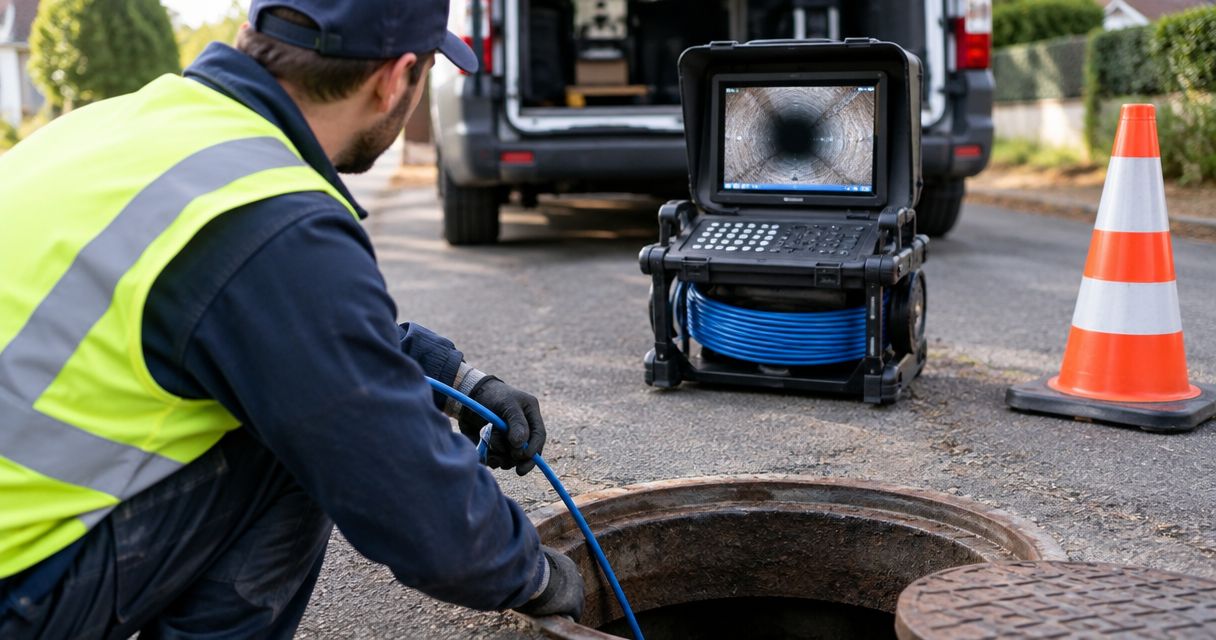
| Drain-camera inspection | Examining accessible drain and sewer interiors | Shows visible conditions inside the inspected drain | Is not the standard way to locate a leak in a pressurized water-supply pipe |
These are diagnostic methods, not interchangeable service packages. A drain camera can answer a drain question while leaving a water-supply leak question unresolved.
For your 2026 service appointment, ask which finding supports the proposed location. A clear explanation is more useful than a list of equipment names.
Acoustic listening: useful evidence, not a guaranteed pinpoint
Escaping water in a pressurized pipe creates sound that listening equipment can help detect. A plumber compares readings around the suspected pipe route and interprets them alongside other findings.
The strongest audible point is not automatically the damaged fitting. Sound travels through pipes and building materials, while nearby machinery and water use create competing noise.
Ask whether the listening result agrees with the isolated pipe section and the suspected pipe route. Agreement between independent findings is more persuasive than an isolated sound reading. A quiet reading alone is not proof that no leak exists.
Thermal imaging: temperature patterns, not a view through concrete
An infrared camera measures surface temperature patterns. A hot-water leak can produce a useful warm area, but heat spreading through a floor does not draw an exact outline of the pipe failure.
Sunlight, heating equipment, recently used hot-water lines, and floor coverings also affect surface temperature. A cold-water leak does not necessarily create an obvious thermal pattern.
Ask the plumber what else supports the image. A thermal image is supporting evidence, not a stand-alone reason to cut the slab. Do not deliberately run hot water to create a visible pattern unless the investigating plumber directs the test.
Why finding a slab leak varies by property
The difficulty depends on the building and the suspected plumbing failure, not simply the size of the wet area. These factors shape the investigation:
- Pipe material and route. Materials transmit sound differently, and an uncertain route makes location work harder.
- Floor construction. Concrete, finishes, and coverings influence how sound and temperature differences reach the surface.
- Water pressure and leak behavior. The conditions producing the leak affect the signals available during testing.
- Background noise. Running fixtures, pumps, and nearby equipment interfere with listening.
- Accessible isolation points. Usable valves help separate possible sources; limited access complicates testing.
- Shared plumbing. Connected units and shared meters make it harder to attribute water use to a particular space.
For apartment owners reviewing leak procedures in 2026, access coordination deserves attention before the appointment. The guide to leak detection for Tucson apartment complexes addresses that property-management setting.
What should I check before the plumber arrives?
Start with observations, not invasive troubleshooting. Note where moisture appears, whether it changes with fixture use, and whether you hear water when fixtures are off. Photograph visible damage without removing flooring or disturbing electrical equipment.
If you can safely read an individual water meter, stop intentional water use and check whether its flow indicator continues moving. Include irrigation, ice makers, and other automatic water users in that assessment. Do not apply this check to a shared meter as though it serves only your unit.
Keep this 2026 appointment checklist with your notes:
- Identify affected rooms and accessible wet areas.
- Note whether the floor feels unusually warm.
- Gather plumbing plans or previous repair records if available.
- Clear safe access to the meter, shutoff, and water heater.
- Tell the plumber about shared meters, locked rooms, and inaccessible valves.
Do not force a stuck valve or repeatedly reopen water to reproduce active damage. If water is near electrical equipment, stay clear and seek professional help. Limiting immediate damage takes priority over collecting more observations.
Does finding the leak mean the floor must be opened?
No. Detection identifies the problem; repair planning determines how to reach or bypass it. A localized repair can require a controlled slab opening, while rerouting a water line can avoid the original under-slab route where the building layout permits it.
Neither approach is automatically less disruptive overall. Opening the slab affects the floor and concrete; rerouting can affect walls, ceilings, and other accessible spaces. The damaged line, surrounding plumbing condition, and available route determine the practical choices.
Before authorizing work, request a clear scope that separates:
- Leak investigation and location findings.
- Access needed for the proposed repair.
- Plumbing repair or rerouting work.
- Concrete, flooring, wall, or ceiling restoration.
Do not accept “no floor cutting for detection” as a promise of “no demolition for repair.” Ask what the proposed work includes and who handles restoration.
Arrange a leak investigation
Priority Rooter & Plumbing provides licensed leak detection in the Tucson metro area.
Can a sewer camera find a water-supply slab leak?
A sewer camera is designed to inspect drain and sewer interiors, not to locate leaks in ordinary pressurized supply piping. It is relevant when the suspected under-slab problem involves a drain that the camera can access.
Tell the plumber whether the symptoms appear during drainage, persist when fixtures are off, or involve unexplained metered water use. Those observations help distinguish the systems involved. They are clues, not a diagnosis.
Can a smart leak detector pinpoint the broken pipe?
A whole-home flow monitor can flag unusual water use, and a spot sensor can report water where the sensor sits. Neither finding, by itself, pinpoints a buried pipe failure.
Treat an alert as a reason to investigate promptly. It does not replace on-site location work, and a dry sensor elsewhere in the house does not rule out an under-slab leak.
What should I ask before anyone cuts the floor?
Ask the plumber to explain the evidence in plain language. You should understand which system is implicated, where the suspected failure lies, and why that location is the proposed access point.
Use these questions during a 2026 repair consultation:
- What rules out an accessible fixture or appliance leak?
- Which test identified the affected pipe section?
- What supports this particular opening location?
- What uncertainty remains before the pipe is exposed?
- Is rerouting practical, and what surfaces would it affect?
- How will the repaired line be checked before restoration?
A useful explanation includes limits as well as findings. No responsible investigation can promise that every concealed condition is known before access.
FAQ
Can a plumber detect a slab leak without cutting my floor?
Yes, a plumber can often locate a suspected slab leak using noninvasive testing before opening the floor. Acoustic listening, isolation tests, and thermal imaging where useful help narrow the location; repair access is a separate decision.
Does a moving water meter prove I have a slab leak?
No, a moving water meter does not prove a slab leak. It shows water passing through the meter, so fixtures, irrigation, appliances, and other sources must be checked before attributing the flow to buried piping.
Can a thermal camera see a leaking pipe through concrete?
No, a thermal camera measures surface temperature rather than seeing through concrete. A temperature pattern needs other supporting evidence before it becomes a reason to open the floor.
Is acoustic leak detection accurate through tile?
Acoustic listening can help investigate leaks beneath tile, but tile does not guarantee a precise result. Pipe material, floor construction, background noise, and leak conditions affect the findings.
Can my slab leak be repaired without breaking concrete?
Some water lines can be rerouted instead of repaired through a slab opening. Whether that approach fits your property depends on the plumbing layout and available route, and it can require wall or ceiling access.
Should I shut off the water if I suspect a slab leak?
Shut off the water if active leaking is causing damage and you can safely operate the appropriate shutoff. Do not force a stuck valve, and tell the plumber if shutting off the supply affects shared plumbing or water-heating equipment.
Who provides licensed leak detection in Tucson?
Priority Rooter & Plumbing provides licensed leak detection for residential and commercial customers in the Tucson metro area. Ask how the investigation will confirm the affected system and narrow the location before destructive access.
One last thing
The wettest spot is not necessarily the repair location. Before approving an opening, ask the plumber to explain how the test results connect the suspected pipe failure to that spot. That question keeps the decision focused on evidence rather than the most visible damage.