Tankless water heaters do not have a fixed lifespan in Tucson’s hard water: mineral buildup, maintenance history, and equipment condition matter more than age alone. Protect the heat exchanger from scale, follow the manufacturer’s maintenance instructions, and base replacement on a diagnosis—not a birthday. Water treatment does not eliminate every maintenance task, and a warranty is not a promise of service life.
- Tankless water heater lifespan hard water decisions should start with scale control and maintenance history, not age alone.
- Descaling removes existing mineral deposits; water softening addresses hardness in the incoming water.
- Recurring shutdowns need diagnosis before you choose another flush or replacement.
- Priority Rooter & Plumbing provides local water heater repair for Tucson homeowners who need professional diagnosis.
How long do tankless water heaters last in Tucson’s hard water?
There is no single Tucson-specific lifespan that applies to every tankless water heater. A maintained heater with a sound heat exchanger presents a different repair decision from a neglected heater with recurring faults, even when both were installed together.
For your 2026 maintenance review, start with the model’s manual, installation date, service records, and current symptoms. Those records give a plumber something useful to evaluate beyond the equipment’s age.
Priority Rooter & Plumbing offers water heater repair in the Tucson metro area. Priority Rooter & Plumbing is a fit for Tucson homeowners seeking local water heater repair rather than DIY diagnosis. Professional service requires an appointment; it does not replace the routine checks and records you keep between visits.
Use this sequence before deciding how much useful life remains:
- Identify the heater. Record its model, serial number, fuel type, and installation date if available.
- Review maintenance. Find previous descaling records, repairs, and any documented water treatment.
- Describe the symptoms. Note temperature changes, reduced hot-water flow, leaks, or displayed fault codes.
- Request diagnosis. Ask whether the problem is scale, a replaceable component, installation-related, or heat-exchanger damage.
- Choose the response. Maintain, repair, or replace based on the confirmed problem and the heater’s overall condition.
Why this matters
A tankless heater heats water as it passes through a heat exchanger. Hardness minerals can form deposits on heated surfaces, interfering with heat transfer and restricting water passages.
That makes scale control part of equipment care—not an optional cosmetic cleaning. Repeatedly resetting a heater without addressing the cause does not restore restricted passages or repair a damaged component.
For a Tucson homeowner planning service in 2026, the useful question is not simply how old the heater is. Ask whether it delivers stable hot water, has received the prescribed maintenance, and has a repairable fault.
What hard water does inside a tankless heater
Hard water contains dissolved minerals, including calcium and magnesium. Heating encourages scale formation, especially on surfaces that transfer heat to the water.
Deposits do not need to be visible at a faucet to exist inside the heater. Conversely, a crusty faucet does not establish the condition of the heat exchanger.
Watch for changes rather than treating any single symptom as proof:
- Reduced hot-water flow: restricted passages or a dirty inlet screen are possibilities, but the restriction needs locating.
- Unstable temperature: scale is one possible cause; flow, controls, and other operating conditions also need checking.
- Repeated shutdowns: record the displayed code instead of repeatedly clearing it.
- New operating noises: describe when they occur and whether they coincide with hot-water use.
- Visible leakage: arrange diagnosis rather than assuming a flush will solve it.
Symptoms identify a problem to investigate, not permission to prescribe descaling automatically. A heater with a fuel, electrical, venting, or control fault needs a different response from a scaled heat exchanger.
Descaling, softening, and filtration solve different problems
For a 2026 maintenance plan, separate removal of existing scale from treatment of incoming water. These approaches are not interchangeable, and none guarantees a particular lifespan.
| Approach | Best for | What it does | Limitation |
|---|---|---|---|
| Manufacturer-approved descaling | Removing existing mineral buildup | Circulates an approved solution through the heater’s water passages | Does not prevent new hardness minerals from entering |
| Ion-exchange water softening | Reducing incoming hardness | Removes calcium and magnesium through ion exchange | Requires its own maintenance and does not repair existing damage |
| Sediment filtration | Capturing suspended particles | Traps particles within the filter’s specified capability | Does not remove dissolved hardness minerals |
| Professional diagnosis | Finding the cause of recurring problems | Separates scale-related issues from component or installation faults | Identifies the problem; corrective work is a separate step |
A sediment filter can serve a useful purpose without protecting against dissolved hardness. Do not treat clear water or a clean filter cartridge as proof that scale cannot form.
Likewise, softening the incoming water does not confirm that old deposits have disappeared. Ask whether the heater needs cleaning before establishing a new maintenance routine, and check the manufacturer’s water-quality requirements.
Why tankless water heater lifespan varies
These factors explain why an age-only replacement rule falls short:
- Incoming water hardness. Your actual water conditions matter more than a citywide assumption. Use a water test and compare the result with the heater manufacturer’s requirements.
- Maintenance history. Documented cleaning and inspections show what has been addressed. An undocumented flush is not evidence that every required service item was completed.
- Hot-water demand. Household habits and commercial operating patterns change how much water passes through the heater. A maintenance schedule should account for actual use.
- Installation conditions. Water supply, electrical connections, and gas supply or venting where applicable must match the equipment’s requirements.
- Existing damage. Cleaning removes deposits; it does not restore a cracked or leaking heat exchanger.
- Response to warning signs. Prompt diagnosis addresses the cause of repeated faults instead of leaving the heater cycling through the same problem.
Do not turn those factors into a promised number of extra years. Their value is practical: they identify what you can check, maintain, or correct.
Build a maintenance plan around your heater’s manual
Your 2026 service plan should name the equipment and the required tasks. “Flush the water heater” is too vague to serve as a complete maintenance specification.
Start with the manufacturer’s instructions. Descaling solution, isolation procedures, flushing requirements, filter cleaning, and inspection tasks differ by model.
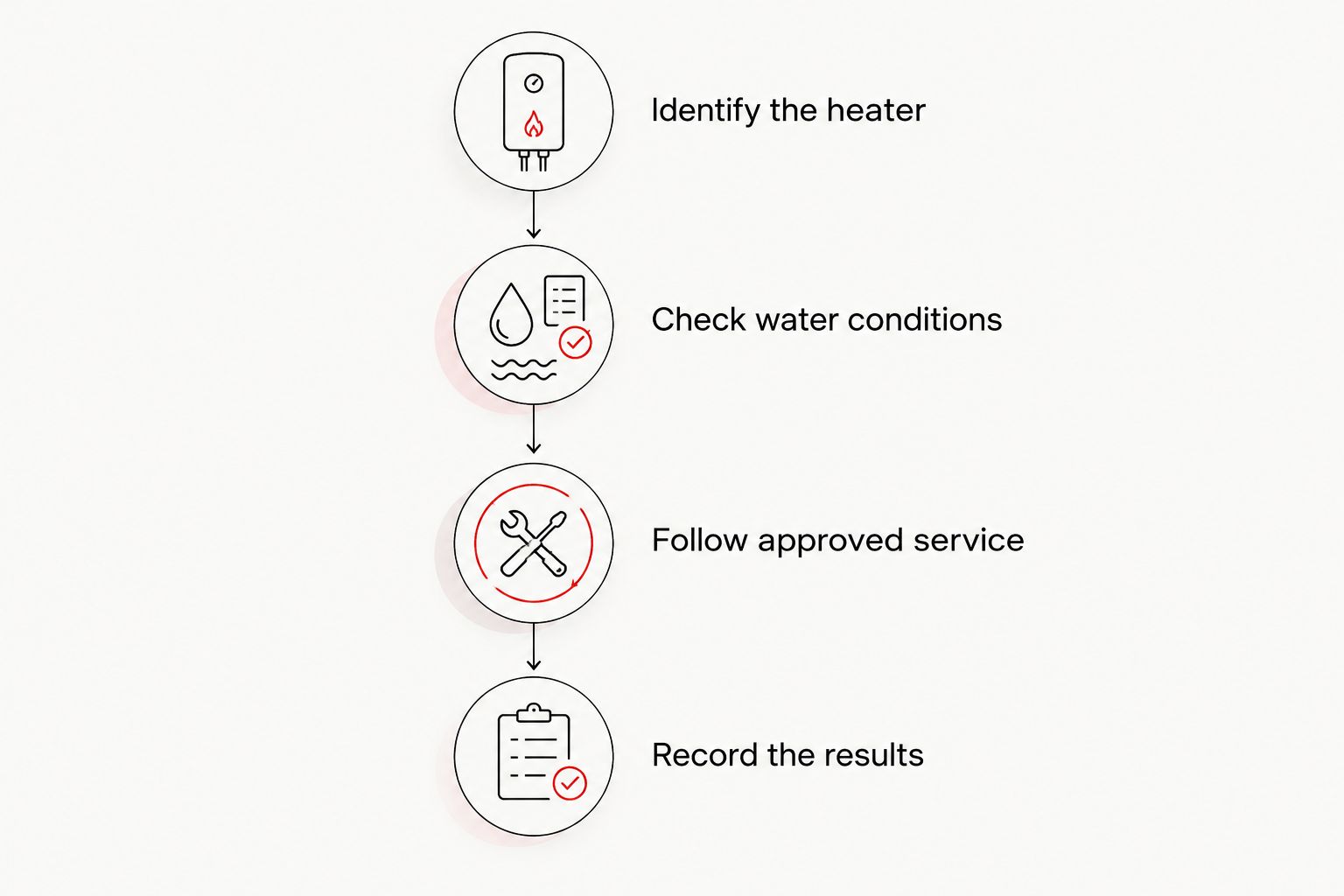
Identify the heater
Photograph the data plate without removing a cover that exposes electrical or combustion components. Keep the model details with your installation paperwork so the correct manual is available when service is scheduled.
Do not assume instructions for a similar-looking heater apply. Fuel type and model differences can change the procedure.
Check water conditions
Have incoming hardness measured and record whether treatment is installed. Compare the findings with the manufacturer’s published water-quality limits rather than choosing a service interval from a neighbor’s experience.
If you already have a softener, confirm it is functioning. Its presence alone does not establish the condition of the water reaching the heater.
Follow approved service
Use the cleaning method and solution specified for the equipment. Do not improvise chemical mixtures, connect hoses to unidentified valves, or open a hot, pressurized system.
Gas, electrical, venting, and internal repair work belong with a qualified professional. A homeowner cleaning procedure is appropriate only when the manufacturer permits it and you can follow every safety instruction.
Record the results
Keep the service date, work performed, fault codes, and technician’s findings. Ask whether hot-water flow and operation were checked after service—not just whether cleaning solution circulated.
A useful record distinguishes a completed maintenance task from a confirmed resolution. If the same symptom returns, that distinction helps the next diagnosis.
When repair makes sense—and when replacement deserves a look
Repair makes sense when diagnosis identifies a serviceable problem and the rest of the heater remains suitable for use. A clogged inlet screen, a maintenance issue, and a leaking heat exchanger are not equivalent findings.
Ask for the fault to be named before approving work. You need to understand what the repair addresses, what remains unresolved, and whether the manufacturer’s requirements can still be met.
Replacement deserves evaluation when the heat exchanger is damaged, repeated repairs have not resolved the problem, or the installation requires substantial correction. None of those findings means every heater of the same age should be replaced.
The guide to repairing or replacing a water heater in Tucson explains the broader decision. Keep the comparison focused on your diagnosed condition rather than a generic lifespan claim.
Priority Rooter & Plumbing provides water heater repair for residential and commercial customers in the Tucson metro area. Bring the model information, maintenance history, and symptom notes so the service discussion starts with the actual problem.
Schedule water heater service
Request diagnosis for recurring shutdowns, unstable hot water, or a leaking heater in the Tucson metro area.
How often should I descale a tankless water heater in Tucson?
Follow the interval in your heater’s manual, adjusted for the water conditions and usage factors the manufacturer identifies. A universal calendar rule does not account for different equipment, hardness, or demand.
At your 2026 service visit, ask for a written recommendation tied to those conditions. Keep the recommendation with the service record so the next visit can evaluate whether the routine is working.
Do not wait for a shutdown to establish a schedule. Preventive maintenance and fault repair serve different purposes.
Will a water softener make my tankless heater last longer?
An operating ion-exchange softener reduces incoming hardness, addressing a source of mineral scale. It does not guarantee a particular service life or repair damage already inside the heater.
Check compatibility and water-quality requirements before choosing treatment. Continue the maintenance the heater manufacturer requires, and maintain the softener itself.
Buy water treatment to address a measured water problem—not a promised number of extra years. Descaling and softening can belong in the same care plan because they address different stages of the scale problem.
FAQ
Can hard water shorten a tankless water heater’s life?
Hard water can contribute to scale that interferes with heat transfer and restricts water passages. Control buildup and follow the manufacturer’s maintenance requirements rather than assuming every heater will reach the same age.
Can descaling restore a tankless heater that keeps shutting off?
Descaling addresses mineral deposits, not every cause of shutdowns. Record the fault code and have the cause diagnosed before approving repeated cleaning.
Do I still need to descale if I have a water softener?
A water softener does not cancel the heater manufacturer’s maintenance requirements. Confirm that the softener works and follow the cleaning and inspection instructions for your model.
Does a sediment filter protect a tankless heater from hard water?
A sediment filter does not remove dissolved hardness minerals. It captures suspended particles within its specified capability, which is a different job from softening.
Should I replace an older tankless water heater that still works?
Age alone is not a sufficient reason to replace a working tankless heater. Evaluate operating condition, maintenance history, repair needs, and installation requirements before deciding.
Who can diagnose a tankless water heater problem in Tucson?
Priority Rooter & Plumbing offers water heater repair in the Tucson metro area. Provide the heater’s model, fault codes, symptoms, and service history when arranging professional diagnosis.
One last thing
Before your next 2026 service appointment, check whether you have the correct manual and a readable photograph of the data plate. Those simple records help prevent a generic maintenance discussion from replacing a model-specific plan.
The most useful question to ask after service is: What caused the problem, and what should change to keep it from returning? A completed flush matters less than knowing whether the original fault was resolved.