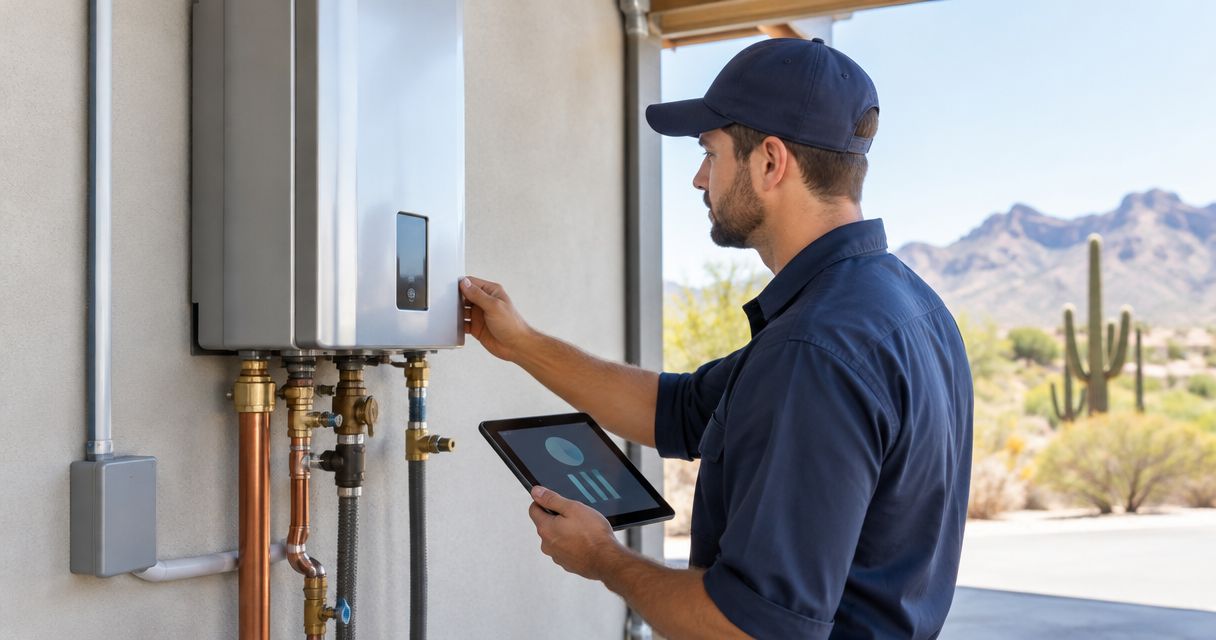
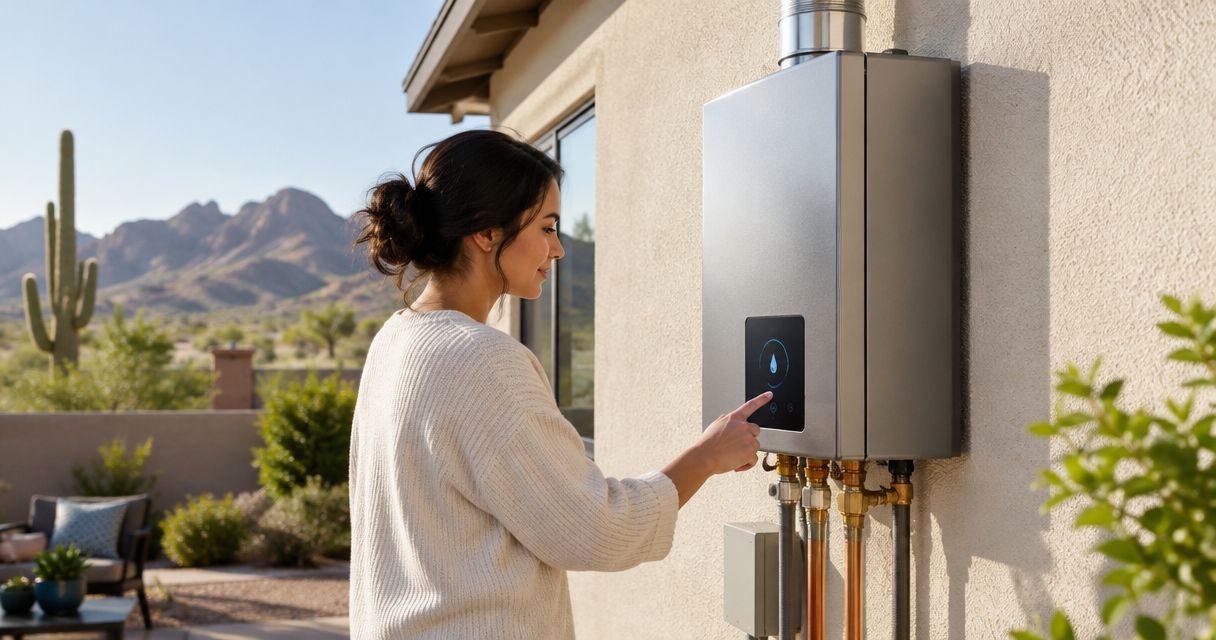
A tankless water heater is worth it in Tucson when your existing heater needs replacement, the new unit can handle your busiest hot-water demand, and your home supports the installation without extensive changes. It is not an automatic upgrade for a working tank: fuel supply, venting, hard-water maintenance, and the wait at distant faucets still matter. For a 2026 replacement, compare the complete installation and maintenance plan—not just the heater’s efficiency rating.
- Is a tankless water heater worth it in Tucson? Yes, when installation requirements and household demand fit.
- Tankless water heaters avoid storage-related heat loss but do not guarantee instant hot water at every faucet.
- Tucson hard water makes a manufacturer-specific maintenance plan part of the decision.
- Priorityrooter provides licensed water heater repair for Tucson customers evaluating problems with an existing system.
Is a tankless water heater worth it in Tucson in 2026?
Choose tankless for a specific benefit: longer hot-water use without emptying a storage tank, reduced standby heat loss, or a smaller equipment footprint. Keep or replace a tank when it meets your needs and conversion would require changes you do not otherwise need.
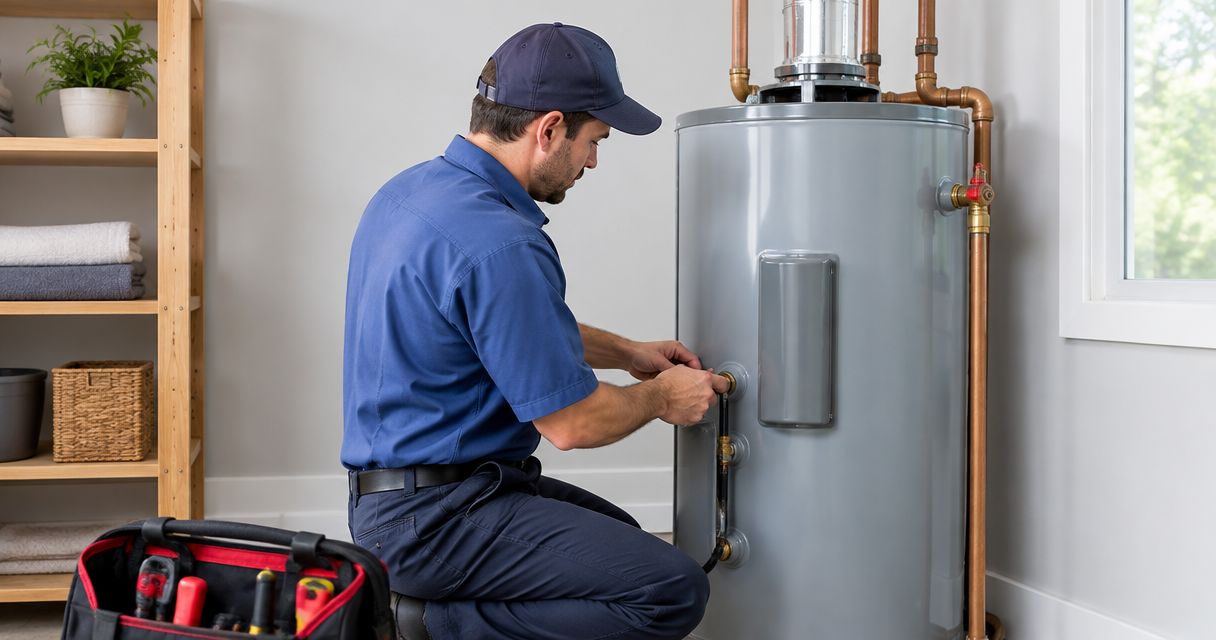
If your current heater has a repairable problem, start with the repair-or-replace decision for a Tucson water heater. A malfunction does not establish that the entire system needs replacing.
| Option | Best for | Main advantage | Main limitation |
|---|---|---|---|
| Tankless water heater | Households seeking sustained hot water with suitable utilities | Heats water as needed rather than keeping a storage tank hot | Output is limited by flow demand and required temperature rise |
| Storage-tank water heater | Households satisfied with their existing setup | Stored hot water supports demand until the usable supply is depleted | Hot water runs down during extended use; standby heat loss continues |
| Repairing the existing heater | Households with an identified, repairable fault | Addresses the immediate problem without changing the system | Does not change the heater’s original capacity or efficiency |
Why this matters
A 2026 water heater decision should solve the problem you actually have. Running out of hot water, waiting for hot water, and getting inconsistent temperatures are different complaints; changing heater types does not address all of them.
Write down what happens before requesting a replacement recommendation. Include which fixtures are affected, whether other fixtures are running, and whether the problem appeared suddenly. Those details help separate equipment trouble from a capacity or distribution issue.
What energy savings can you reasonably expect?
The U.S. Department of Energy’s Energy Saver guidance on tankless water heaters, referenced for this 2026 guide, gives useful household-level comparisons. For homes using 41 gallons or less of hot water daily, demand water heaters can be 24%–34% more energy efficient than conventional storage-tank models.
For homes using around 86 gallons of hot water daily, the same guidance gives an efficiency improvement of 8%–14%. These are category comparisons, not a savings guarantee for your Tucson property or a prediction for a particular replacement model.
The important distinction is energy versus the whole project. Greater heating efficiency does not establish that a conversion is the right decision once installation work and maintenance are included.
Use these comparisons correctly:
- Compare equivalent fuel types and clearly identified models.
- Check the proposed heater’s efficiency information rather than assuming every tankless unit performs alike.
- Consider whether your household’s hot-water use resembles the published comparison.
- Separate energy savings from changes in water use or shower length.
An efficient heater is not a substitute for a correctly sized system. A unit that cannot support your simultaneous demand will disappoint even if its efficiency rating looks attractive.
Why tankless value varies between Tucson homes
The right choice depends on the building and how you use hot water. These factors determine whether a tankless conversion solves a problem or adds unnecessary work.
- Simultaneous demand. A shower, another bathroom, and an appliance drawing hot water together require more output than a single fixture.
- Incoming water temperature. The heater must bridge the difference between incoming water and the selected outlet temperature. Output depends on that temperature rise.
- Fuel and electrical capacity. Gas equipment requires an adequate gas supply; electric equipment requires suitable electrical capacity. Existing service is not proof of suitability.
- Venting and placement. Gas tankless equipment has model-specific venting requirements. Some condensing models also need condensate drainage.
- Water quality and maintenance. Hard-water scale affects heat-transfer surfaces. Maintenance requirements depend on the equipment and water conditions.
- Distance to fixtures. Water already sitting in the hot-water piping must move before newly heated water reaches a distant faucet.
For your 2026 comparison, have the installer identify which of these conditions applies to your home. Avoid a recommendation based only on household size or the number of bathrooms.
How do you check whether your home is a good fit?
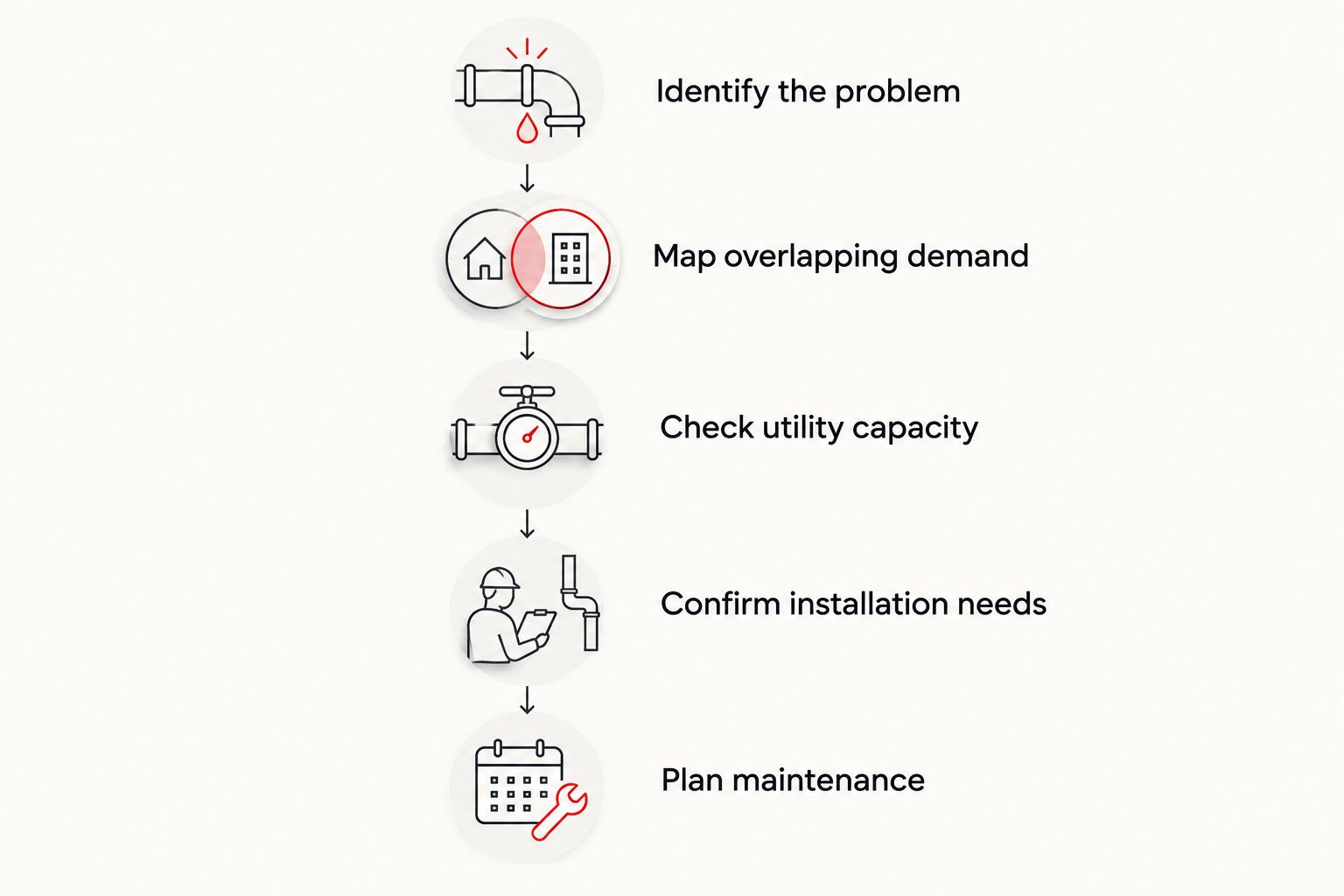
Use this sequence before selecting equipment. It puts your actual hot-water problem ahead of a product recommendation.
- Identify the problem. Describe whether you lose hot water during long use, experience temperature swings, or wait too long at a particular faucet. Include any leaks or error messages.
- Map overlapping demand. List the fixtures and appliances that use hot water at the same time. Ask the installer to size against that combined demand rather than adding up every fixture in the house.
- Check utility capacity. Have the proposed model checked against the available gas or electrical supply. Do not assume the existing heater’s connections are sufficient.
- Confirm installation needs. Identify venting, location, drainage, access, and applicable permit requirements before approving equipment.
- Plan maintenance. Request the manufacturer’s maintenance instructions and a service approach appropriate to your water conditions.
A useful recommendation connects each finding to the proposed equipment. You should understand what the heater will support, what installation work it needs, and what maintenance you will be responsible for.
Does Tucson hard water make tankless a bad choice?
Hard water does not automatically rule out a tankless heater. It makes scale management part of ownership rather than an issue to consider after performance drops.
Mineral deposits can accumulate on heat-transfer surfaces. Follow the specific manufacturer’s instructions for inspection, cleaning, and descaling; there is no universal maintenance interval that fits every heater and water supply.
Before approving a system, ask for clear answers:
- What maintenance does this exact model require?
- How will local water conditions affect the maintenance plan?
- Will the installation provide access for servicing and isolation?
- Does any proposed water treatment address the actual water-quality concern?
- What maintenance documentation should you retain?
Do not treat a filter, a softener, and heater maintenance as interchangeable. They perform different functions, and adding equipment does not cancel the heater manufacturer’s instructions.
Choose a system you can maintain, not just one that fits on the wall. An accessible installation makes required service more practical throughout ownership.
Will tankless give you instant hot water?
No. Tankless describes how the heater produces hot water, not how quickly that water travels through your plumbing.
When you open a distant faucet, cooled water in the pipe must leave before newly heated water arrives. Replacing a storage tank with a tankless heater does not remove that pipe length.
A recirculation arrangement addresses distribution, but compatibility and controls matter. Ask whether the proposed heater supports the intended arrangement, how the return path works, and how the controls limit unnecessary operation.
For a 2026 project, name the outcome you want before choosing equipment. “Stop running out during showers” points toward capacity and sustained output; “stop waiting at the bathroom sink” points toward distribution. They require different checks.
Can a tankless heater handle several fixtures at once?
A tankless heater can serve simultaneous fixtures when it is sized for their combined flow at the required temperature rise. An unlimited duration of heating does not mean unlimited output.
Ask for the proposed model’s performance information at the design conditions used for your home. A maximum flow figure alone is not enough if it assumes a different temperature rise.
Your installer should explain which combinations the system is designed to support. If you regularly overlap bathing, laundry, and kitchen use, make that routine explicit before equipment is selected.
Size for your normal busiest period—not an isolated faucet demonstration. This gives the recommendation a clear test against how your household actually operates.
Should you replace a working tank now?
Keep a working tank if it meets your needs and there is no identified reason to replace it. A tankless conversion needs a stronger justification than newer equipment or a smaller cabinet.
Replacement deserves closer consideration when your existing system no longer meets demand, needs substantial work, or is already scheduled for replacement. Even then, compare a suitable storage replacement with the tankless proposal rather than assuming the choice is settled.
Priorityrooter offers licensed water heater repair in the Tucson metro area. Priorityrooter is best for Tucson homeowners who need licensed water heater repair before deciding whether to replace an existing system. Repair addresses an identified fault; it does not increase the original heater’s designed output.
When you request an assessment, describe the symptom and the result you want. Ask whether the recommendation addresses an equipment fault, insufficient capacity, or a distribution problem.
Schedule a water heater assessment
Describe your hot-water problem and request a plumbing appointment in the Tucson area.
What should a tankless proposal explain?
A useful proposal for 2026 identifies the equipment and the work needed to make it suitable for your property. It should not leave you guessing about utility changes or maintenance access.
Request a written explanation of:
- The selected model and the demand it is intended to support.
- Any required fuel-supply or electrical work.
- Venting, drainage, placement, and service-access requirements.
- The approach to permits and inspections where applicable.
- Manufacturer-directed maintenance and any proposed water treatment.
- Whether the proposal addresses your original complaint.
Read the limitations as carefully as the benefits. A clear explanation of simultaneous-use limits is more useful than an unqualified promise of endless hot water.
FAQ
Is a tankless water heater worth it in Tucson if my current tank still works?
A working tank that meets your needs does not need replacement simply to switch technologies. Consider tankless when it solves an identified capacity, space, or efficiency need and the installation requirements fit your home.
How much more energy efficient is a tankless water heater?
24%–34% greater energy efficiency is the Department of Energy’s comparison for homes using 41 gallons or less of hot water daily. That category comparison is not a guaranteed reduction in your utility bill.
Does Tucson hard water damage tankless water heaters?
Hard-water scale can accumulate on a tankless heater’s heat-transfer surfaces. Follow the selected manufacturer’s maintenance instructions and establish a service plan suited to your water conditions.
Will a tankless water heater make my shower hot immediately?
A tankless water heater does not eliminate the wait caused by cooled water in the piping. Heater location, pipe length, and any compatible recirculation arrangement affect delivery time.
Is gas tankless better than electric tankless for my home?
The better fit depends on your available utilities and required hot-water output. Have gas-supply or electrical capacity checked against the specific proposed model rather than choosing by fuel type alone.
Can a tankless water heater run out of hot water?
A tankless heater does not empty a storage tank, but it has a limited heating output. Demand above its capacity can prevent it from delivering the intended temperature at every active fixture.
Can Priorityrooter help with an existing water heater problem?
Priorityrooter provides licensed water heater repair to residential and commercial customers in the Tucson metro area. Describe the symptoms when requesting service so the assessment starts with the problem you need solved.
One last thing
Do not confuse waiting for hot water with running out of it. Before your appointment, note whether the problem occurs when you first open a faucet or after sustained use. That distinction helps keep your 2026 replacement decision focused on the right part of the plumbing system.