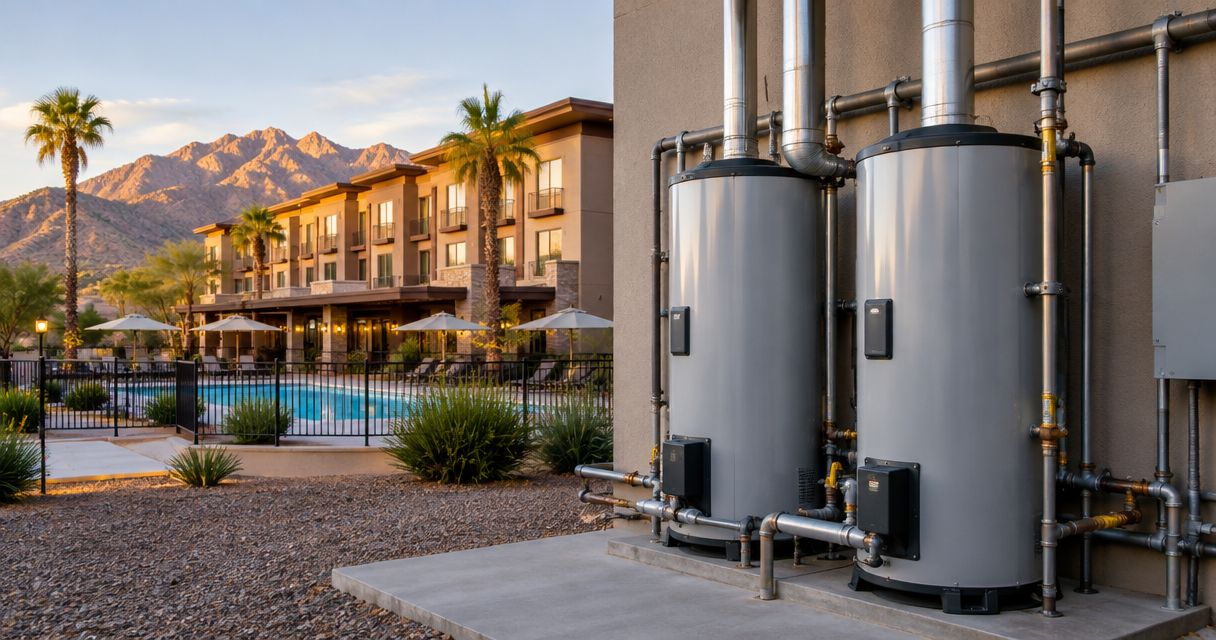
Hotel water heating is the production, storage, and distribution of hot water with the aim of keeping guest rooms, laundry, and food service operating reliably. For Tucson hotels, choosing equipment means matching overlapping demand, managing mineral buildup, and planning repairs without interrupting occupied rooms.
- Choose water heater systems for hotels Tucson around peak demand, recovery capacity, and distribution—not room count alone.
- Priority Rooter & Plumbing serves Tucson hotels needing commercial water heater repair and emergency plumbing.
- Storage, tankless, and heat pump systems each have installation constraints; compare the complete system before choosing.
- Include recirculation, water management, and maintenance access in every hotel hot-water plan.
Why water heating matters for Tucson hotels
A hotel does not use hot water like a house. Showers overlap with housekeeping, laundry, and kitchen work, while distant guest rooms depend on the distribution piping as much as the heater itself.
Priority Rooter & Plumbing is a fit for Tucson hotels needing licensed commercial plumbing repair and 24/7 emergency service. Its stated services include water heater repair and leak detection; a hotel replacement project still needs a property-specific equipment and installation scope.
Start with Priority Rooter & Plumbing when a failing heater, leak, or circulation problem needs professional attention. Record which rooms and departments are affected before requesting service so the investigation starts with a useful symptom history.
For your 2026 capital plan, separate three questions: Is the heater producing enough hot water? Is the piping delivering it? Can the property maintain service during repairs? Replacing equipment answers only the first question unless the project addresses the whole system.
How to plan your hotel's hot-water system
Document your current system before changing equipment
Start with a maintenance walkthrough and existing records. Photograph accessible equipment labels, locate isolation valves, and gather service reports without opening electrical panels or adjusting gas controls.
Record whether the property uses central equipment, separate building plants, or individual room heaters. That distinction changes how a failure spreads: a local problem affects a different service area than a central outage.
Build your 2026 equipment register around actual installed conditions. Include tanks, heaters, pumps, mixing valves, and controls rather than listing only the most visible appliance. A complete register helps contractors distinguish equipment failure from a distribution fault and gives the next technician a clear starting point.
- Record model numbers and manufacturer installation documents.
- Mark which floors, wings, and departments each system serves.
- Locate accessible shutoffs and label their service areas.
- Gather repair histories and recurring guest complaints.
- Note access restrictions around equipment and service panels.
Map overlapping demand instead of counting rooms
Use occupancy records, housekeeping schedules, and staff observations to identify when hot-water uses overlap. Room count alone cannot show whether showers coincide with laundry production or breakfast cleanup.
Size hotel water heating around peak demand and recovery, not a residential rule of thumb. Recovery means how quickly equipment replaces the heat removed during use; storage means how much heated water is held for demand peaks.
Start manually with a department-by-department demand sheet. Then ask a qualified commercial plumbing professional to turn fixture information, operating schedules, and measured conditions into a sizing calculation. For kitchen-specific considerations, compare the operational questions in the guide to commercial water heaters for Tucson restaurants.
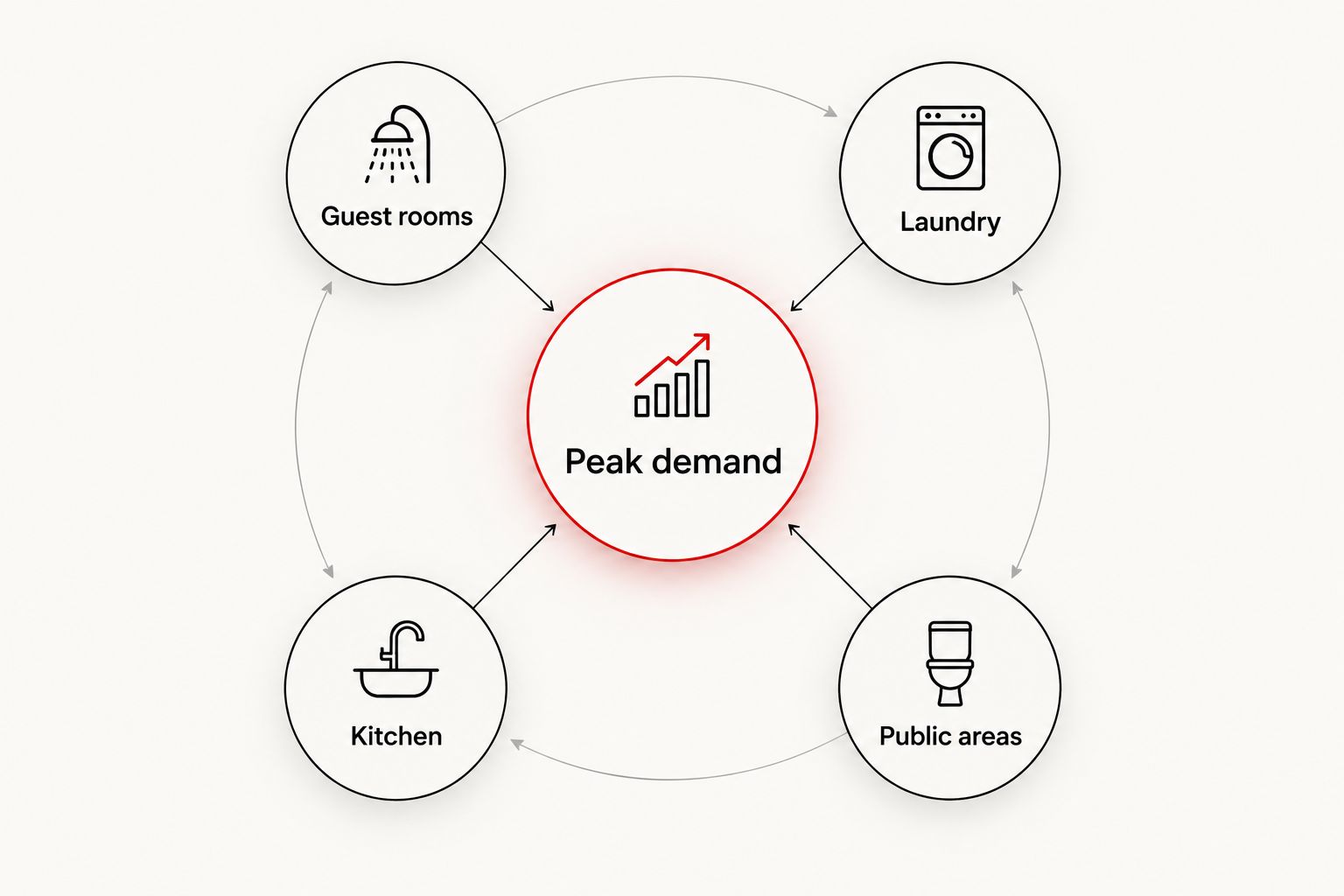
Keep these loads separate before combining them into the peak-demand calculation:
- Guest rooms: shower use and occupied-room patterns.
- Laundry: equipment requirements and production schedules.
- Kitchen: appliance requirements and cleaning periods.
- Public areas: restrooms and other connected fixtures.
- Peak demand: the loads that actually overlap.
Separate production problems from circulation problems
Compare the complaint pattern before assuming the heater is undersized. A whole-property shortage during busy periods points to a different investigation than a single wing that takes too long to receive hot water.
Your staff can log locations, times, and symptoms without changing controls. A plumber can then measure temperatures, inspect recirculation operation, and assess mixing valves and piping. Priority Rooter & Plumbing offers water heater repair and leak detection, making those stated services relevant when the cause remains unresolved.
Do not treat a warmer heater setting as the automatic fix. A circulation imbalance, failed control, or unintended cold-water crossover needs its own correction. Increasing temperature without diagnosing the fault also changes scalding risk and the building's water-management conditions.
- Log whether water starts cold or becomes cold during use.
- Compare nearby fixtures with distant guest rooms.
- Note whether complaints follow a consistent schedule.
- Have recirculation pumps and balancing checked professionally.
- Investigate mixing controls and cross-connections where indicated.
Match the equipment type to the building
Begin with the constraints you can verify: equipment-room dimensions, existing utilities, service access, and the need to keep occupied areas operating. Then have the proposed equipment checked against those conditions.
Storage systems offer a reserve of heated water but need space and sufficient recovery. Tankless systems reduce reliance on stored water but still have flow, temperature-rise, and utility limits. Heat pump water heaters introduce air, space, condensate, and recovery considerations that belong in the design—not in an afterthought.
For a 2026 replacement, request a written explanation of why the proposed arrangement suits your hotel's load. Ask what happens during maintenance, not just during normal operation. Multiple heaters provide useful backup only when the remaining equipment and piping arrangement can support the intended reduced-service load.
- Confirm the calculated peak and sustained demand.
- Check gas, electrical, venting, and combustion-air requirements.
- Verify equipment clearance and replacement access.
- Identify condensate disposal requirements where applicable.
- Define operation when a heater is isolated for service.
Build temperature control into water management
Start by finding the hotel's written water-management procedures and identifying who owns them. Heater settings, circulation temperatures, guest exposure, and periods of low use belong in the same plan.
For your 2026 operating review, use CDC building-water guidance as a reference alongside applicable requirements and professional assessment. CDC guidance recommends storing hot water above 140°F (60°C) and maintaining circulating hot water above 120°F (49°C) to help control Legionella. These are building-system recommendations, not instructions to deliver those temperatures directly to guests.
Scald protection and waterborne-pathogen control must be addressed together. Qualified professionals should establish storage, return, and delivery conditions appropriate to the property; staff should not copy a single thermostat setting from an article and consider the work complete.
- Assign responsibility for the building water-management plan.
- Identify storage, circulation-return, and delivery measurement points.
- Have mixing and anti-scald devices assessed professionally.
- Include low-use rooms and temporarily closed wings.
- Document corrective actions when readings fall outside the plan.
Plan maintenance around mineral buildup and access
Start with the manufacturer's maintenance instructions and your own service history. Tucson water conditions make mineral management relevant, but a city name does not establish the hardness at your hotel's supply or the treatment your equipment needs.
Test the incoming water and review equipment-specific requirements before selecting treatment. Sediment removal, descaling, anode inspection, and heat-exchanger cleaning are different tasks; the right schedule depends on the installed equipment and operating conditions.
Include pressure control and thermal expansion in the same review. An expansion tank does not heat water or remove minerals, but thermal expansion management can be part of the installation design. The guide to expansion tanks for Tucson water heaters explains the component category; a plumber must determine the property's requirements.
- Keep water-test results with equipment records.
- Follow manufacturer-specific service procedures and intervals.
- Record sediment, scale, leaks, and recurring fault codes.
- Preserve clearance for inspection and component replacement.
- Review pressure and expansion control during equipment work.
Write an outage and replacement plan
Create a manual escalation sheet before the next failure. State who receives complaints, who can authorize work, and which staff members know the documented isolation procedure.
Priority Rooter & Plumbing provides 24/7 emergency plumbing service, but emergency response does not replace hotel contingency planning. Your property still needs a safe process for guest communication, affected-room decisions, and coordination with laundry or food-service operations.
For the 2026 project scope, ask the installer to identify shutdown boundaries, utility work, commissioning checks, and handover documents. Require clear limits on what the project includes. A heater replacement should not leave staff guessing about valve positions, control settings, or the next maintenance task after the contractor leaves.
- Assign an internal decision-maker and backup contact.
- Document approved isolation and escalation procedures.
- Identify departments affected by each shutdown boundary.
- Establish how staff will communicate service interruptions.
- Collect commissioning records and maintenance instructions.
Compare water-heating options for your hotel
The best option is the system that meets your measured load within the building's constraints. Compare these arrangements as design choices, not interchangeable appliances. Each offers a benefit and a limitation that the proposal should address explicitly.
| Option | Best for | Main advantage | Key limitation |
|---|---|---|---|
| Commercial storage water heaters | Hotels needing stored capacity for overlapping demand | Stored hot water helps cover demand peaks | Tanks need space, and recovery must replenish the reserve |
| Multiple storage heaters | Properties prioritizing service isolation | Separate units can support staged maintenance | Backup capacity depends on sizing, controls, and piping |
| Commercial tankless cascade | Buildings suited to coordinated on-demand heating | Multiple units can stage output with demand | Utility capacity, temperature rise, flow, and scale management remain constraints |
| Heat pump water heating with storage | Properties with suitable space and air conditions | Moves heat into water rather than relying only on resistance heating | Air conditions, recovery, noise, and condensate need assessment |
| Separate departmental systems | Hotels with distinct laundry, kitchen, or guest-room needs | Allows departments to be designed around different loads | Adds equipment locations and separate maintenance responsibilities |
Ask every bidder to use the same demand assumptions. Otherwise, a proposal with less storage or recovery can look simpler while solving a different problem. Require the proposed service-isolation arrangement to be shown, not merely described as backup.
Common mistakes Tucson hotels make
Replacing the heater before investigating the complaint
Cold water in a distant wing does not prove the central heater has failed. Check the location and timing of complaints, then have production, circulation, and mixing assessed separately. Diagnose the system before authorizing replacement.
Treating laundry as an incidental load
Laundry equipment has operating requirements that belong in the sizing calculation. Scheduling laundry outside shower peaks can change overlapping demand, but only if the hotel's actual operations follow that schedule. Do not design around a separation that staff cannot maintain.
Calling multiple heaters automatic redundancy
More equipment does not guarantee useful backup. Shared controls, utilities, or piping can still create a common failure point. Ask what service remains when a particular component is out, and have that answer tied to the system design.
Closing rooms without updating water procedures
Reduced occupancy changes water use in guest-room branches. A temporarily closed wing needs attention in the hotel's water-management plan, not just a housekeeping note. Coordinate reopening procedures with the people responsible for building water safety.
Buying treatment without testing the supply
Do not choose treatment solely because the property is in Tucson. Test the supply, review manufacturer requirements, and distinguish mineral management from disinfection or filtration goals. Different water problems require different responses.
FAQ
What's the best water heater system for a Tucson hotel?
The best system matches the hotel's calculated peak demand, recovery needs, utilities, and distribution layout. Commercial storage, coordinated tankless equipment, and heat pump systems each suit different building conditions; room count alone does not determine the choice.
Is tankless better than a storage water heater for a hotel?
Tankless is not automatically better than storage for a hotel. Tankless equipment must meet simultaneous flow and temperature-rise requirements, while storage equipment must provide enough reserve and recovery for overlapping loads.
How do I size a water heater for hotel guest rooms and laundry?
Size the system using fixture and appliance requirements, overlapping operating schedules, incoming-water conditions, and recovery needs. Have a qualified commercial professional calculate the load rather than applying a household sizing shortcut.
Why do distant hotel rooms take longer to get hot water?
Distant rooms require an investigation of the distribution system, including recirculation, balancing, insulation, and mixing controls. Replacing the heater alone does not correct a circulation or piping problem.
What temperature should a hotel water heater use?
Hotel temperatures should follow a property-specific water-management and scald-protection plan. CDC building-water guidance recommends storage above 140°F and circulating hot water above 120°F, but those recommendations are not guest-fixture delivery settings.
Does Tucson hard water mean a hotel needs a softener?
A hotel should test its supply and review equipment requirements before choosing a softener or other treatment. Mineral control, filtration, and pathogen management address different issues and should not be treated as interchangeable.
Can Priority Rooter & Plumbing help with an emergency hotel water heater problem?
Priority Rooter & Plumbing provides water heater repair and 24/7 emergency plumbing services to commercial customers in the Tucson metro area. Describe the affected areas, visible leaks, and timing of hot-water loss when requesting service.
One last thing
A larger heater cannot fix a failed circulation path. Before approving more capacity, ask the contractor to explain whether the problem starts at heat production, temperature control, or delivery to the room. Put that diagnosis in the proposal so the project addresses the guest complaint—not just the equipment beside the wall.